
Hops in Beer Brewing: Backa
Published: January 29, 2026 at 8:51:11 PM UTC
Backa, a hop variety from Serbia's Bačka region, is classified as a European aroma hop, known for its noble qualities. Homebrewers and craft-beer enthusiasts find it intriguing for its delicate aroma and traditional profile.
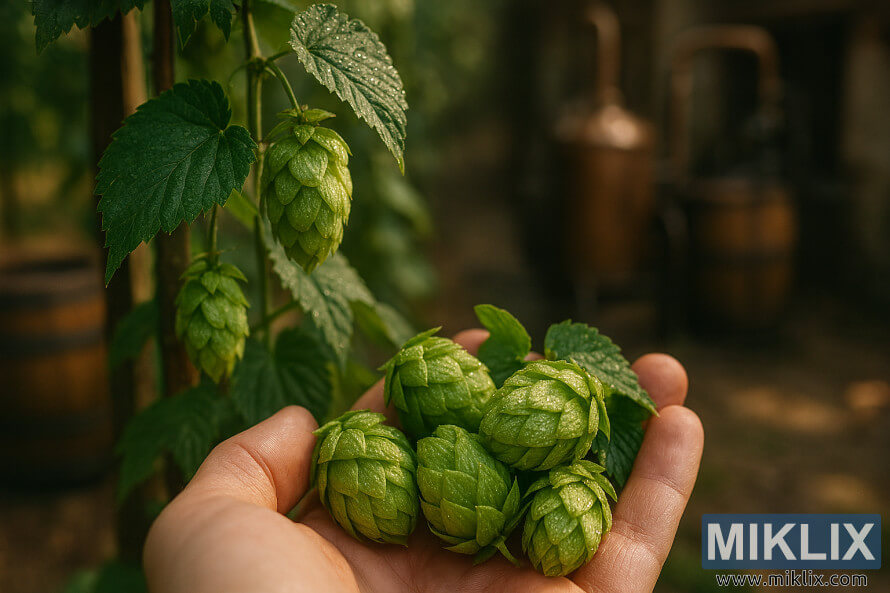
Click or tap the image for more information and higher resolutions.
Historically, Backa hops have shown low to moderate alpha acids, typically between 3–5% in older samples. More recent analyses have sometimes found values near 2.1% or below 3%.
The chemical makeup of Backa aroma hops is dominated by myrcene (around 50%), humulene (approximately 24%), and caryophyllene (near 12%), with traces of farnesene. These compounds make it suitable for use as a subtle European aroma hop, rather than a bittering variety.
This guide will delve into the botany, growing behavior, and full chemical profile of Backa hops. It will also explore their flavor and aroma in beer, recommended additions, practical recipes, and product forms. Additionally, it will cover storage best practices, blending suggestions, sensory quality checks, historical breeding context, and market availability. Sources include Oregon State University/USDA cultivar records, Bačka landrace agronomic reports, and published hop references like the John I. Haas Hops Companion and regional breeding literature by Jan, Wagner, and Alfred Haunold.
Key Takeaways
- Backa is a Serbian aroma hop from the Bačka region, noted for noble-like character.
- Added to USDA/Oregon State collection in 1956, useful for historical reference.
- Alpha acids are low to moderate, often 3–5% historically and sometimes ~2% in recent samples.
- Essential oils lean toward myrcene, humulene, and caryophyllene—ideal for aroma use.
- This Backa hop profile suits European-style lagers and subtle craft ale applications.
Overview of Backa hops as a European aroma variety
The Backa hop's roots trace back to the Bačka region in Serbia. It was first documented in the mid-20th century and is listed in Oregon State University's records from 1956. This history places it among the Serbia hops celebrated for their unique aromas.
Backa is marketed as a European aroma hop. It's known for its subtle, floral notes, making it ideal for pilsners, lagers, and light ales. Its use is primarily for enhancing aroma, not bitterness, due to its moderate acid levels.
Historical alpha-acid levels for Backa were around 3–5%. However, recent data shows a decline, with some crops falling below 3% and others averaging about 2.1%. This shift makes Backa more suitable for recipes where aroma is key, not bitterness.
Recipes often suggest adding Backa in the late-kettle, whirlpool, or dry-hop stages. It's recommended to use 20–30% of the hop bill for Backa. This ensures its European aroma notes complement the malt and yeast without dominating them.
- Botanical origin: Bačka landrace, Serbia hops heritage.
- Positioning: European aroma hop with noble hop characteristics.
- Alpha-acid trend: historically 3–5%, recent reports near 2.1% or lower.
- Usage: aroma-focused additions rather than primary bittering.
Botanical characteristics and growing behavior
The origin of Backa lies in a Bačka landrace from northern Serbia. This variety is a female cone type, traditionally used in brewing. Field descriptions highlight its rustic origins, lacking a modern pedigree. Thus, detailed genetic maps are scarce.
In native trials, Backa showed a moderately high hop yield. Figures near 2,017 kg/ha (about 1,800 lb/acre) reflect its strong field performance in local climates. This makes Backa growing appealing to small farms that align with the region's seasonality.
Trials outside the Balkans reveal limitations. Oregon field tests indicate medium-late maturation and clear downy mildew susceptibility. Growers in wetter or cooler regions must closely monitor disease pressure. They should also expect different timing than in Serbia.
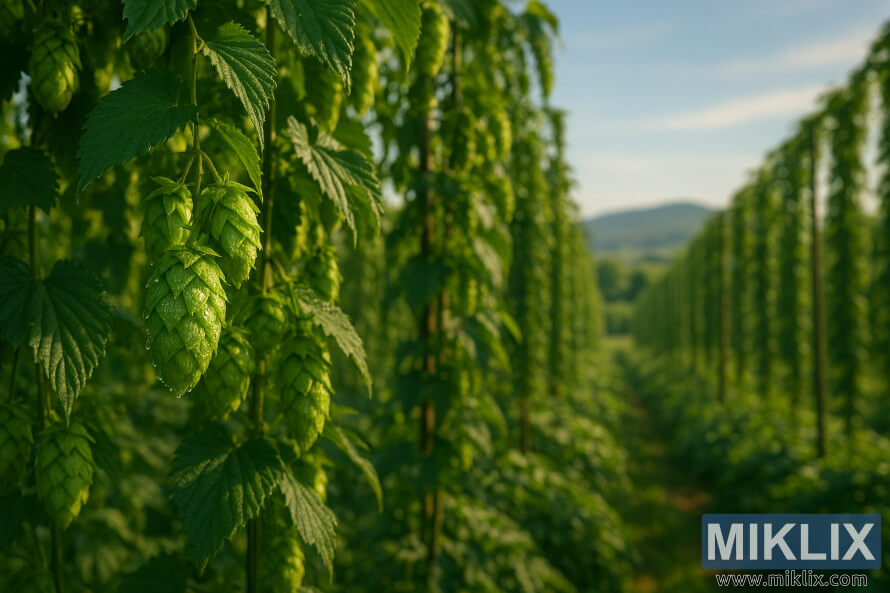
From a hop agronomy perspective, Backa thrives in its native conditions. It is not considered a high-alpha commercial breeding target due to relatively low alpha levels. Management should focus on canopy ventilation, regular scouting, and fungicide plans to combat downy mildew susceptibility.
Practical implications for growers are clear. Those considering Backa growing beyond its home range should start with trial blocks. Monitor hop yield Backa against local cultivars, record maturity dates, and adapt trellis and pruning to reduce humidity around cones.
- Origin: Bačka landrace, Serbia
- Yield: moderately high in native fields (≈2,017 kg/ha)
- Disease: noted downy mildew susceptibility in non-native trials
- Breeding status: limited genetic pedigree; not a high-alpha target
- Agronomy focus: ventilation, scouting, and maturity monitoring
Chemical profile: alpha acids, beta acids, and essential oils
The chemical makeup of Backa reveals a low bitterness potential, complemented by a rich aromatic oil blend. Historical data indicates alpha acids range from 3–5%. However, commercial analyses typically report values closer to 2%, with some studies suggesting a central value of 2.1% and occasional peaks up to 4.8%.
Regarding beta acids, Backa's levels are generally around 3.0%. This moderate beta acid content ensures stability and prevents bitterness from becoming overwhelming as hops age. Brewers can use Backa as a gentle bittering hop, relying on its aromatic oils for flavor.
The essence of Backa lies in its essential oils. Studies and cultivar analyses reveal a hop oil composition predominantly featuring myrcene, humulene, and caryophyllene. The typical ratio is about 50% myrcene, 24% humulene, and 12% caryophyllene, with farnesene adding subtle green-leafy or citrus notes.
The sensory impact of myrcene, humulene, and caryophyllene blends is crucial for Backa's performance in brewing. Myrcene contributes herbaceous, resinous, and green flavors. Humulene adds piney and woody notes. Caryophyllene introduces spice, woody, and clove-like flavors. Farnesene, present in small amounts, enhances brightness and adds a light citrus leaf aroma.
- Alpha acids: low, often ~2% — suited to late additions for subtle bitterness.
- Beta acids: near 3.0% — influence aging and oxidation-derived flavors.
- Hop oil composition: dominated by myrcene, humulene, caryophyllene with farnesene traces.
Grasping the Backa chemical profile aids brewers in planning their additions and pairings. Employing oil-forward techniques—such as late kettle, whirlpool, and dry hopping—allows the myrcene, humulene, and caryophyllene-led aroma of Backa essential oils to shine. This approach minimizes bitterness from the alpha acids.
Flavor and aroma profile in beer
Backa flavor profile is characterized by European restraint, unlike the bold, fruity American hop character. It offers herbaceous, green notes reminiscent of fresh-cut grass or leafy top notes. These come from high myrcene levels.
Piney and woody elements emerge from humulene, providing a steady backbone. This is particularly beneficial in lager and pilsner applications. Caryophyllene adds a sweet-woody quality with faint spice and clove hints, especially with late-kettle or whirlpool additions.
Traces of farnesene contribute subtle green or citrus accents, maintaining balance. Brewers seeking a refined noble hop impression rely on these layered traits. They aim to deliver an elegant profile.
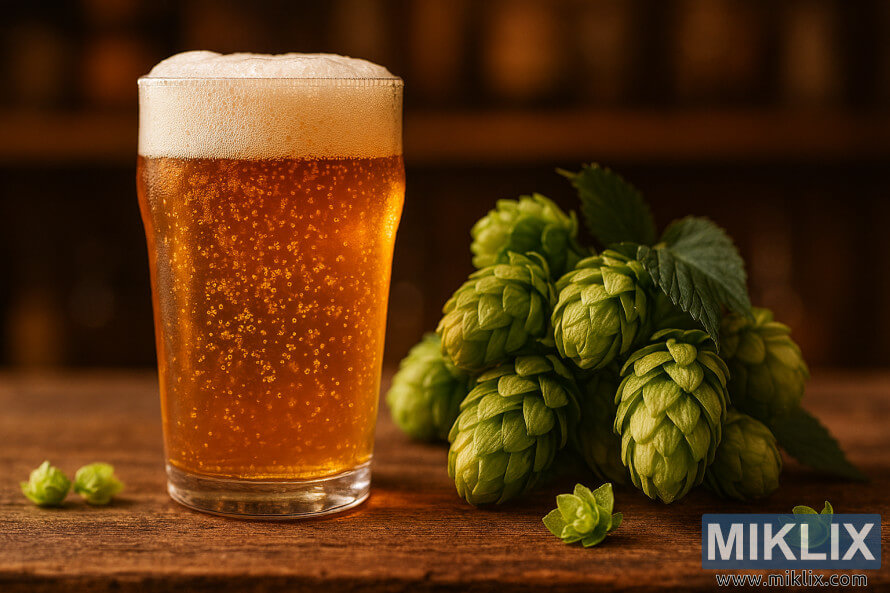
The aroma of Backa in beer is influenced by dosage, timing, and hop form. With low alpha acids, it excels in aroma roles rather than bittering. To highlight the delicate noble hop flavors, use late additions, whirlpool hops, or light dry hopping.
When blended, herbaceous piney spice Backa pairs well with Saaz or Hallertau for a rounded, traditional European aroma. This combination results in a subdued and refined aroma. It's perfect for beers where subtlety and drinkability are key.
Click or tap the image for more information and higher resolutions.
Typical brewing uses and additions for Backa hops
Backa is celebrated for its aromatic qualities. Brewers add it late in the boil to preserve its delicate oils. This method ensures a subtle aroma without significant bitterness, thanks to a 10–5 minute addition.
Whirlpool additions are another popular method for Backa. This technique involves a whirlpool rest at 70–80°C. It extracts volatile oils into the wort while minimizing harsh vegetal notes. Short contact times of 15–30 minutes are recommended for this approach.
Cold-side work is crucial when considering Backa hops. Dry hopping Backa enhances the beer's floral and fruity notes. The duration of dry hopping, ranging from 3 to 7 days, depends on the beer's strength and temperature.
- Late-boil additions: 10–5 minutes for aroma additions and slight flavor lift.
- Whirlpool/steep: whirlpool Backa for 15–30 minutes at moderate temp to capture essential oils.
- Dry-hop: dry hopping Backa on the cold side to maximize aroma without extraction of harsh components.
In hop blends, Backa typically constitutes about 25% of the hop bill. This allocation ensures a dedicated aroma component. It also allows for the use of higher-alpha hops for bittering and complementary aroma varieties like Saaz or Hallertau.
Backa should not be used as a primary bittering hop. Its low alpha-acid content restricts IBUs unless used in large quantities. Expect minimal bittering when Backa is added early in the boil.
- For a pilsner or lager: small late-boil and a moderate whirlpool Backa charge, then light dry hopping for a floral top note.
- For pale ales: combine Backa with citrusy hops at 20–30% of the aroma bill and finish with a cold-side dry hop.
- For specialty ales: use whirlpool Backa to add subtle spice and floral layers without raising bitterness.
Recipe metadata and brewing guides provide guidelines for timing and contact times for optimal aroma. Practical trials in your system will refine quantities and schedules specific to your wort size and fermenter profile.
Recommended beer styles and pairing with Backa hops
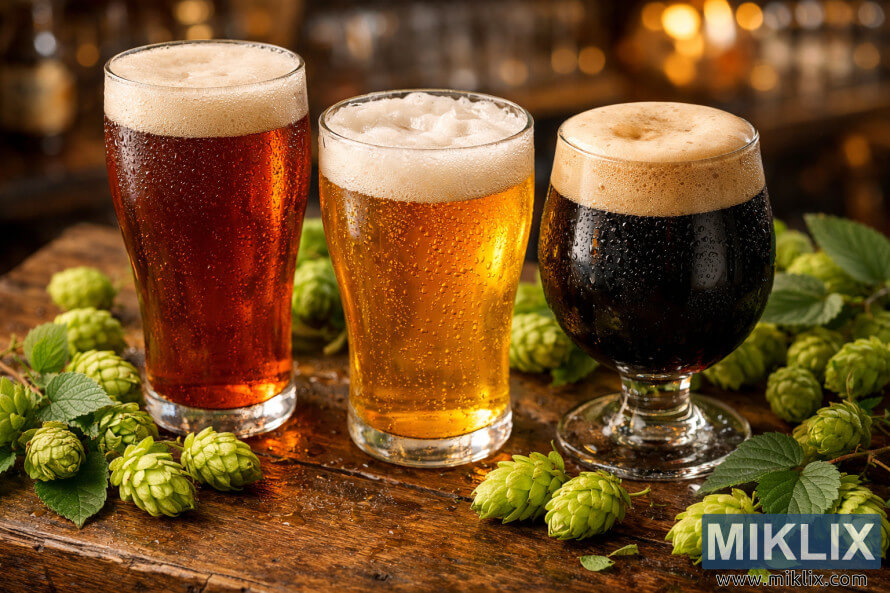
Backa excels in traditional European lagers, where subtlety and balance are key. It's perfect for pilsner and lager Backa, enhancing the floral top notes and adding a soft herbal undertone.
Consider Backa in Helles, Kölsch, Vienna lager, and classic German lagers. These styles benefit from its low-to-moderate bitterness and late additions. This approach showcases the noble hop character.
For Belgian ales, Backa adds spice and subtle wood tones. Pair it with saisons or farmhouse ales to introduce a gentle pine-herb note. This complements the yeast-driven esters without overpowering them.
- Classic pairings: pilsner Backa with Saaz-like restraint for crisp finishes.
- Hybrid approaches: lager Backa blended with modern citrus hops to soften tropical notes.
- Ales: use Backa in session ales where low bitterness and aromatic depth are desired.
The choice of yeast significantly impacts the beer's character. Clean lager yeasts highlight the noble hop traits. Neutral ale yeasts, like Kölsch or American ale strains, bring out herbal and floral aspects.
Belgian strains add depth to Belgian ale Backa, emphasizing spicy esters. These complement hop-derived wood and clove notes. For modern craft beers, blending Backa with classic aromatics creates balanced, nuanced brews.
Click or tap the image for more information and higher resolutions.
Dosage guidelines and practical recipe examples
When planning hop additions, treat Backa as an aroma-focused variety. It's common to use Backa for about 25% of total hop additions in blended recipes. For single-hop trials, Backa percentages can vary widely, with medians around 12.1% and extremes reaching 94.7% in some datasets.
For batches of 5–20 gallons, use modest amounts for late or dry additions. A good rule of thumb is 0.5–1.5 oz per 5 gallons for late kettle, whirlpool, or dry hop. If you're combining Backa with more assertive varieties, you may need to reduce the amount.
Backa has low alpha acids, making it unsuitable for bittering unless you're using a large amount. If you aim for any measurable IBUs from Backa, increase the weight accordingly. Also, factor in alpha values for the total mash and first-wort additions.
- Pilsner framework: bitter with Saaz or Magnum, then use 25% Backa in late kettle or whirlpool to add noble herbal top notes. Consider a small dry hop for lift.
- Saison framework: build bitterness with Styrian Golding or Saaz and add 25% Backa in the whirlpool for green, peppery accents and subtle complexity.
- Single-hop trial: concentrate additions in late whirlpool and dry hop to showcase Backa aroma. Expect restrained noble character rather than bold tropical or citrus.
Hop scheduling Backa should favor late kettle, whirlpool, and dry-hop slots. Reserve minimal early-boil time for bittering unless you compensate with much larger masses. For consistent results, break additions into three parts: late kettle, whirlpool, and a small dry hop to protect volatile oils.
If you ask how much Backa hops to use for aroma, start with the middle of the practical range and adjust by taste across batches. Track Backa dosage per gallon and Backa recipe adjustments so you can tune intensity and aroma with each brew.
Hop form and product choices for Backa (cones, pellets, extracts)
Brewers face a decision between Backa cones and pellets, balancing freshness against convenience. Whole-cone hops offer a fresh aroma, ideal for small batches where subtlety is key. However, cones are bulkier, have lower utilization, and require careful storage to preserve volatile oils.
For most, T-90 T-45 Backa pellets are the preferred choice for regular use. These pellets are denser, easier to dose, and maintain better shelf stability than whole cones. They provide consistent results in mash and kettle additions, making inventory control simpler for production brewing.
Backa pellets labeled T-90 are the standard. T-45 or lupulin-enriched pellets are rare for Backa due to its low alpha acid content. However, specialty processors might create enriched formats if demand increases. For brewers aiming for consistent aroma with minimal waste, T-90 T-45 Backa options are worth exploring.
Backa extract plays a limited role. Extracts concentrate alpha acids for bittering, but Backa's low alpha acids make straight extracts rare. Yet, hop essential oils or blended Backa extract products can capture the cultivar's oil profile for late or post-fermentation aroma. These products allow brewers to add Backa character without the bulk.
- Whole-cone Backa: ideal for small batches and trial runs, offering a tactile and aromatic experience but with a short shelf life.
- Backa pellets (T-90): the practical choice for most brewers, providing stability, uniformity, and easy storage.
- Backa extract and oil blends: specialized for aroma finishing or when minimal vegetal matter is desired.
Assess hop product types based on recipe goals, scale, and storage capacity. For aroma-driven ales, start with cones for trial batches and then switch to T-90 pellets for production. If you need concentrated aroma with low solids, consider a Backa extract or hop oil blend for post-fermentation use.
Click or tap the image for more information and higher resolutions.
Storage, freshness, and oil preservation for best aroma
Backa's aroma is due to its delicate hop oils, such as myrcene, humulene, and caryophyllene. These oils are quickly lost when exposed to oxygen and warm temperatures. Therefore, proper storage is crucial to preserve the flavor and freshness of hops.
To keep the aroma intact, follow a few simple steps. Use hop vacuum sealing or nitrogen-flushed bags to reduce oxygen contact. Store sealed hops in a dedicated hop freezer at -18°C (0°F) or colder. This slows down oil loss and enzyme activity.
Pellets generally last longer than whole cones because they have less surface area exposed to oxygen. However, any form benefits from vacuum sealing before freezing. This maximizes shelf life and preserves oils.
Whenever possible, handle hops in cold conditions. Weigh and dose them quickly, then return unused portions to the freezer without delay. Cold-side additions, like whirlpool or dry-hop, help retain more volatile compounds in the beer.
- Minimize light and heat exposure at every step.
- Limit air in packages when transferring or measuring.
- Consider hop oil products for consistent aroma when seasonal supply varies.
Small habits can lead to significant improvements in preserving hop oils and maintaining Backa's signature aroma. Regular attention to packaging and temperature ensures hop freshness remains paramount—inside the fermenter.
Blending Backa with other hop varieties
Backa blends are effective when they maintain a balanced hop profile. Use Backa as a supporting aroma, making up 20–30% of the aroma bill. This adds a herbal, noble character while other varieties provide lift.
For a restrained, traditional profile, pair Backa with Saaz, Tettnang, Hallertau, or Styrian Golding. These noble hop blends preserve a delicate herbal-pine tone. They also keep bitterness soft.
To add depth, try Backa hop combinations with English Fuggle or East Kent Goldings. Small doses of these hops introduce spice and earthy notes. These contrast Backa’s herbal thread.
Use hop pairing Backa with citrus-forward varieties in low proportions for brightness without losing backbone. A modest citrus hop can provide lift. Backa tames sharp top notes.
- Strategy: Backa as 20–30% of the aroma bill for balance.
- Timing: add Backa late in the whirlpool or in dry hop to protect delicate oils.
- Formulation: manage oil mix so high-myrcene hops do not dominate aroma.
Taste tests and recipe metadata commonly show about 25% Backa usage in blends. Brewers use this ratio to let citrus or floral partners shine. They do this above a steady noble base.
When designing Backa hop combinations, check oil profiles and adjust additions. Preserve Backa’s herbal nuance by limiting hot-side additions. Lean on late aroma placements.
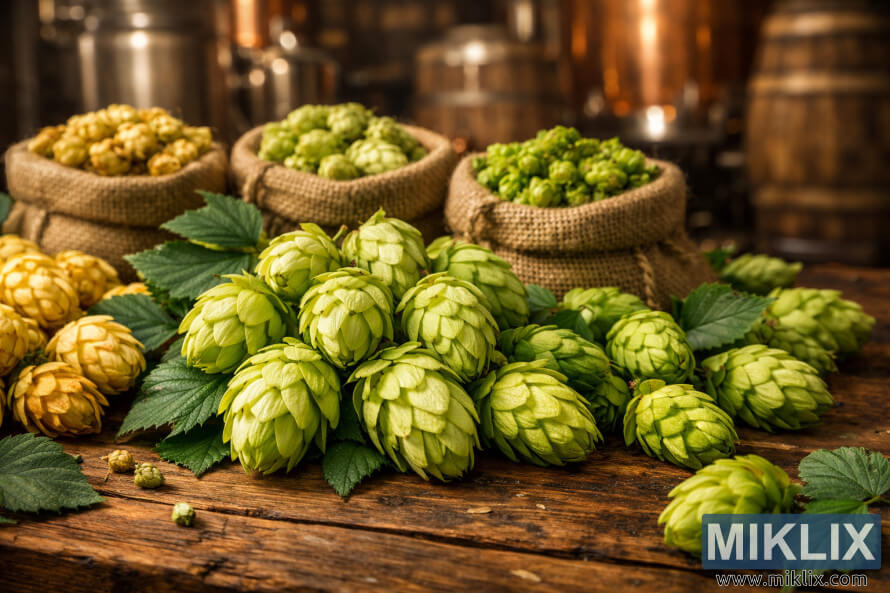
Click or tap the image for more information and higher resolutions.
Sensory evaluation and quality control in the brewhouse
Begin by smelling whole cones and pellets to check for freshness and noble notes. Look for herbaceous myrcene, piney humulene, and spicy caryophyllene. Any dull, papery, or cardboard smells indicate oxidation.
For hop aroma assessment, use a brief tasting protocol. Brew a 1–2 liter single-hop wort with late addition and cool it quickly. Smell both hot and cold samples to observe volatile oil shifts and confirm aroma intensity.
- Measure alpha and beta acids and compare to baselines. Typical recent Backa alpha sits near 2–3%.
- Check essential oil totals and the relative levels of myrcene, humulene, and caryophyllene.
- Log lot-to-lot variability so adjustments are traceable.
Implement hop QC from receiving to kettle. Verify cold-storage chain, vacuum or oxygen-barrier packaging, and note pellet friability. Inspect whole cones for mold, dryness, or discoloration before acceptance.
Use a simple scoring sheet for hop aroma assessment and back it with analytics when available. Compare sensory notes to lab values to refine dosing and timing in recipes.
Run small pilot brews when a batch reads outside expected ranges. Adjust late-add levels or dry-hop time to reach desired aroma expression before scaling to production.
Keep records labeled by lot and date so brewing quality control hops remain consistent across seasons. Regular sensory rounds and targeted analyses help stabilize aroma outcomes in finished beer.
Historical and breeding context of Backa
Backa's origins are rooted in the Bačka landrace, cultivated for generations in Serbia's Pannonian plain. Local farmers chose vines for their aroma, hardiness, and field vigor, long before breeding programs were formalized.
The cultivar was formally conserved in the USDA hop collection at Oregon State University in 1956. This accession helped safeguard material for study and comparison with other European aroma hops.
Despite its historical significance, few studies have explored Backa's exact pedigree or genetic markers. It is generally regarded as a regional, noble-type aroma hop, rather than a product of systematic breeding programs.
- Traditional origin: Bačka landrace, selected on-farm for aroma traits.
- Conservation record: accessioned into the USDA hop collection (OSU) in 1956.
- Breeding role: limited use in contemporary crosses compared with newer cultivars.
Regional agronomy reports and the International Hop Production Bureau highlight Backa as a preserved heritage cultivar. Brewers and geneticists find these records invaluable for studying European aroma types' evolution.
Interest in Backa persists, focusing on documenting its traits and exploring its potential in modern breeding programs. Currently, it serves as a bridge between traditional Bačka cultivation and curated germplasm in public collections.
Conclusion
Backa hops summary: Backa, a Serbian hop from the Bačka region, was added to the USDA/OSU collection in 1956. It's marketed as a European-type aroma hop with noble characteristics. It has low alpha acids, typically around 2%, and an essential oil profile dominated by myrcene, humulene, and caryophyllene. This composition gives it subtle herbal, piney, and lightly spicy notes, unlike bold citrus or tropical flavors.
Backa brewing takeaways highlight its use in aroma. Brewers should add it late in the kettle, whirlpool, and dry-hop stages. It's best used at about 25% of the aroma hop bill in recipes. Pairing it with classic noble varieties like Saaz or Hallertau, or using it alongside modern hops, adds a restrained herbal lift. This complements lagers and traditional ales without overpowering them.
Operationally, follow Backa hop recommendations: choose pellets for stability, store cold and vacuum-sealed to protect volatile oils, and run sensory quality checks on incoming lots. Expect limited market availability and treat Backa as a specialty noble-style aroma hop. For brewers seeking subtle herbaceous and piney accents, Backa is a measured, distinctive choice. It aligns with European tradition, where nuance matters.
Further Reading
If you enjoyed this post, you may also like these suggestions:
- Hops in Beer Brewing: Tahoma
- Hops in Beer Brewing: Whitbread Golding
- Hops in Beer Brewing: Lubelska-Pulawy