
Growing Corn: Your Complete Guide to Sweet Success in the Garden
Published: March 13, 2026 at 8:38:18 PM UTC
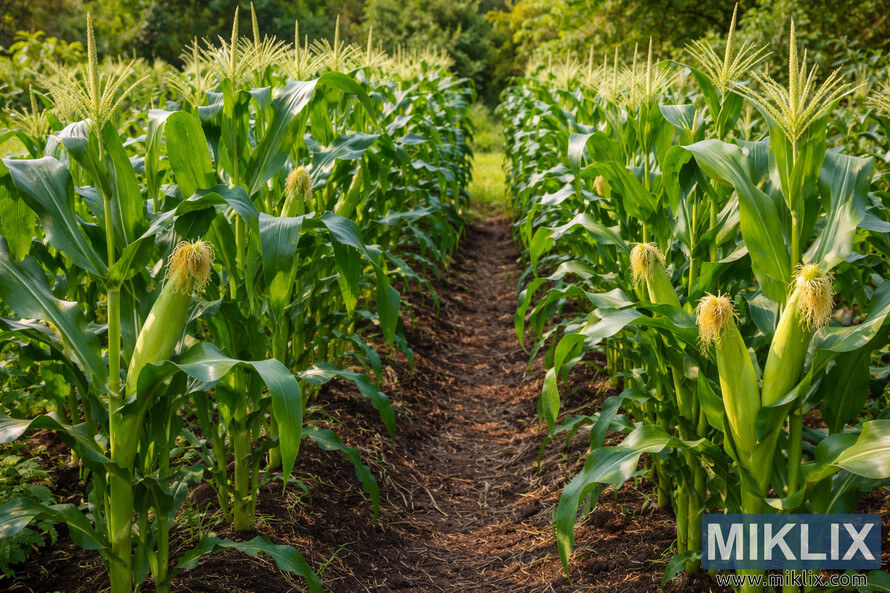
Growing corn in your home garden brings unmatched satisfaction. Nothing compares to the sweetness of freshly picked sweet corn. The sugar content peaks right at harvest. Within hours, natural sugars begin converting to starch. Home gardeners enjoy a flavor advantage store-bought corn simply cannot match.
Click or tap the image for more information and higher resolutions.
Many people believe corn requires vast agricultural fields. This misconception stops gardeners from trying. The truth surprises most beginners. A modest backyard garden space easily accommodates corn plants. Modern varieties thrive in compact areas. Container growing works for urban gardeners with limited ground space.
This comprehensive guide walks you through every step. You will learn variety selection matched to your region. Soil preparation techniques ensure strong plant growth. Proper watering and fertilizer schedules maximize ear development. Pest management protects your crop naturally. Harvest timing captures peak sweetness. Storage methods preserve quality.
Choosing the Right Corn Variety for Your Region
Selecting the proper corn variety determines your success before you even plant. Different types suit different climates and growing seasons. Sweet corn dominates home gardens. However, within sweet corn, distinct categories exist based on sugar content and texture.
Understanding Sweet Corn Types
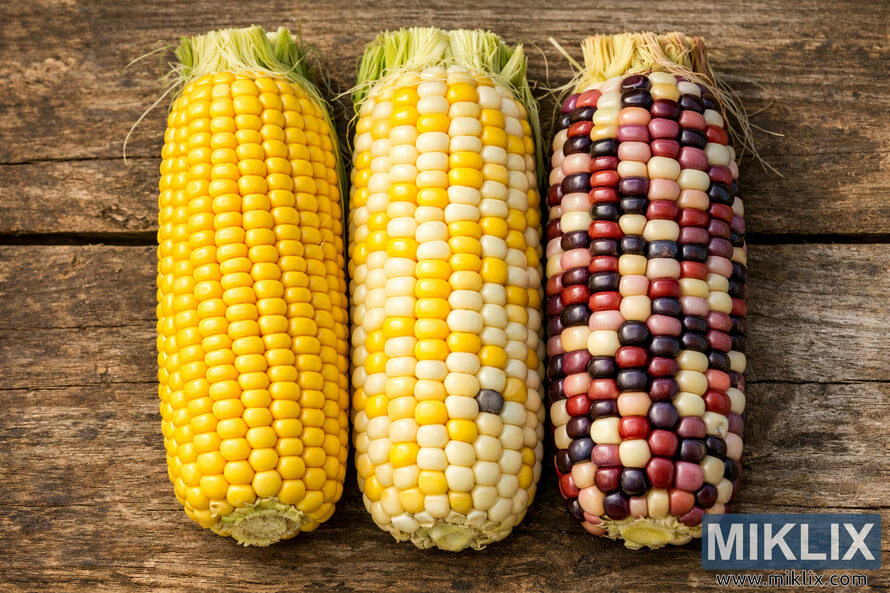
Modern sweet corn falls into three main categories. Each type offers different sweetness levels and storage characteristics. Standard sweet corn provides traditional flavor. Sugar-enhanced varieties increase sweetness moderately. Supersweet types maximize sugar content dramatically.
Click or tap the image for more information and higher resolutions.
Standard Sweet Corn (su)
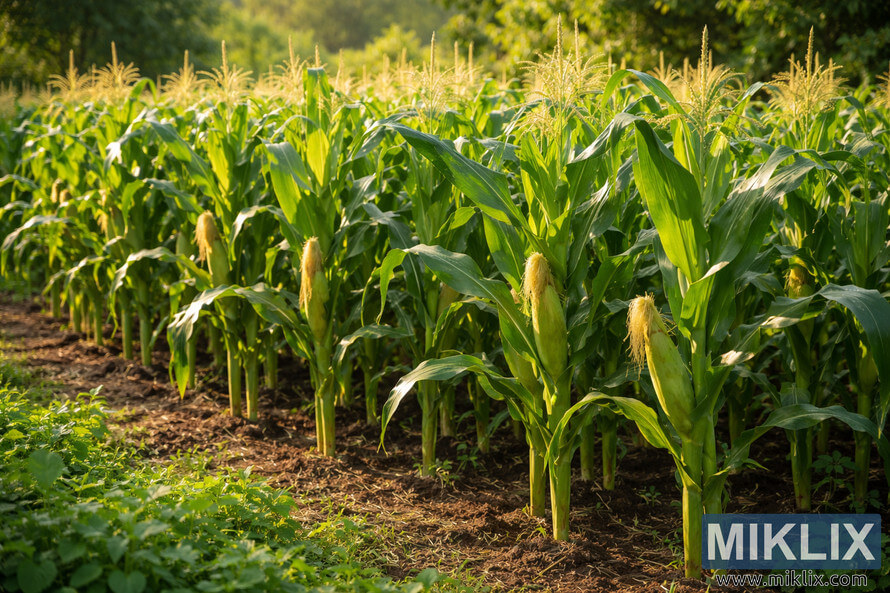
Traditional varieties carry the su gene. These plants produce corn with classic flavor. The sugar content remains moderate compared to newer types. Quality decreases rapidly after harvest. You should eat or preserve standard sweet corn within hours of picking. The texture tends toward creamy rather than crispy.
Standard varieties excel in cooler climates. Seeds germinate reliably in cold soil. Plants tolerate early spring weather better than other types. Many gardeners prefer the old-fashioned corn taste. These varieties work wonderfully for canning and freezing.
Click or tap the image for more information and higher resolutions.
Sugar-Enhanced Corn (se)
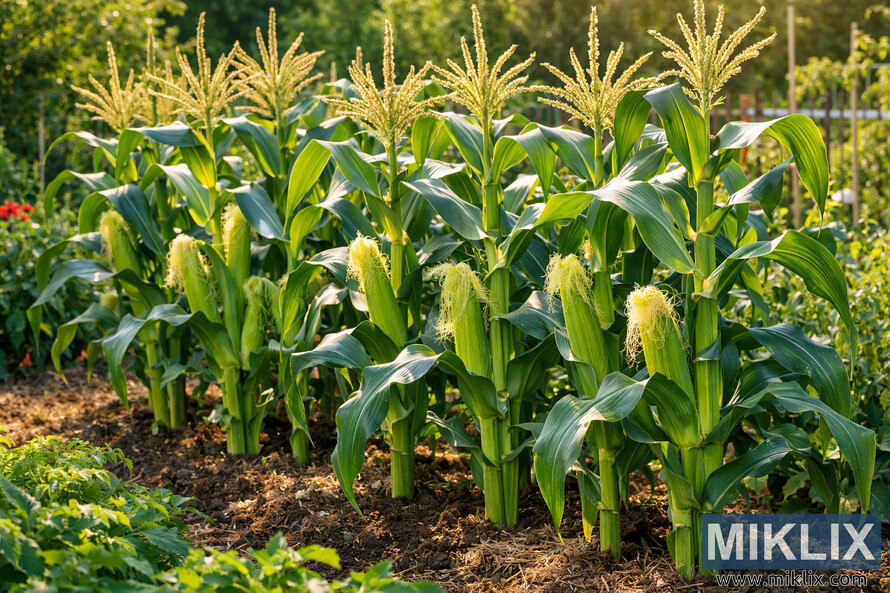
Sugar-enhanced varieties offer a middle ground. The sugar content exceeds standard types significantly. Kernels remain sweet longer after harvest. You gain several days of quality storage in the refrigerator. The texture balances between creamy and crisp.
These varieties suit most home gardeners perfectly. Plants show good vigor across various weather conditions. Seeds germinate well even when soil temperatures remain cool. The flavor satisfies people who find supersweet varieties too intense. Most sugar-enhanced varieties mature in 70 to 80 days.
Click or tap the image for more information and higher resolutions.
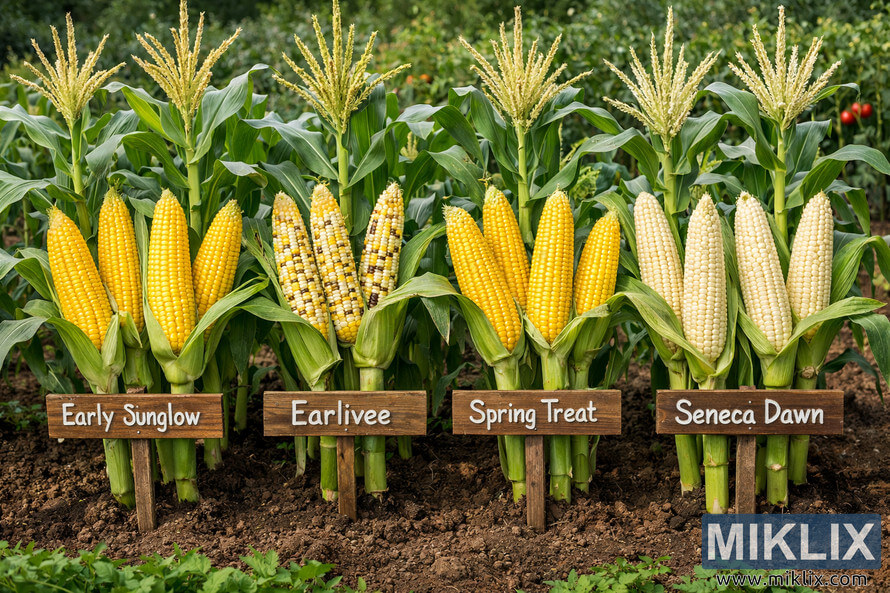
Cool Season Varieties
- Early Sunglow - 63 days to maturity
- Earlivee - 66 days, cold-tolerant
- Spring Treat - 68 days, sweet flavor
- Seneca Dawn - 65 days, reliable germination
Click or tap the image for more information and higher resolutions.
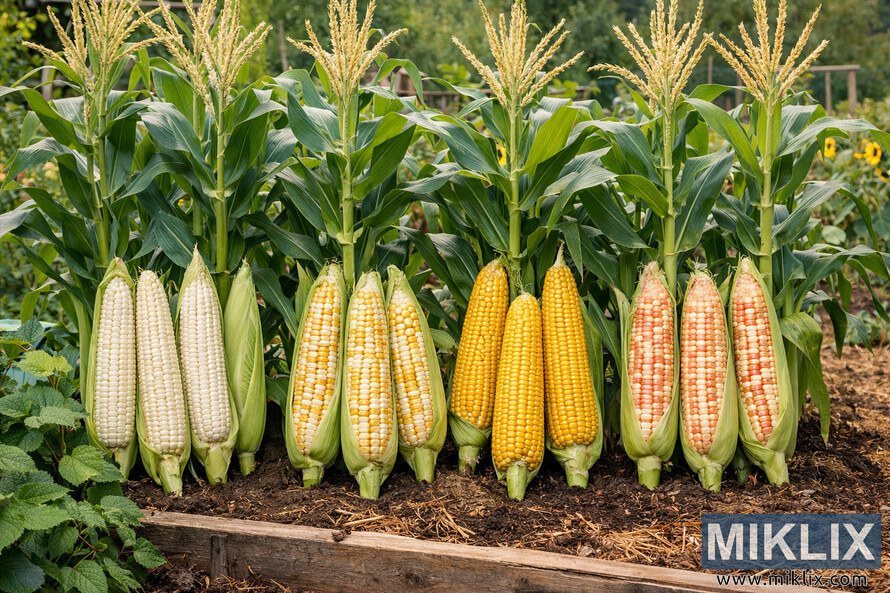
Warm Season Varieties
- Silver Queen - 92 days, large ears
- Peaches and Cream - 83 days, bi-color
- Bodacious - 75 days, disease resistant
- Ambrosia - 75 days, excellent sweetness
Click or tap the image for more information and higher resolutions.
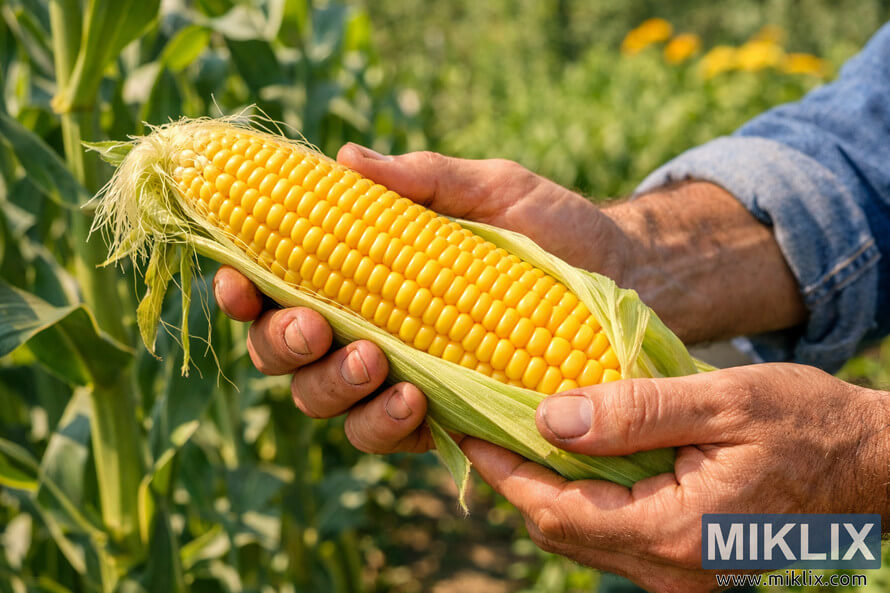
Supersweet Corn (sh2)
Supersweet varieties carry the sh2 gene. This genetic modification dramatically increases sugar levels. Some types contain four times the sugar of standard corn. The extra sweetness persists for days after harvest. Kernels maintain crispy texture even when cooked.
These varieties demand warm soil for germination. Seeds rot easily in cold, wet ground. Wait until soil reaches 65 degrees Fahrenheit before planting. The growing season should remain consistently warm. Supersweet types require isolation from other corn varieties. Cross-pollination with standard types ruins kernel quality.
Click or tap the image for more information and higher resolutions.
Matching Varieties to Your Growing Season
Your local climate determines which varieties succeed. The frost-free period in your area sets planting limits. Corn needs specific time from planting to harvest. Early varieties mature in 60 to 70 days. Mid-season types require 70 to 85 days. Late-season varieties need 85 to 100 days.
Count backwards from your typical first fall frost date. This calculation reveals your planting window. Northern gardeners benefit from early maturing varieties. Southern regions accommodate successive plantings of any type. Cool coastal areas favor sugar-enhanced varieties over supersweet types.
Short Growing Season Strategies
Gardeners in northern climates face challenges. Frost dates limit the growing season significantly. Focus on varieties maturing in 75 days or less. Start seeds indoors to gain extra weeks. Transplant carefully to avoid root disturbance. Black plastic mulch warms soil for faster growth.
Tip: Make successive plantings every two weeks. This extends your harvest period throughout the growing season. Stop planting 90 days before the expected first frost in fall.
Top Recommended Corn Varieties for Home Gardeners
Based on performance across diverse conditions, these varieties consistently deliver excellent results. Each offers unique advantages for different garden situations and taste preferences.
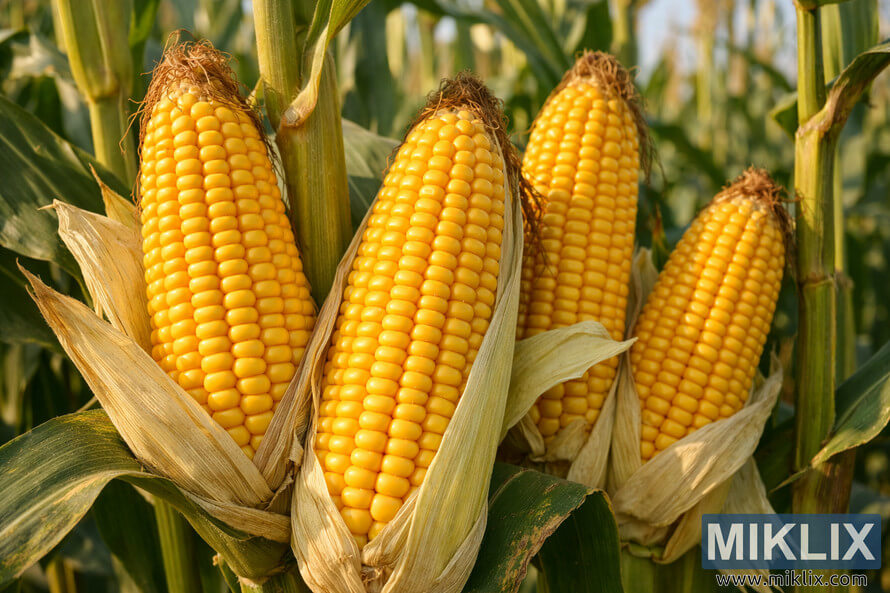
Golden Bantam - Beginner Friendly
- Flavor: 4.7/5
- Cold Tolerance: 4.5/5
- Ease of Growing: 4.8/5
- Days to Maturity: 78 days
- Type: Standard Sweet (su)
- Best For: Cool climates, northern gardens, traditional flavor lovers
This heirloom variety has satisfied home gardeners since 1902. Plants reach 5 to 6 feet tall. Ears measure 6 to 7 inches with 8 rows of kernels. The classic sweet corn flavor remains unmatched. Seeds germinate reliably in cooler soil.
Click or tap the image for more information and higher resolutions.
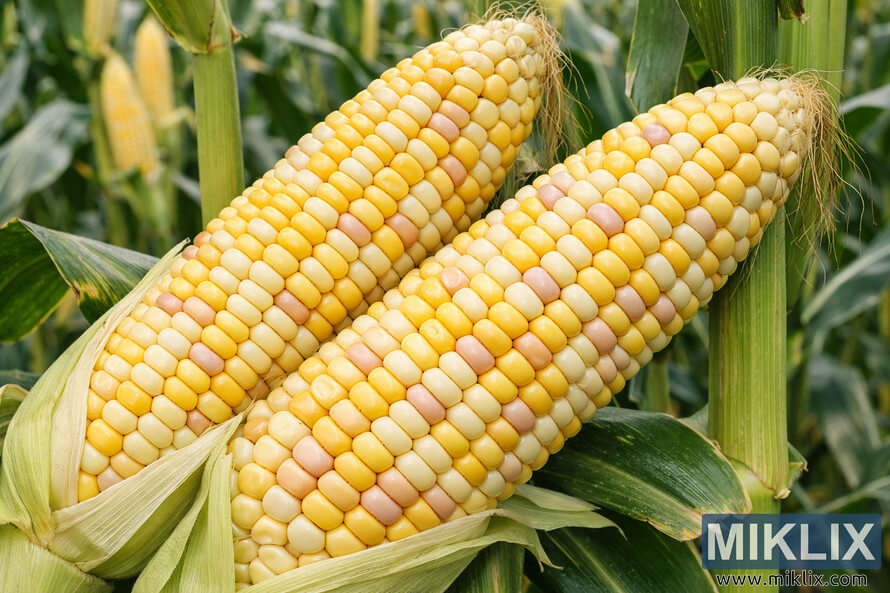
Honey Select - Most Popular
- Flavor 4.9/5
- Disease Resistance 4.6/5
- Yield 4.7/5
- Days to Maturity: 79 days
- Type: Sugar-Enhanced (se)
- Best For: All regions, successive planting, extended harvest
Honey Select dominates home garden plantings nationwide. The tri-color kernels mix yellow, white and cream. Ears reach 8 inches with excellent fill. Sweetness level satisfies without overwhelming. Plants show outstanding disease resistance. This variety performs reliably in variable weather.
Click or tap the image for more information and higher resolutions.
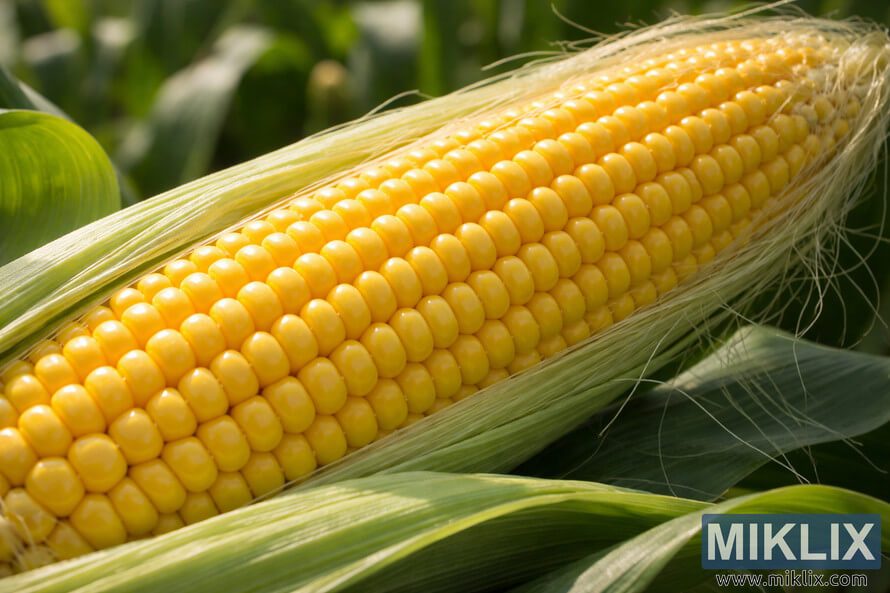
Incredible - Highest Sugar
- Sweetness 5.0/5
- Texture 4.5/5
- Storage 4.4/5
- Days to Maturity: 85 days
- Type: Supersweet (sh2)
- Best For: Warm climates, maximum sweetness preference, fresh eating
Incredible lives up to its name for sweetness. The sugar content reaches exceptional levels. Kernels maintain crispy texture through cooking. Ears measure 8 to 9 inches with 18 to 20 rows. Plants require warm soil and consistent heat. Isolate from other corn types by 250 feet minimum.
Click or tap the image for more information and higher resolutions.
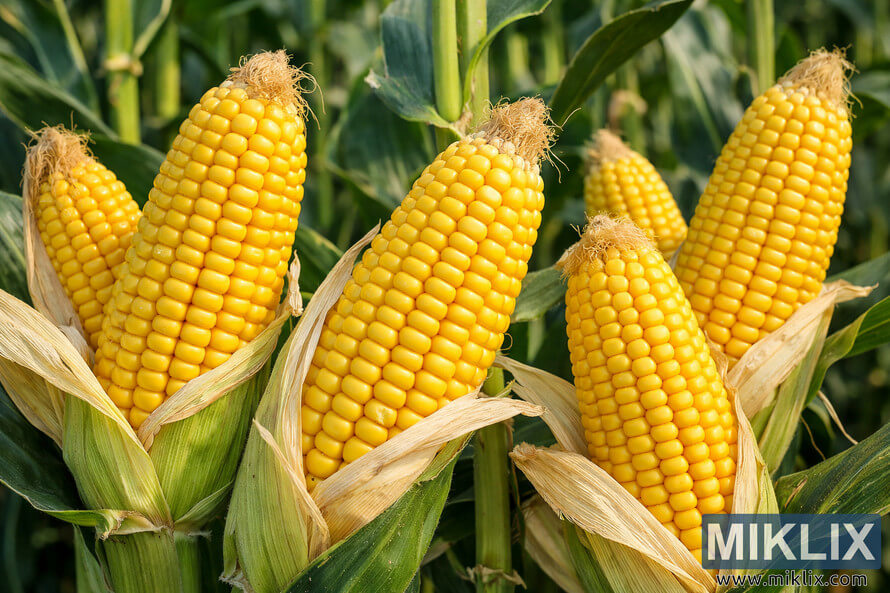
Early Sunglow - Fast Maturing
- Speed 5.0/5
- Flavor 4.2/5
- Compact Size 4.6/5
- Days to Maturity: 63 days
- Type: Sugar-Enhanced (se)
- Best For: Short seasons, succession planting, small gardens
Early Sunglow brings the season's first harvest. Plants mature in just 63 days from planting. The compact stalks reach only 4 to 5 feet tall. Ears measure 6 inches with tender kernels. This variety suits northern regions perfectly. Plant multiple successions for continuous harvest throughout summer.
Click or tap the image for more information and higher resolutions.
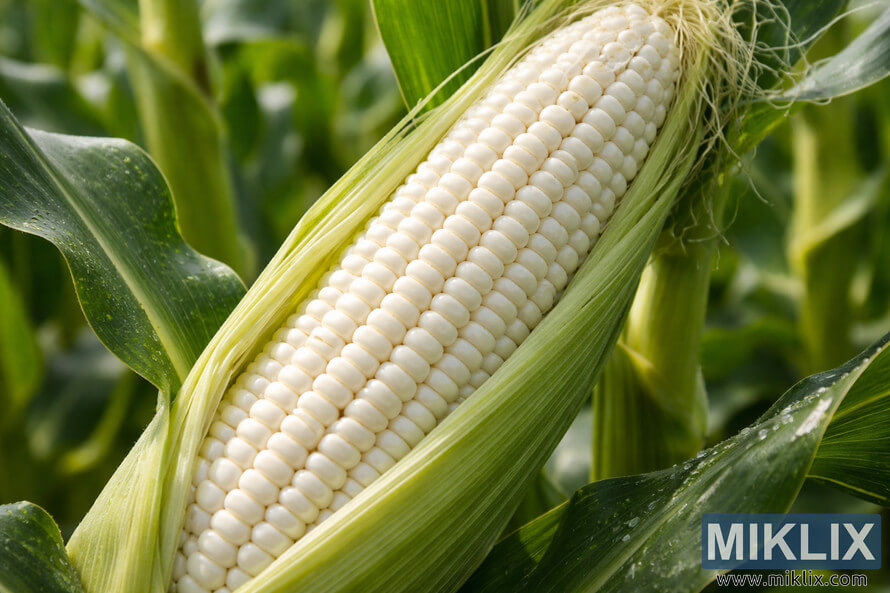
Silver Queen - Heirloom Quality
- Flavor 4.8/5
- Ear Size 4.7/5
- Tenderness 4.6/5
- Days to Maturity: 92 days
- Type: Standard Sweet (su)
- Best For: Traditional flavor, large gardens, long season regions
Silver Queen represents the gold standard for white sweet corn. This legendary variety produces 8 to 9 inch ears. Pure white kernels deliver exceptional tenderness. The classic sweet corn flavor satisfies purists. Plants grow 7 to 8 feet tall. Requires longer season but rewards patience with outstanding quality.
Click or tap the image for more information and higher resolutions.
Peaches and Cream - Bi-Color Beauty
- Appearance 4.8/5
- Flavor 4.6/5
- Versatility 4.7/5
- Days to Maturity: 83 days
- Type: Sugar-Enhanced (se)
- Best For: Visual appeal, mixed uses, reliable production
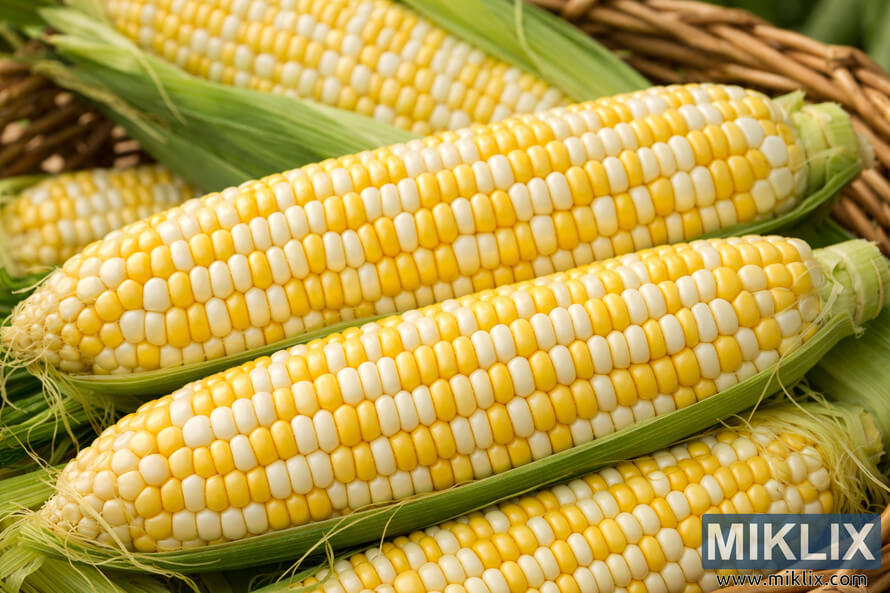
Peaches and Cream combines beauty with exceptional taste. The bi-color kernels create striking visual appeal. Yellow and white kernels mix randomly on each ear. Ears reach 8 inches with excellent fill. This variety adapts to various growing conditions. Plants show strong vigor and consistent production.
Click or tap the image for more information and higher resolutions.
Preparing Soil and Planting Seeds for Success
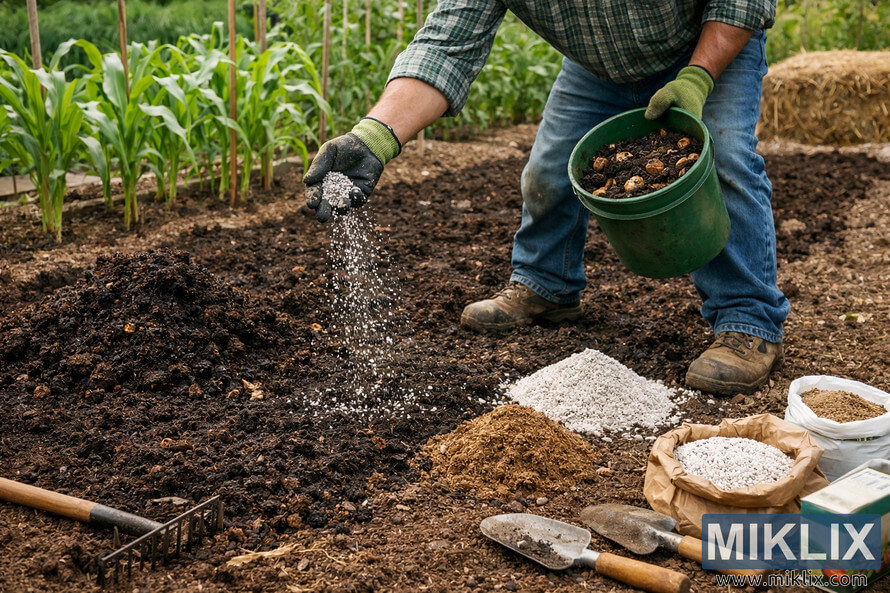
Proper soil preparation creates the foundation for healthy corn plants. Corn demands nutrient-rich ground to support its rapid growth. Plants reach mature height within 60 to 90 days. This explosive development requires abundant nutrition immediately available in the soil.
Click or tap the image for more information and higher resolutions.
Soil Requirements and Testing
Corn thrives in loamy soil with excellent drainage. The ideal pH ranges from 6.0 to 6.8. Heavy clay soils impede root development. Sandy ground drains too quickly and lacks nutrients. Amend problem soils before planting time arrives.
Test your garden soil in early spring. Home test kits provide basic information. County extension offices offer detailed analysis. Results reveal pH levels and nutrient deficiencies. This information guides amendment applications precisely.
Improving Soil Structure
Add organic matter to enhance any soil type. Compost improves clay and sand equally. Work 2 to 4 inches of finished compost into planting beds. This material increases water retention. Drainage improves simultaneously. Beneficial microorganisms multiply in organic-rich environments.
Aged manure provides similar benefits with added nutrients. Apply well-rotted manure in fall. Fresh manure burns plant roots. Allow six months for proper decomposition before planting season begins.
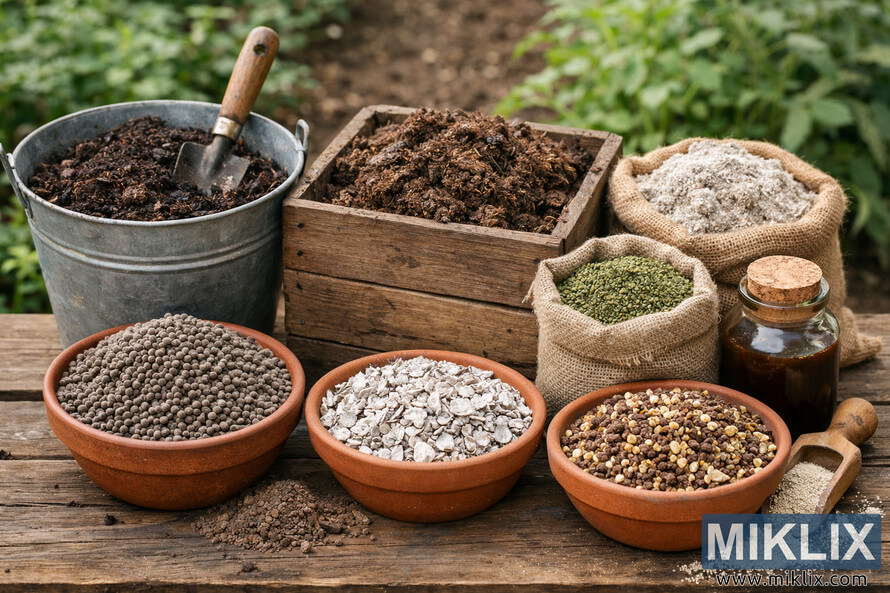
Essential Soil Amendments
- Finished compost - 2 to 4 inches worked into beds
- Aged manure - applied in fall, 1 to 2 inches
- Bone meal - 5 pounds per 100 square feet for phosphorus
- Greensand - 10 pounds per 100 square feet for potassium
- Blood meal - 3 pounds per 100 square feet for nitrogen
- Lime - only if pH tests below 6.0
- Sulfur - only if pH exceeds 7.0
Click or tap the image for more information and higher resolutions.
Timing Your Planting for Optimal Results
Corn seeds require warm soil for germination. Cold, wet ground causes seed rot. Wait until soil temperature reaches 60 degrees Fahrenheit at 2-inch depth. Measure with a soil thermometer for accuracy. This typically occurs 2 weeks after the last spring frost date.
Early planting risks losing seeds to cold. Late planting shortens the growing season. Regional climate determines ideal timing. Northern gardeners plant from mid-May through early June. Southern regions begin in March or April. High-altitude areas wait until June.
Temperature Tip: Standard varieties germinate at 60°F soil temperature. Sugar-enhanced types perform best at 65°F. Supersweet varieties require 70°F minimum. Use black plastic mulch to warm soil faster in spring.
Succession Planting Strategy
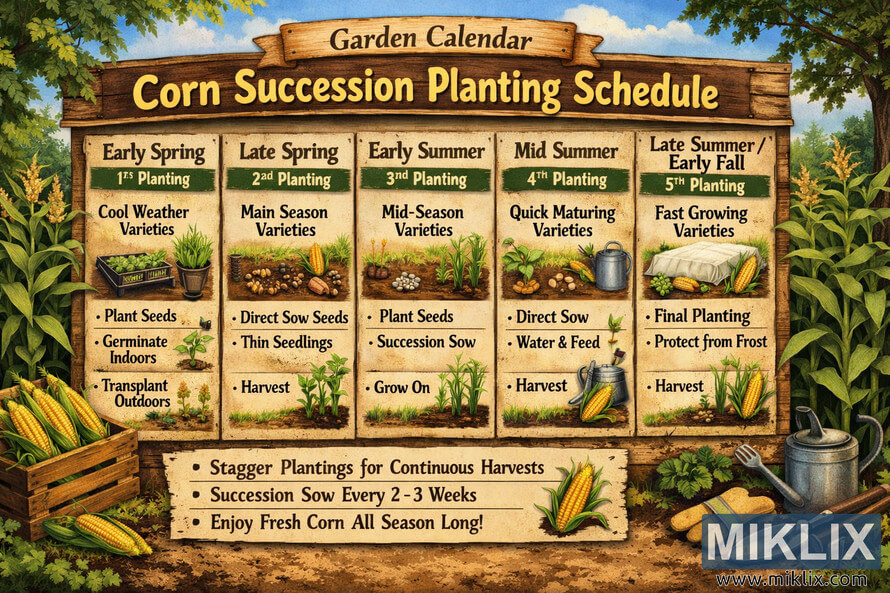
Extend your harvest period through successive plantings. Plant small sections every 2 weeks. Continue until 90 days before fall frost. This approach provides fresh corn throughout summer and fall. Each planting matures at different times.
Mix early, mid-season and late varieties. Plant all three simultaneously for staggered harvest. Early types mature first. Mid-season varieties follow. Late plantings finish the season. This technique maximizes garden productivity.
Click or tap the image for more information and higher resolutions.
Planting Methods and Spacing
Corn requires specific spacing for successful pollination. Wind carries pollen from tassels to silk. Plants must grow close together. Blocks of multiple short rows work better than single long rows. This arrangement ensures adequate pollination.
Block Planting Configuration
Create planting blocks with at least 4 rows. Space rows 30 to 36 inches apart. This distance accommodates mature plant size. Allow room for walking between rows during maintenance. Plant seeds 8 to 12 inches apart within rows.
Minimum block size should contain 16 plants. Four rows with four plants each works adequately. Larger blocks improve pollination success. More plants means more pollen availability. This results in better ear fill and fewer missing kernels.
| Garden Size | Recommended Configuration | Row Spacing | Plant Spacing | Expected Yield |
| Small (100 sq ft) | 4 rows × 6 plants | 30 inches | 10 inches | 24-36 ears |
| Medium (200 sq ft) | 4 rows × 12 plants | 36 inches | 12 inches | 48-72 ears |
| Large (400 sq ft) | 6 rows × 16 plants | 36 inches | 12 inches | 96-144 ears |
| Container Garden | 4 plants per group | N/A | 12 inches | 4-8 ears |
Direct Seeding Technique
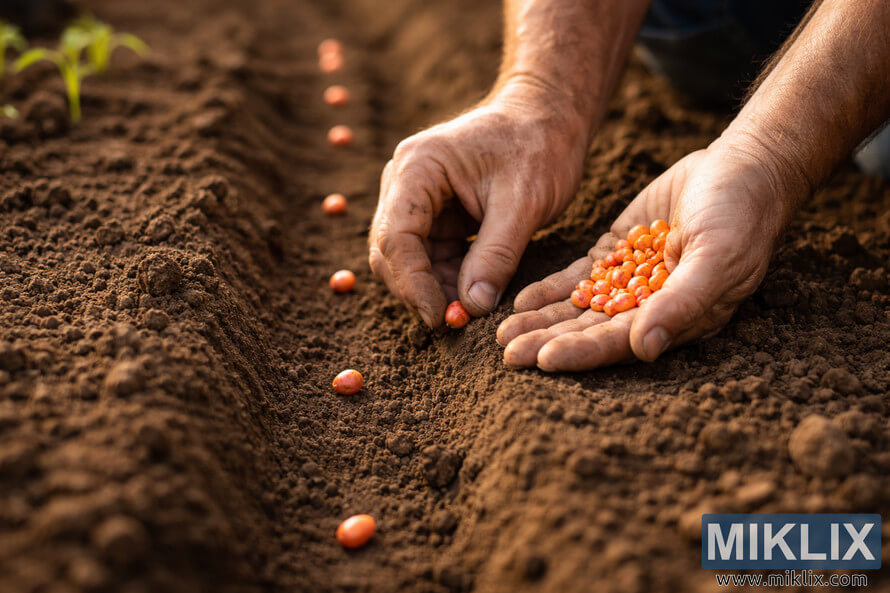
Plant seeds directly in prepared ground. Corn transplants poorly due to sensitive roots. Direct seeding produces stronger plants with better establishment. Create furrows 1 to 2 inches deep. Place seeds at proper spacing intervals.
Plant 2 seeds per location initially. This insurance policy protects against poor germination. Thin to strongest seedling when plants reach 4 inches tall. Remove weaker plant carefully to avoid disturbing roots of keeper plant.
Click or tap the image for more information and higher resolutions.
Essential Planting Tools and Supplies
Quality tools make planting faster and more accurate. Basic equipment handles most home garden needs. Specialized tools improve efficiency for larger plantings. Invest in durable items that last multiple seasons.
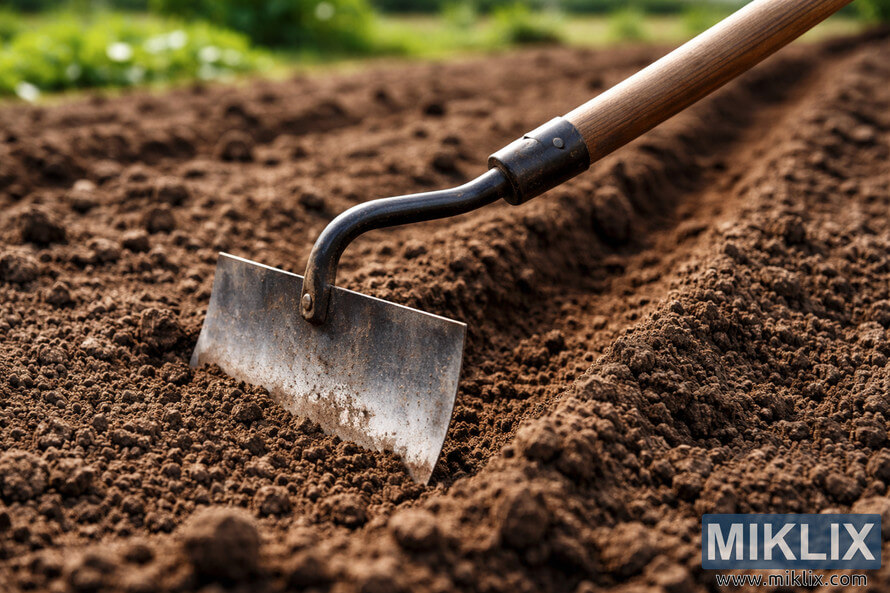
Garden Hoe
Purpose: Creating planting furrows, cultivating soil
Essential for making straight, uniform furrows at proper depth. Choose a hoe with 6 to 8 inch blade width. Sturdy construction handles heavy soil work. Use for weed control between rows throughout the growing season.
Click or tap the image for more information and higher resolutions.
Soil Thermometer
Purpose: Monitoring soil temperature for ideal planting timing
Accurate temperature readings prevent premature planting. Insert probe 2 inches deep at planting depth. Take readings in morning for most accurate assessment. Prevents seed rot from cold soil conditions.
Measuring Tools
Purpose: Ensuring proper spacing and straight rows
Tape measure and string line create straight rows. Garden stakes mark row ends. Proper spacing ensures adequate pollination. Maintains organization for easier maintenance throughout the growing season.
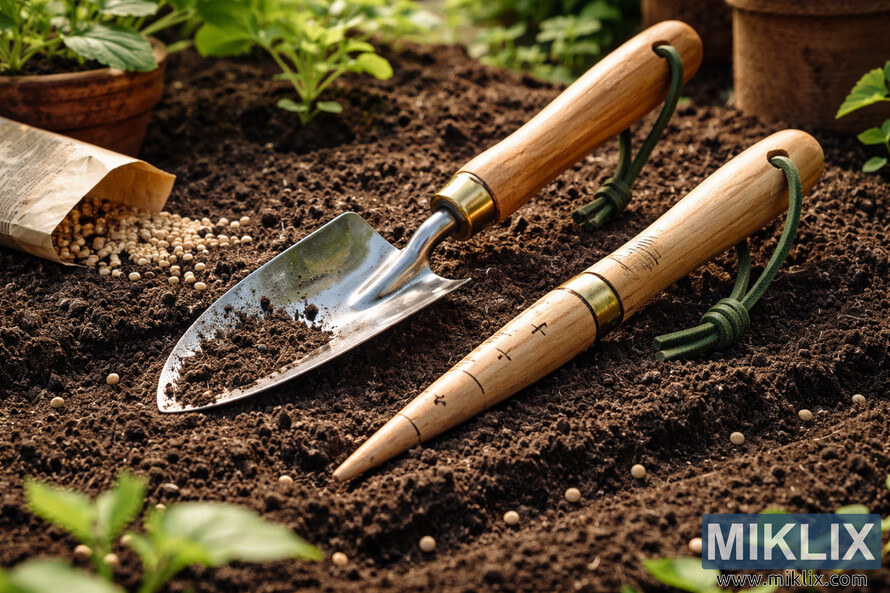
Hand Trowel & Dibber
Purpose: Precise seed placement and covering
Trowel moves soil efficiently at planting time. Dibber creates individual planting holes at exact depth. Perfect for controlled spacing in small gardens. Stainless steel resists rust and soil adhesion.
Click or tap the image for more information and higher resolutions.
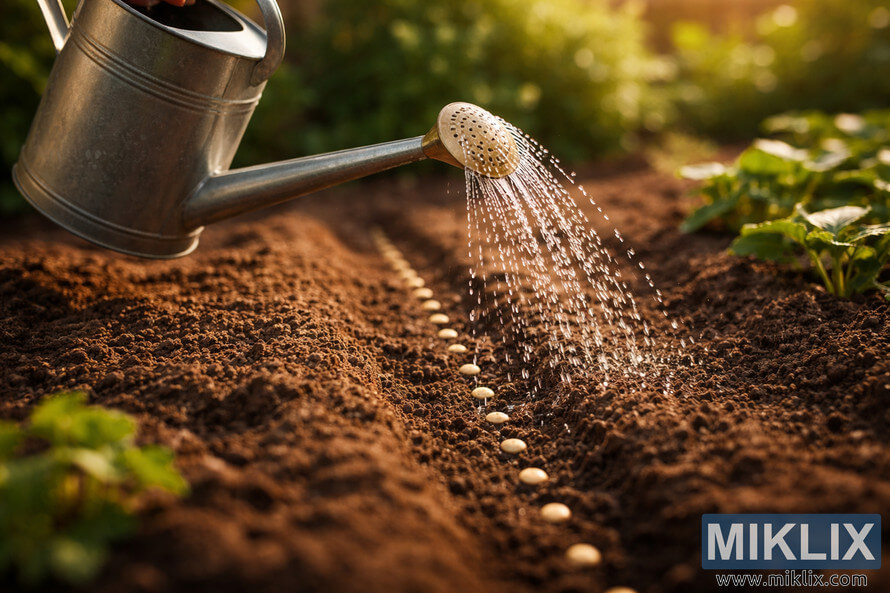
Watering Can
Purpose: Gentle initial watering after planting
Long spout reaches between rows without disturbing seeds. Gentle water flow prevents seed displacement. Essential for keeping soil moist during germination period. Two-gallon capacity handles multiple rows efficiently.
Click or tap the image for more information and higher resolutions.
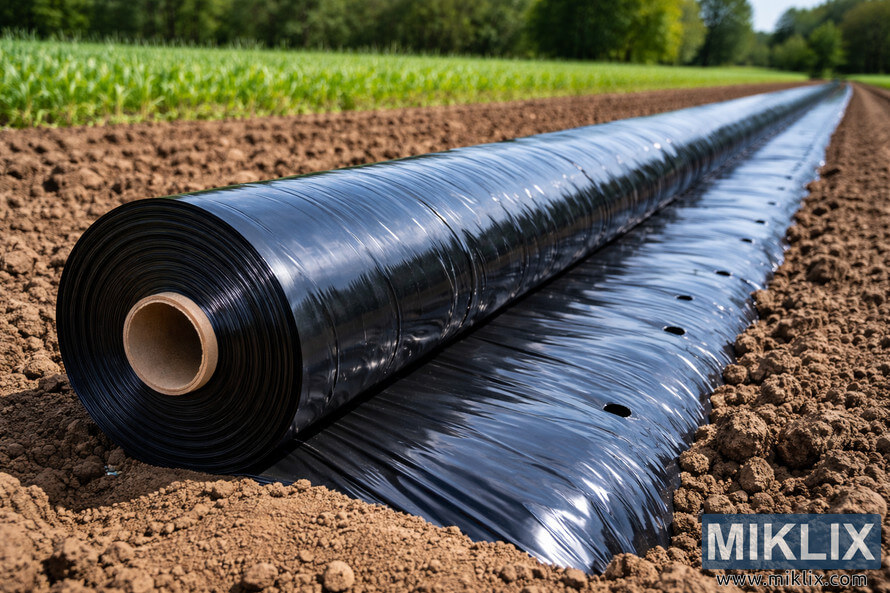
Black Plastic Mulch
Purpose: Warming soil and suppressing weeds
Accelerates soil warming by 10 to 15 degrees. Enables earlier planting in cool climates. Blocks weed growth completely under plastic. Conserves soil moisture throughout growing season. Commercial grade lasts full season.
Click or tap the image for more information and higher resolutions.
Container Growing for Limited Spaces
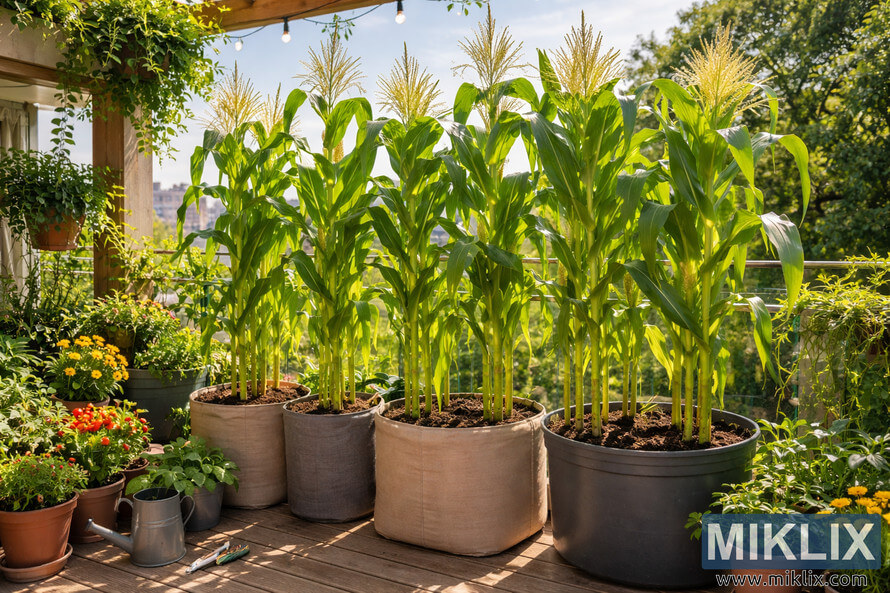
Urban gardeners with no ground space can still grow corn. Container culture works with proper variety selection. Choose dwarf or early maturing varieties. Standard field corn grows too large for containers. Compact types adapt well to pot culture.
Container Selection and Preparation
Use large containers holding at least 5 gallons of soil. Bigger proves better for corn growth. Half whiskey barrels work excellently. Large plastic pots provide adequate volume. Ensure containers have drainage holes in the base.
Fill with high-quality potting mix. Garden soil compacts in containers. Commercial potting mix drains properly while retaining moisture. Mix in slow-release fertilizer at planting time. This provides steady nutrition throughout the growing season.
Click or tap the image for more information and higher resolutions.
Growing Requirements in Containers
Place containers in full sun location. Corn demands 6 to 8 hours direct sunlight daily. Group at least 4 containers together. This arrangement ensures adequate pollination between plants. Wind carries pollen from plant to plant within the group.
Container soil dries faster than ground soil. Check moisture daily during hot weather. Water thoroughly when top inch feels dry. Feed every 2 weeks with liquid fertilizer. Container plants cannot access ground nutrients. Supplemental feeding maintains healthy growth and ear development.
Watering and Fertilizing Requirements Throughout the Season
Corn plants demand consistent moisture and abundant nutrients. Water needs change as plants develop. Fertilizer applications must match growth stages. Understanding these requirements prevents common problems. Proper care produces plump ears filled with tender kernels.
Click or tap the image for more information and higher resolutions.
Water Requirements by Growth Stage
Corn's water needs vary dramatically through its life cycle. Young seedlings require light, frequent watering. Mature plants need deep, less frequent irrigation. Critical periods demand perfect moisture levels. Drought stress during these times ruins ear development.
Germination and Seedling Stage
Keep soil consistently moist but not waterlogged during germination. Seeds rot in saturated ground. The top inch should feel damp to touch. Water lightly every 2 to 3 days in absence of rain. Germination occurs within 7 to 10 days in warm soil.
Young seedlings establish shallow root systems initially. Continue light watering every 3 to 4 days. The goal maintains even moisture without drowning roots. Avoid overhead watering during hottest part of day. Early morning irrigation reduces disease risk and water loss.
Vegetative Growth Period
Rapid growth begins once plants reach knee height. Root systems expand both deep and wide. Transition to deeper, less frequent watering. Apply 1 to 1.5 inches weekly through rain or irrigation. Deep watering encourages strong root development.
Check soil moisture at 4 to 6 inch depth. Insert finger or use moisture meter. Water when this zone begins drying out. Shallow watering creates weak roots near the surface. Plants become vulnerable to drought stress and wind damage.
Critical Watering Period: The 2-week window surrounding tasseling and silk emergence is absolutely crucial. This stage determines kernel formation. Even brief drought stress drastically reduces yields. Ensure consistent moisture during this period.
Tasseling, Silk and Pollination Stage
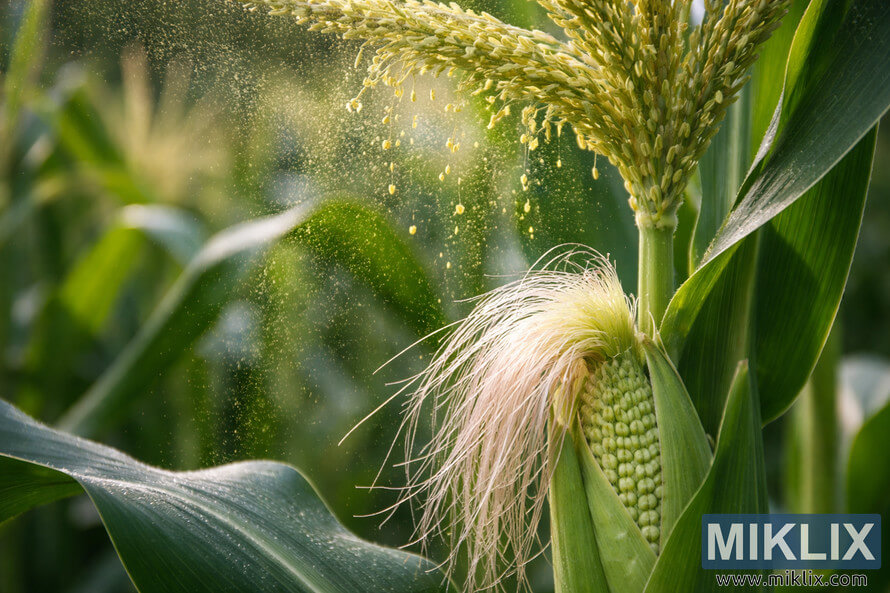
This critical period determines your harvest success. Corn tassels appear at plant tops first. Silks emerge from developing ears days later. Each silk connects to a single kernel position. Pollen must reach every silk for complete ear fill.
Maintain perfect soil moisture during this 2-week window. Stress causes incomplete pollination. Missing kernels on ears indicate drought during this stage. Water deeply twice weekly if rain fails. Apply 1.5 to 2 inches total weekly.
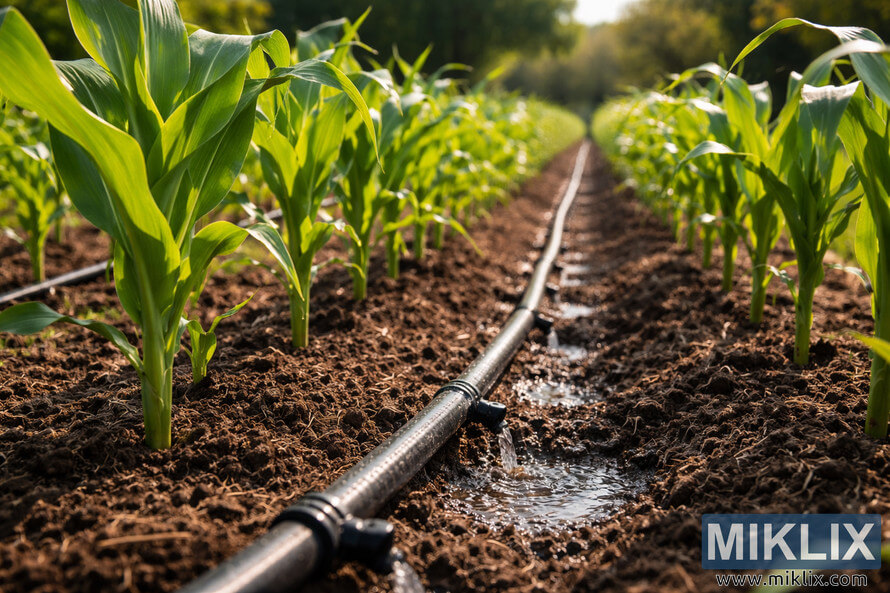
Avoid overhead watering while silk is fresh. This can wash away or damage pollen. Use drip irrigation or soaker hoses instead. Water early morning allowing foliage to dry before evening. This practice reduces disease problems.
Click or tap the image for more information and higher resolutions.
Ear Development and Maturation
After successful pollination, kernels begin filling. Ears swell as kernels develop. This stage requires continued adequate moisture. Reduce watering slightly as harvest approaches. Excess water late in season creates bland flavor. Sugar content decreases with too much moisture.
Gradually taper watering as ears mature. Watch for silk browning and ear firmness. Stop irrigation 1 week before planned harvest. This allows sugars to concentrate. Flavors intensify with slight moisture stress during final ripening.
Irrigation Methods and Systems
Choose irrigation methods matching your garden size and budget. Various systems deliver water efficiently. Each approach offers distinct advantages. Proper technique conserves water while meeting plant needs.
Hand Watering
Best for small plantings under 50 plants. Provides precise control over water application. Use watering wand with gentle spray pattern. Water at soil level rather than overhead. Time-consuming but connects you with plants daily. Monitor individual plant health easily. Cost-effective for beginning gardeners.
- Suitable for gardens under 200 square feet
- Minimal equipment investment required
- Excellent for observing plant health
- Labor-intensive for larger areas
Soaker Hoses
Ideal for medium-sized gardens up to 500 square feet. Porous hoses seep water directly into soil. Place between corn rows along base of plants. Reduces water waste through evaporation. Delivers moisture slowly allowing soil absorption. Leave in place all season. Connect to timer for automatic operation. More efficient than overhead sprinklers.
- Water efficiency up to 90 percent
- Reduces foliar disease problems
- Easy installation and adjustment
- Moderate initial cost with long lifespan
Drip Irrigation
Most efficient system for any garden size. Delivers water directly to root zones. Emitters space along supply lines at plant locations. Completely eliminates water waste. Reduces weed growth between rows. Leaves foliage dry preventing disease. Expensive initial setup justified by water savings. Automated systems operate on timers.
- Water efficiency exceeds 95 percent
- Precise delivery to each plant
- Adapts to any garden configuration
- Higher initial investment required
Sprinkler Systems
Suitable for large gardens exceeding 1000 square feet. Covers wide areas quickly with minimal labor. Use during early morning hours only. Midday application wastes water to evaporation. Evening watering promotes disease development. Oscillating sprinklers work better than stationary types. Apply 1 inch per session measured in containers.
- Covers large areas efficiently
- Lower equipment cost than drip systems
- Higher water consumption overall
- May increase foliar disease pressure
Fertilizer Requirements for Maximum Production
Corn ranks among the heaviest feeders in vegetable gardens. Plants extract massive amounts of nitrogen from soil. Phosphorus supports strong root development. Potassium strengthens stalks and improves ear quality. Regular feeding maintains vigorous growth and quality yields.
Pre-Planting Soil Preparation
Build soil fertility before planting time. Work amendments into beds during spring preparation. Balanced organic fertilizer feeds plants throughout the season. Apply 2 to 3 pounds per 100 square feet. Work into top 6 inches of soil.
Compost contributes slow-release nutrients continuously. Layer 2 to 4 inches over planting area. Incorporate thoroughly with existing soil. This foundation supports plants from emergence through harvest.
| Nutrient | Purpose | Organic Sources | Application Rate | Timing |
| Nitrogen (N) | Leaf and stalk growth, chlorophyll production | Blood meal, fish emulsion, composted manure | 3-5 lbs per 100 sq ft | Side-dress when knee-high and at tasseling |
| Phosphorus (P) | Root development, energy transfer, ear formation | Bone meal, rock phosphate | 5 lbs per 100 sq ft | At planting, worked into soil |
| Potassium (K) | Disease resistance, stalk strength, kernel quality | Greensand, kelp meal, wood ash | 10 lbs per 100 sq ft | At planting, side-dress at tasseling |
| Calcium (Ca) | Cell wall strength, nutrient uptake | Lime, gypsum, eggshells | 2-3 lbs per 100 sq ft | Fall or early spring application |
| Magnesium (Mg) | Chlorophyll production, enzyme activation | Epsom salt, dolomitic lime | 1 lb per 100 sq ft | At planting or as foliar spray |
Side-Dressing During Growth
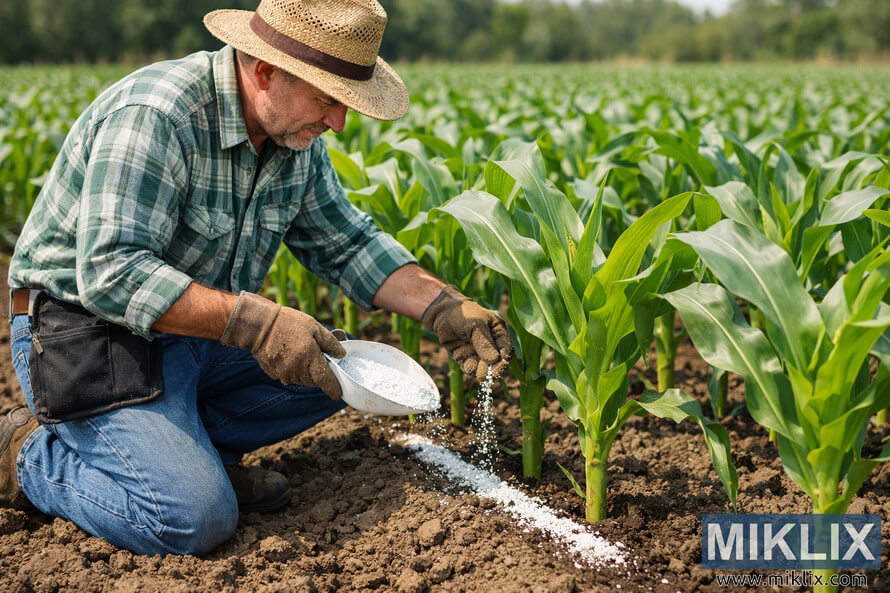
Additional nitrogen applications boost production significantly. Side-dress when plants reach knee height. Apply nitrogen-rich fertilizer along rows. Keep material 6 inches from plant stems. Scratch into soil surface lightly. Water thoroughly after application.
Second feeding occurs at tasseling stage. This supports ear development and kernel fill. Use same application method as first feeding. Blood meal or fish emulsion provide quick nitrogen. Compost tea offers balanced nutrition with beneficial microbes.
Click or tap the image for more information and higher resolutions.
Organic Versus Synthetic Fertilizers
Both approaches successfully grow corn. Organic fertilizers release nutrients slowly. Soil microbes break down organic matter. Plants receive steady nutrition over extended periods. Soil structure improves simultaneously. Synthetic fertilizers deliver nutrients immediately. Plants respond quickly to applications.
Organic methods build long-term soil health. Microbe populations increase. Water retention improves. Future crops benefit from accumulated organic matter. Synthetic fertilizers provide nothing beyond plant nutrients. Soil quality remains unchanged or potentially degrades.
Organic Fertilizer Benefits
- Improves soil structure and water retention
- Feeds beneficial soil microorganisms
- Slow release prevents nutrient leaching
- Builds long-term soil fertility
- Reduces environmental runoff concerns
- Creates sustainable growing system
Organic Fertilizer Limitations
- Higher initial cost per pound
- Slower visible plant response
- Nutrient ratios less precise
- May require larger application amounts
- Results depend on soil temperature
- Organic sources vary in quality
Recognizing and Correcting Nutrient Deficiencies
Plants display visible symptoms when nutrients lack. Early detection allows correction before yields suffer. Learn to read plant signals. Prompt treatment restores healthy growth quickly.
Common Deficiency Symptoms
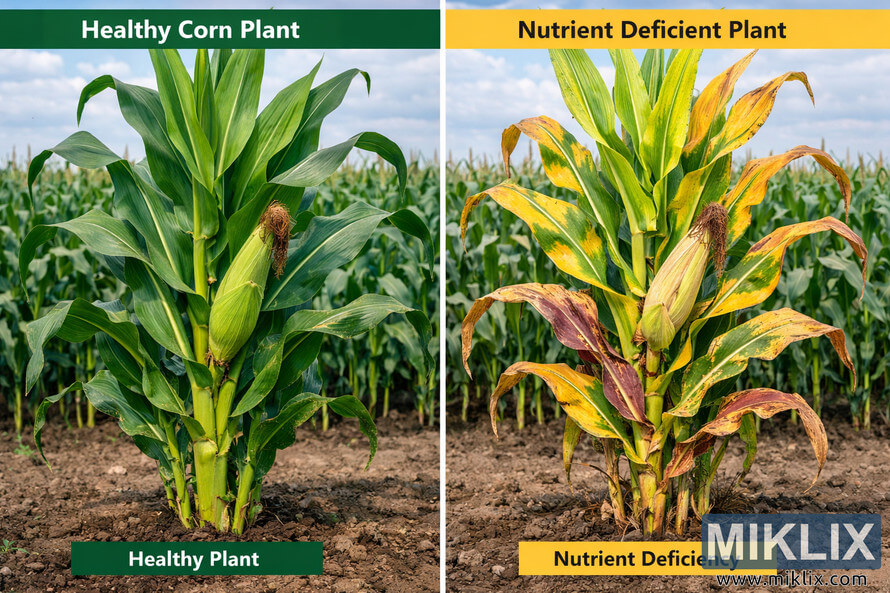
Nitrogen deficiency appears as pale green or yellow leaves. Older bottom leaves show symptoms first. Growth slows noticeably. Plants remain stunted. Stalks appear spindly and weak. Apply nitrogen-rich fertilizer immediately. Fish emulsion provides quick correction. Blood meal offers longer-lasting results.
Phosphorus deficiency creates purple or reddish leaf tints. This appears most commonly in cool soil. Young plants show symptoms prominently. Growth delays significantly. Apply bone meal around plant bases. Rock phosphate provides long-term phosphorus availability.
Potassium deficiency causes yellowing and browning on leaf edges. Older leaves show damage first. Margins appear scorched or burned. Stalks weaken significantly. Apply greensand or kelp meal. Wood ash provides quick potassium boost but raises soil pH.
Click or tap the image for more information and higher resolutions.
Pest and Disease Management for Healthy Corn Plants
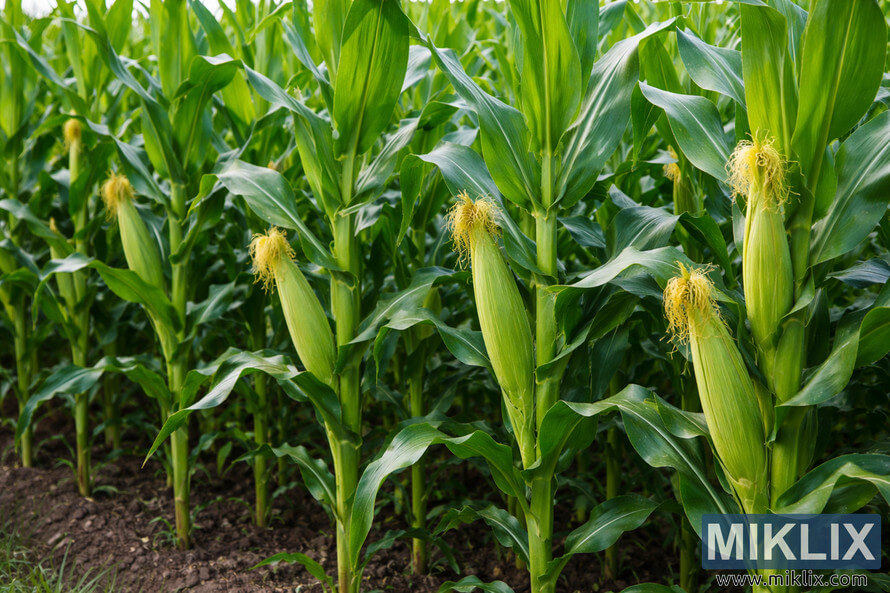
Corn faces various pest and disease challenges throughout the growing season. Prevention works better than treatment. Healthy plants resist problems more successfully. Understanding common issues helps you respond quickly. Early intervention prevents minor problems from becoming crop disasters.
Click or tap the image for more information and higher resolutions.
Common Corn Pests and Control Methods
Several insects target corn specifically. Each pest attacks different plant parts. Damage ranges from cosmetic to devastating. Integrated pest management combines multiple control strategies. This approach reduces chemical use while protecting crops.
Corn Earworm
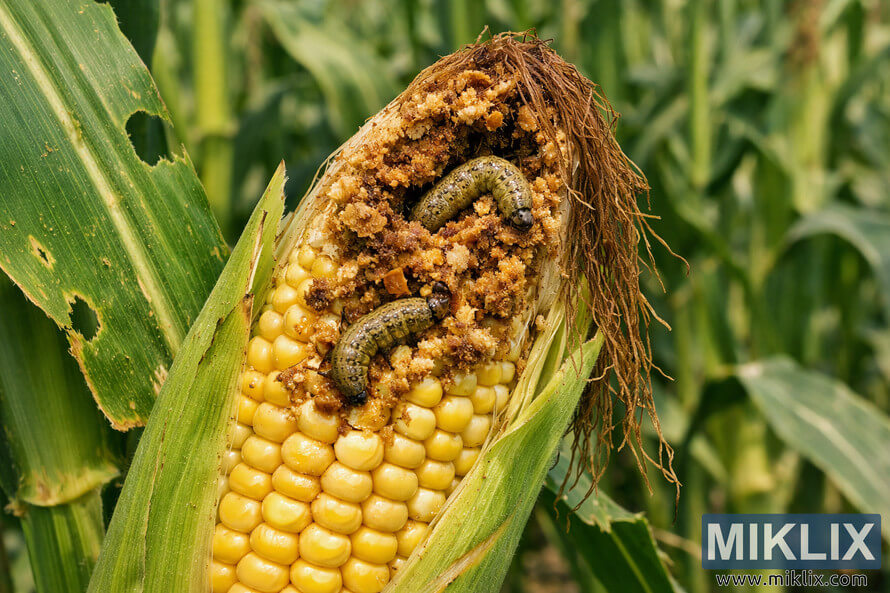
This pest ranks as the most serious threat to home garden corn. Adult moths lay eggs on fresh silk. Larvae hatch and crawl down silk into developing ears. Caterpillars feed on kernels at ear tips. Damage ruins eating quality and opens entry for disease.
Monitor silk emergence closely. Check ears every few days. Look for small caterpillars on silk. Apply mineral oil to silk tips 3 to 7 days after silk appears. Use eyedropper to place 20 drops inside silk channel. This smothers young larvae before they reach kernels. Repeat treatment every 3 days through silk browning.
Treatment Timing: Mineral oil treatment works only when applied at the right stage. Too early wastes effort because silk hasn't emerged. Too late allows larvae to reach kernels. The ideal window is 3 to 7 days after silk first appears.
Click or tap the image for more information and higher resolutions.
European Corn Borer
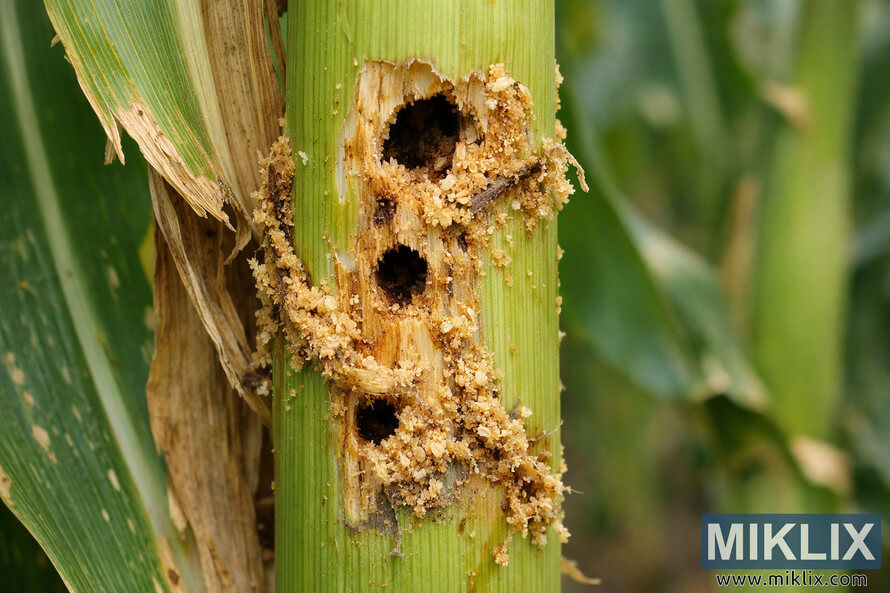
These caterpillars tunnel into stalks and ears. Entry holes appear on stalks. Sawdust-like frass accumulates at hole openings. Damage weakens stalks causing breakage. Ears show feeding damage around kernels. Bt (Bacillus thuringiensis) provides effective organic control.
Apply Bt spray when plants reach 18 inches tall. Repeat applications every 5 to 7 days. Continue through tasseling stage. Spray targets egg-laying sites on leaves and stalks. Bt kills young larvae before they bore inside plants. This organic bacteria harms only caterpillars.
Click or tap the image for more information and higher resolutions.
Corn Flea Beetles
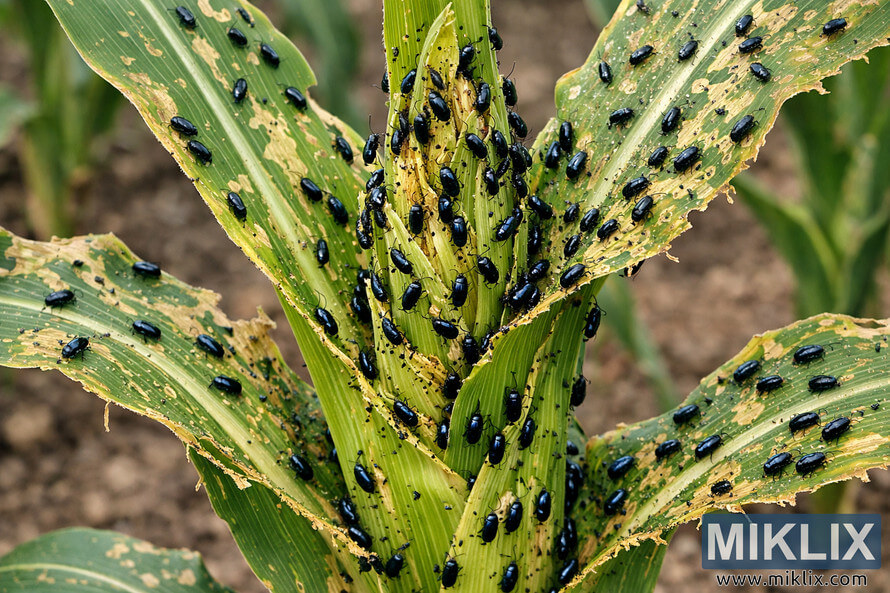
Tiny black beetles attack young seedlings. Adults chew small holes in leaves. Feeding creates a shot-hole appearance. Heavy infestations stunt or kill young plants. Beetles also spread bacterial wilt disease. This disease proves more damaging than direct feeding.
Row covers protect seedlings from beetles effectively. Install covers immediately after planting. Remove covers when plants reach knee height. Beetles move to other food sources by then. Diatomaceous earth dusted on seedlings provides additional protection. Reapply after rain or irrigation.
Click or tap the image for more information and higher resolutions.
Japanese Beetles
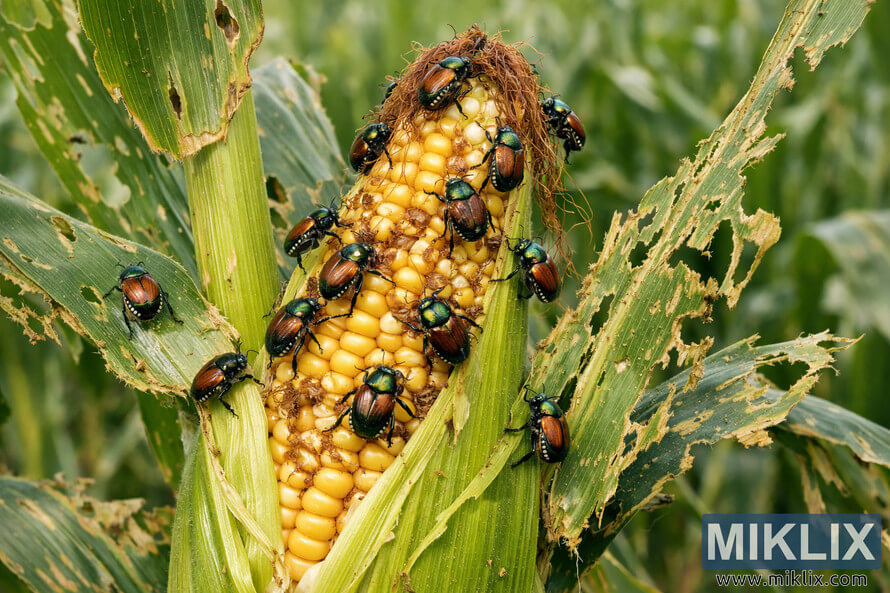
These metallic green and copper beetles skeletonize leaves. They feed on silk also. Large populations can completely destroy silk before pollination. Hand-picking controls small populations effectively. Collect beetles early morning when they move slowly. Drop into soapy water for disposal.
Milky spore disease controls beetle grubs in soil. Apply according to package directions. Results develop over 2 to 3 seasons. Neem oil spray repels adult beetles temporarily. Apply every 5 to 7 days during peak beetle season. Focus spray on silk to protect pollination.
Click or tap the image for more information and higher resolutions.
Aphids
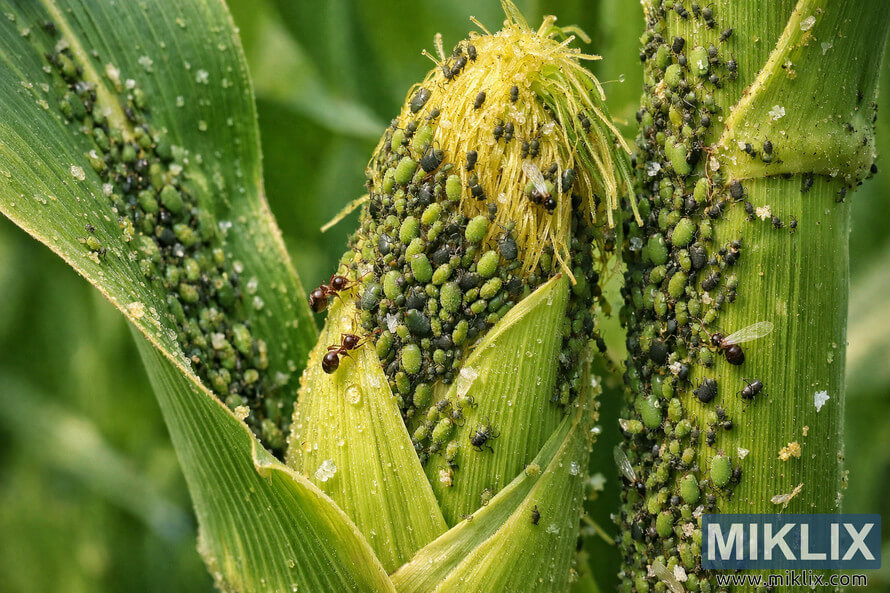
Small soft-bodied insects cluster on leaves and tassels. They suck plant sap weakening plants. Aphids excrete sticky honeydew. Black sooty mold grows on honeydew. Heavy infestations stunt growth significantly. Aphids also transmit viral diseases.
Strong water spray dislodges aphids effectively. Focus spray on undersides of leaves. Repeat every few days as needed. Ladybugs and lacewings feed on aphids naturally. Avoid broad-spectrum insecticides that kill beneficial insects. Insecticidal soap provides organic control for severe infestations.
Click or tap the image for more information and higher resolutions.
Prevention Strategies
- Plant early varieties to avoid peak pest periods
- Remove and destroy crop debris after harvest
- Rotate corn to different garden areas yearly
- Till soil in fall to expose overwintering pests
- Encourage beneficial insects with diverse plantings
- Monitor plants weekly for early pest detection
- Maintain plant health through proper care
Organic Control Options
- Bt spray for caterpillar pests (borers, earworms)
- Mineral oil for earworm prevention
- Row covers for flea beetle exclusion
- Neem oil for beetle repellent
- Insecticidal soap for soft-bodied insects
- Diatomaceous earth for crawling insects
- Hand-picking for large visible pests
Disease Prevention and Management
Fungal and bacterial diseases attack corn under favorable conditions. Moisture and humidity promote disease development. Cultural practices prevent most problems. Resistant varieties reduce disease pressure significantly.
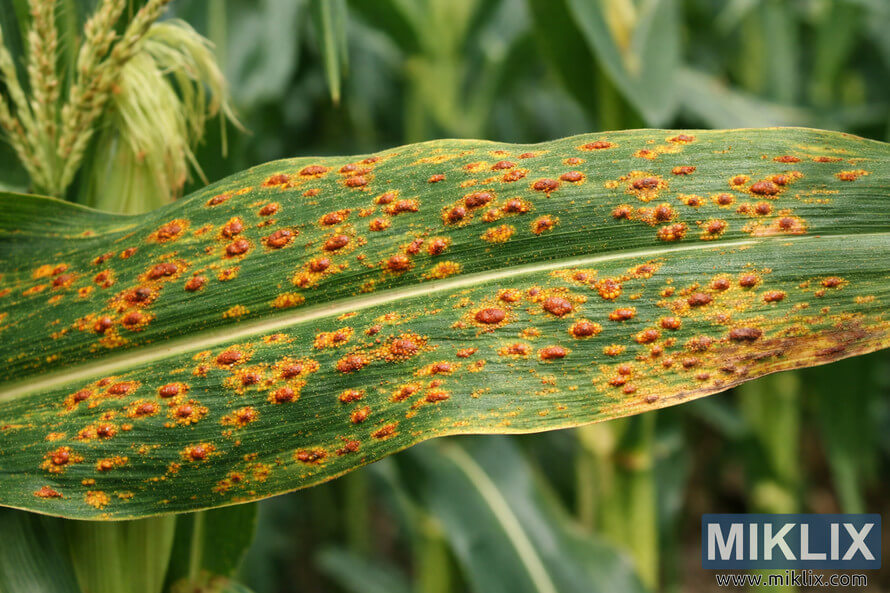
Common Rust
Small raised pustules appear on leaves. Pustules start yellow-orange, turning reddish-brown. Heavy infection reduces photosynthesis. Yields decrease from loss of leaf area. Humid weather with moderate temperatures favors development. Rust spreads rapidly between plants.
Plant resistant varieties in areas with rust history. Provide adequate spacing for air circulation. Avoid overhead watering that keeps foliage wet. Remove severely infected leaves. Sulfur-based fungicides provide organic control. Apply at first symptom appearance. Repeat every 7 to 10 days in wet weather.
Click or tap the image for more information and higher resolutions.
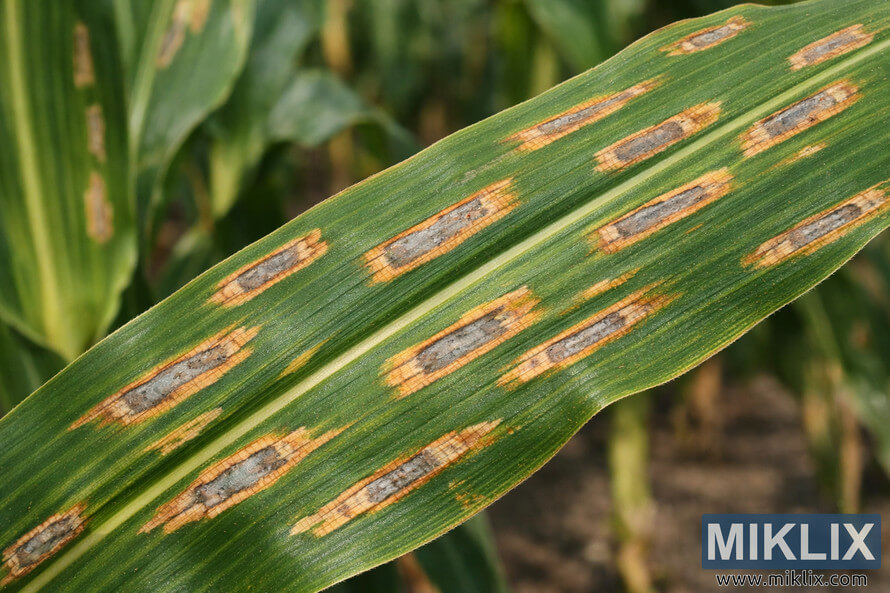
Gray Leaf Spot
Rectangular gray or tan lesions develop on leaves. Spots align parallel to leaf veins. Severe infection causes entire leaves to die. Disease thrives in hot, humid conditions. Fungus overwinters on corn debris in soil. Spores infect new plants the following season.
Practice crop rotation rigorously. Never plant corn in the same location consecutive years. Remove and destroy all corn debris after harvest. This eliminates overwintering fungus. Choose resistant hybrids for humid climates. Maintain good air circulation with proper spacing.
Click or tap the image for more information and higher resolutions.
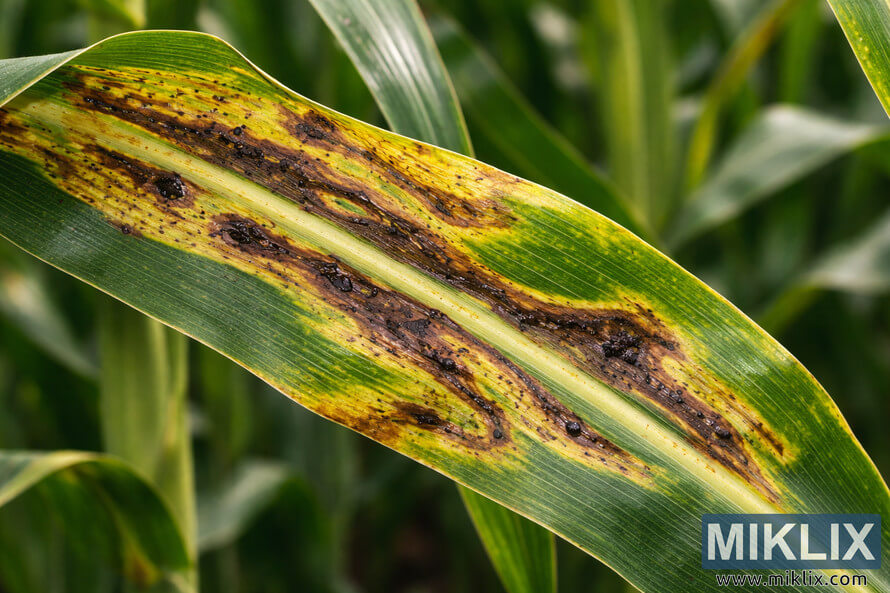
Stewart's Bacterial Wilt
This bacterial disease creates irregular yellow streaks on leaves. Streaks follow leaf veins. Entire leaves may wilt and die. Young plants often die completely. Flea beetles spread bacteria between plants. Disease severity relates to flea beetle population.
Control flea beetles to prevent disease spread. Use row covers on young plants. Plant later when flea beetle populations decline. Choose resistant sweet corn varieties. Several modern hybrids resist this disease. Remove infected plants immediately to prevent bacteria spread.
Click or tap the image for more information and higher resolutions.
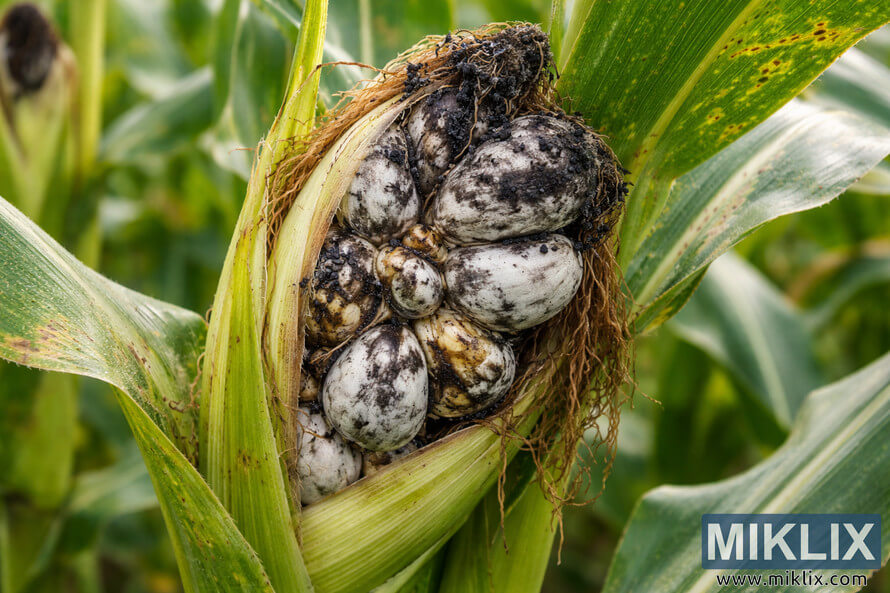
Corn Smut
Large grayish galls form on ears, tassels and stalks. Galls contain masses of black spores. This fungal disease looks alarming but rarely causes total loss. Individual galls can be removed safely. Some cultures consider young galls a delicacy.
Remove galls before they burst open. This prevents spore spread to other plants. Burn or deeply bury infected material. Fungus spores survive in soil for years. Rotate planting areas when smut appears. Avoid excess nitrogen fertilizer. High nitrogen increases smut susceptibility.
Click or tap the image for more information and higher resolutions.
| Disease | Symptoms | Favorable Conditions | Prevention | Organic Treatment |
| Common Rust | Orange-red pustules on leaves | Moderate temperature, high humidity | Resistant varieties, good spacing | Sulfur spray every 7-10 days |
| Gray Leaf Spot | Rectangular gray lesions on leaves | Hot, humid weather | Crop rotation, debris removal | Remove infected leaves, improve air flow |
| Stewart's Wilt | Yellow streaks, wilting | Warm winters, high flea beetle populations | Control flea beetles, use resistant varieties | Remove infected plants immediately |
| Corn Smut | Large grayish galls on plants | Hot weather, plant wounds | Avoid excess nitrogen, gentle cultivation | Remove galls before they open |
| Northern Corn Leaf Blight | Long tan lesions with dark borders | Cool, wet conditions | Resistant hybrids, crop rotation | Copper-based fungicide spray |
Wildlife Damage Prevention
Raccoons, deer and birds cause significant damage to corn. These animals possess excellent hearing and smell. They detect ripening corn from considerable distances. Protection requires multiple strategies working together.
Raccoon Control
Raccoons cause the most frustration for home gardeners. These intelligent animals learn quickly. They hear corn ripening and strike at night. Entire crops can be destroyed in single evening. Damage appears suddenly just before harvest.
Electric fencing provides most reliable protection. Install 2-wire system around corn patch. Place lowest wire 6 inches above ground. Second wire should be 12 inches high. Raccoons touch both wires when climbing. The shock trains them to avoid the area.
Alternative deterrents work with varying success. Radio playing talk stations may discourage visits. Motion-activated lights and sprinklers startle animals. Commercial raccoon repellents require frequent reapplication. Harvest corn promptly at peak ripeness. Don't leave ripe ears inviting extended visits.
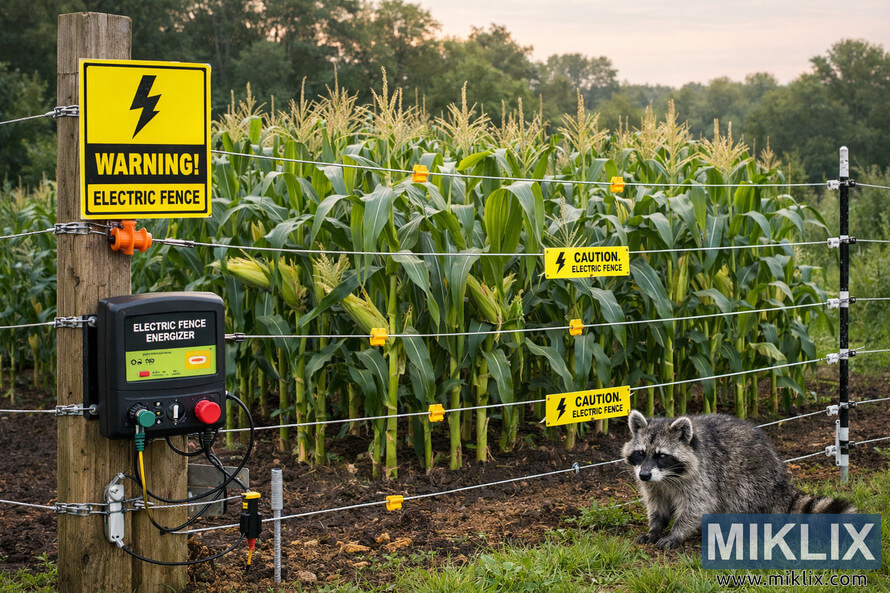
Click or tap the image for more information and higher resolutions.
Bird Deterrents
Birds peck kernels on ripening ears. Crows and blackbirds cause most problems. Damage often leads to secondary disease issues. Row covers protect developing ears effectively. Remove covers once kernels fully develop. Birds lose interest in mature ears.
Visual deterrents work temporarily. Reflective tape fluttering in wind scares birds. Predator decoys must move for effectiveness. Birds quickly learn stationary objects pose no threat. Relocate decoys every few days. Netting over ears provides complete protection.
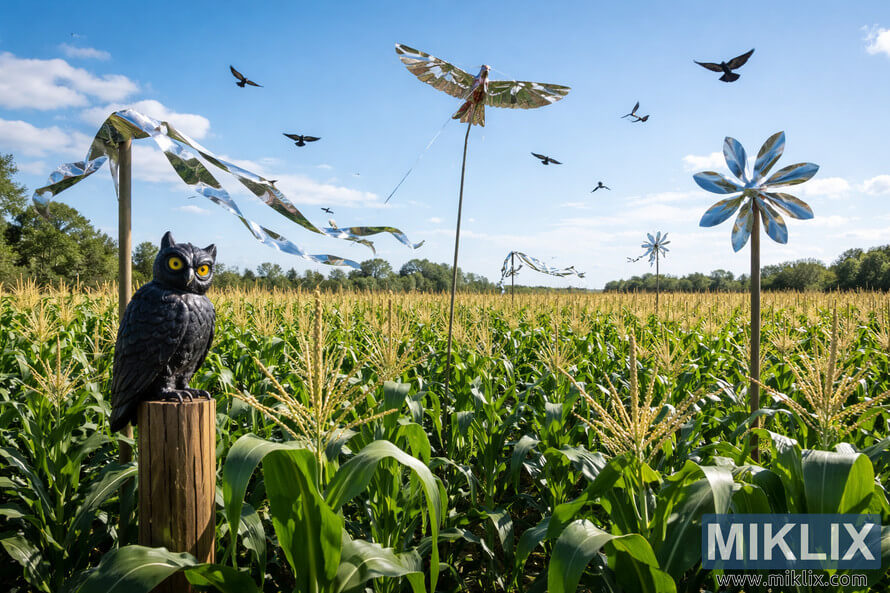
Click or tap the image for more information and higher resolutions.
Deer Management
Deer eat corn plants at any growth stage. They prefer young tender shoots but damage mature plants also. Standard garden fencing won't stop determined deer. They easily jump 6-foot barriers. Tall fencing or alternative designs become necessary.
Eight-foot woven wire fencing excludes deer completely. This solution requires significant investment. Double fence systems work at lower heights. Install two 4-foot fences spaced 3 feet apart. Deer won't jump when they can't see landing spot. Slanted single fence designs angle outward 45 degrees. Seven-foot height prevents jumping.
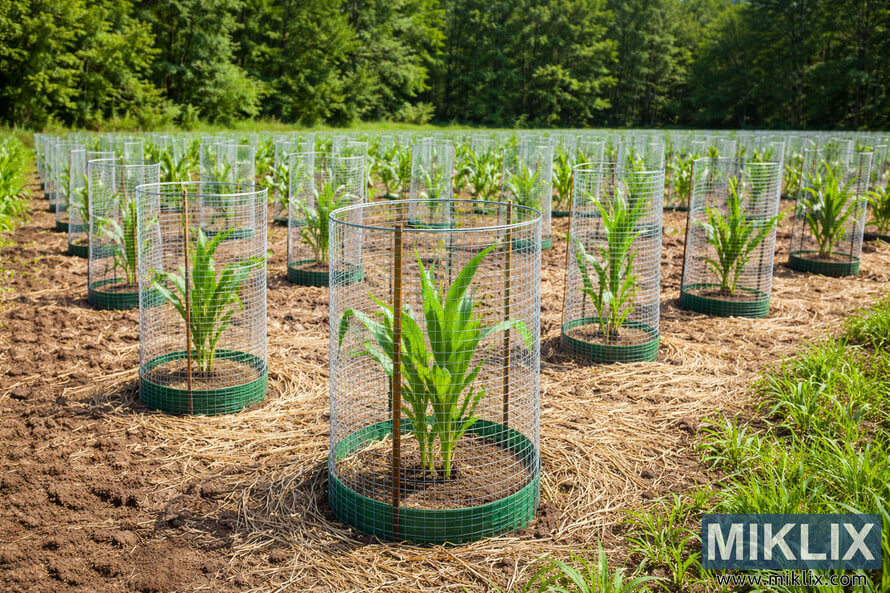
Click or tap the image for more information and higher resolutions.
Knowing When to Harvest for Peak Flavor and Quality
Perfect harvest timing maximizes corn sweetness and texture. Ears develop rapidly during final stages. A single day makes substantial quality difference. Learning harvest indicators ensures you pick at absolute peak. This skill separates average results from exceptional quality.
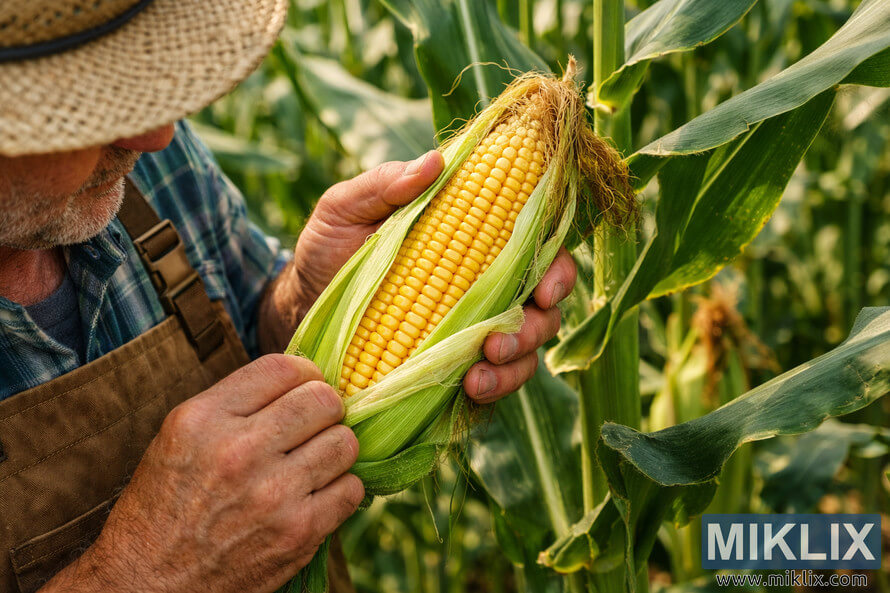
Click or tap the image for more information and higher resolutions.
Visual Indicators of Maturity
Several physical signs indicate approaching harvest time. Monitor ears closely as maturity date nears. Multiple indicators together confirm readiness. Relying on single sign may lead to premature or delayed harvest.
Silk Color Changes
Fresh silk emerges pale green to yellow-green. Color deepens as ears mature. Brown, dried silk signals approaching harvest readiness. Complete browning doesn't guarantee perfect ripeness. Additional checking confirms actual kernel development stage.
Time elapsed since silk emergence guides expectations. Most varieties require 18 to 24 days from silk to harvest. Count days from first silk appearance. Mark calendar or keep garden journal. This tracking improves timing accuracy over multiple seasons.
Ear Appearance and Feel
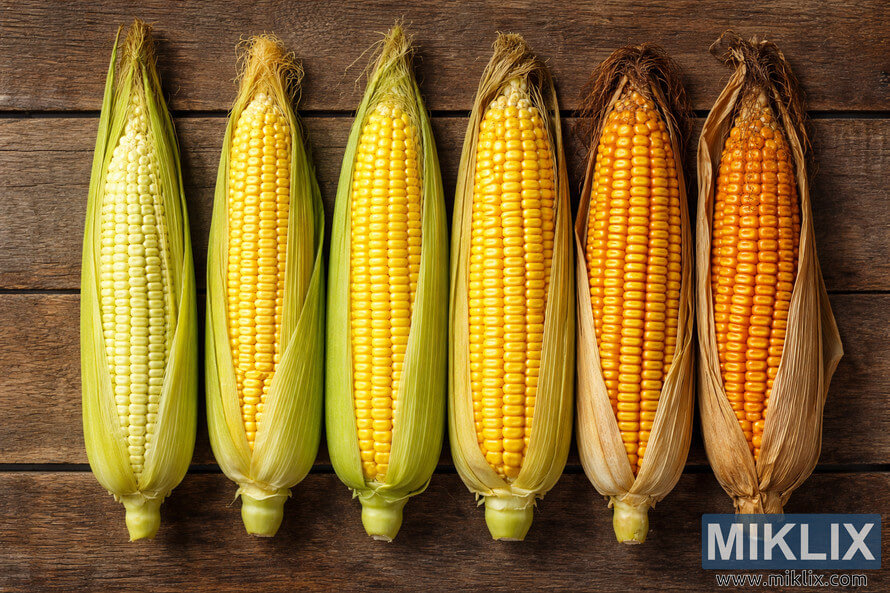
Mature ears feel full and rounded. Underdeveloped ears appear pointed or cylindrical. Gently squeeze ears through husks. Plump kernels create firm, filled-out feel. Gaps or soft spots indicate incomplete development. Kernels continue enlarging until final days before harvest.
Husk color transitions from bright green to slightly faded. Husks may develop brown tints at tips. This discoloration spreads downward as ears mature. However, husks remain mostly green at perfect harvest stage. Completely dried brown husks indicate over-maturity.
Click or tap the image for more information and higher resolutions.
The Fingernail Test for Perfect Ripeness
This traditional test accurately determines harvest readiness. Carefully peel back small section of husk. Expose several kernel rows. Press thumbnail firmly into single kernel. Observe liquid that emerges.
Interpreting Test Results
Clear watery liquid indicates immature kernels. Sugar content remains low. Texture will be too firm and starchy. Wait 3 to 5 more days before testing again. Ears need additional development time.
Milky white liquid signals perfect harvest timing. This stage captures maximum sugar before starch conversion begins. Kernels offer ideal tenderness. Sweet flavor peaks at this moment. Harvest immediately for best quality. Don't delay once this stage appears.
Thick pasty liquid or no liquid means overripe kernels. Starch has replaced sugars. Kernels become tough and chewy. Flavor diminishes significantly. These ears work for animal feed but disappoint for table use. Harvest promptly but expect reduced quality.
Harvest Window: Perfect eating quality lasts only 3 to 5 days. After the milk stage appears, sugar content decreases daily. Starch increases simultaneously. Plan to process or consume corn within hours of picking for absolute best quality.
Time of Day Matters
Harvest timing affects sweetness levels noticeably. Sugar content fluctuates throughout the day. Understanding these changes helps maximize quality. Early morning picking captures corn at its absolute sweetest.
Morning Harvest Advantages
Plants accumulate sugars overnight. Cool temperatures slow sugar-to-starch conversion. Morning ears contain peak sweetness levels. Harvest before temperatures climb above 70 degrees. This typically means picking before 10 AM during summer.
Morning corn also feels crisper and fresher. Plant tissues contain maximum moisture. Kernels snap cleanly when bitten. This texture quality deteriorates as day progresses. Heat and sun exposure cause moisture loss and texture changes.
Proper Harvesting Technique
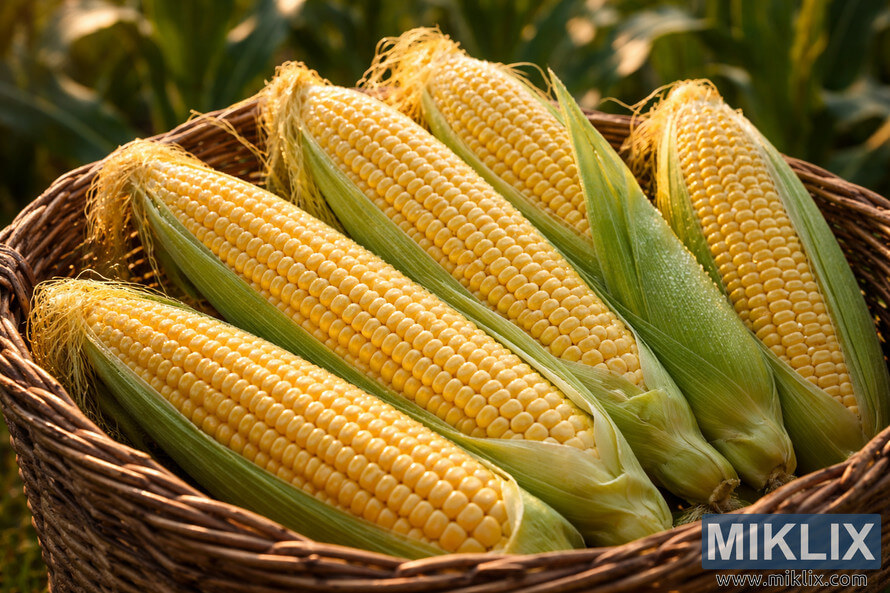
Grasp ear firmly near base. Bend downward sharply while twisting. Ear snaps cleanly from stalk at attachment point. Avoid pulling straight away from plant. This can uproot or damage stalks unnecessarily. One quick motion removes ear completely.
Harvest only what you'll use immediately. Each hour after picking decreases quality. Sugar converts to starch continuously. Flavor and texture decline rapidly. Standard varieties lose half their sugar within 24 hours at room temperature. Refrigeration slows but doesn't stop conversion.
Click or tap the image for more information and higher resolutions.
Extending Harvest Period
Several strategies provide fresh corn over extended time. Planning and timing create continuous supply. This approach prevents feast-or-famine harvest patterns common with single plantings.
Succession Planting Schedule
Plant new sections every 2 weeks throughout the season. Each planting matures at different time. This staggers harvest over months instead of days. Start first planting at appropriate date for your region. Make second planting 2 weeks later. Continue until 90 days before fall frost.
Calculate final planting date carefully. Count backwards from expected first frost. Subtract variety maturity days plus 10-day safety margin. This determines latest safe planting date. Later plantings risk frost damage before maturity.
Multiple Variety Strategy
Plant early, mid-season and late varieties simultaneously. Each type matures at different pace. Early varieties harvest first. Mid-season types follow weeks later. Late varieties finish the season. Single planting date produces month-long harvest period.
Choose varieties carefully for this approach. Ensure all types suit your climate. Verify sufficient frost-free days for latest variety. This method works especially well in regions with long growing seasons. Northern gardeners should emphasize early and mid-season types.
Early Season Harvest (60-70 Days)
- Expect smaller ear size than later varieties
- Perfect for short season climates
- Allows multiple succession plantings
- Generally more cold-tolerant at planting
- Ideal for first harvest of season
Late Season Harvest (85-100 Days)
- Produces largest ears with most rows
- Often superior flavor development
- Requires long frost-free period
- Best for single-variety plantings
- Finishes garden season strong
Yield Expectations
Understanding realistic yields helps with planning. Garden corn produces differently than commercial fields. Plant spacing and care level affect results significantly. Home gardens typically achieve higher per-plant yields than agriculture.
Per-Plant Production
Most corn plants produce one mature ear suitable for eating. Some vigorous varieties develop second smaller ear. This ear often matures several days later than primary ear. Both ears reach eating quality under ideal conditions. Adequate spacing and fertility increase two-ear production.
Calculate expected yield by counting plants. Assume one ear per plant for planning. Multiply plant count by 0.8 for conservative estimate. This accounts for pollination failures and pest losses. Add bonus ears as pleasant surprises rather than counting on them.
| Garden Size | Plants | Conservative Yield | Optimistic Yield | Servings |
| Small Block (4×6 plants) | 24 plants | 20 ears | 30 ears | 10-15 meals for family of 4 |
| Medium Block (4×12 plants) | 48 plants | 40 ears | 60 ears | 20-30 meals for family of 4 |
| Large Block (6×16 plants) | 96 plants | 80 ears | 120 ears | 40-60 meals for family of 4 |
| Extra Large (8×20 plants) | 160 plants | 130 ears | 200 ears | 65-100 meals for family of 4 |
Tips for Storing and Using Your Homegrown Corn
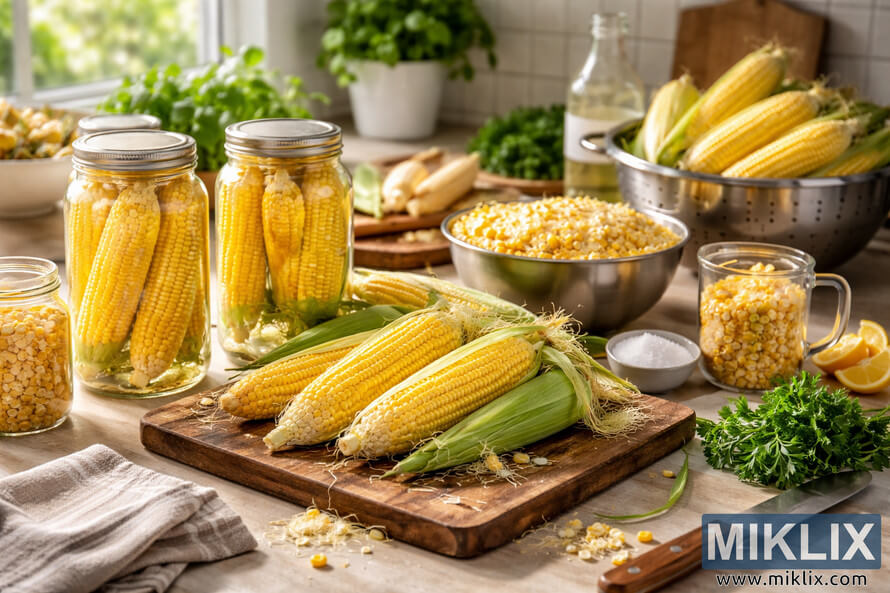
Preserving corn quality after harvest requires prompt action. Every hour delays processing, quality declines. Multiple preservation methods suit different uses. Understanding each technique maximizes your harvest value. Proper storage extends enjoyment of homegrown corn for months.
Click or tap the image for more information and higher resolutions.
Short-Term Storage Methods
Fresh corn maintains best quality for limited time. Even refrigeration only slows quality loss. Use these methods when consuming within several days. Speed remains crucial for preserving sweetness and texture.
Immediate Refrigeration
Place unhusked corn directly in refrigerator after harvest. Leave husks intact during storage. This natural packaging protects kernels and retains moisture. Store in plastic bag to maintain humidity. Corn keeps 3 to 5 days this way. Quality decreases daily even under refrigeration.
Sugar-enhanced varieties store better than standard types. Enhanced sugars convert to starch more slowly. Supersweet varieties retain quality longest. These can maintain acceptable quality up to one week refrigerated. Standard varieties should be used within 2 days for best flavor.
Ice Water Storage
This restaurant technique extends quality several additional hours. Fill large container or cooler with ice water. Submerge unhusked ears completely. Keep container in refrigerator or cool location. Change ice as it melts. This super-chills corn stopping sugar conversion almost completely. Works for 12 to 24 hours maximum.
Freezing for Long-Term Storage
Freezing preserves corn quality for 8 to 12 months. Proper technique maintains flavor and texture remarkably well. Blanching before freezing remains essential. This process stops enzyme activity that causes quality loss during frozen storage.
Blanching Procedure
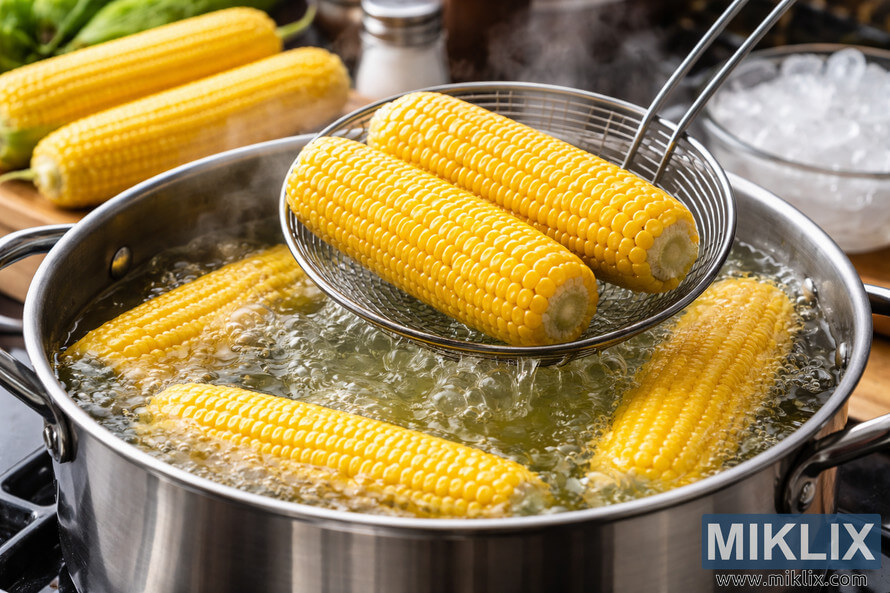
Bring large pot of water to rolling boil. Remove husks and silk from corn completely. Plunge ears into boiling water. Small ears require 7 minutes. Medium ears need 9 minutes. Large ears demand 11 minutes. Time exactly for best results.
Prepare ice bath in large container before blanching. Fill with half ice, half water. Transfer blanched corn immediately to ice bath. Cool completely, approximately same time as blanching. This rapid cooling stops cooking process. Remove ears and drain thoroughly.
Click or tap the image for more information and higher resolutions.
Whole Ear Freezing
Wrap each blanched ear individually in plastic wrap. Place wrapped ears in freezer bags. Remove as much air as possible before sealing. Label bags with variety and date. Stack flat in freezer for efficient storage. Whole ears work perfectly for grilling or roasting after thawing.
Alternatively, use vacuum sealer for superior results. Vacuum-sealed corn resists freezer burn longer. Quality remains excellent for full year. Initial equipment investment pays dividends for serious preservers.
Cut Corn Freezing
Remove kernels from cob after blanching and cooling. Use sharp knife to cut down length of cob. Rotate ear and repeat around circumference. Scrape cob with back of knife. This releases remaining kernel pieces and sweet milk.
Package cut kernels in measured portions. Pint or quart freezer bags work well. Flatten bags before freezing for quick thawing later. Label with quantity and date. Spread bags flat in freezer initially. Stack after completely frozen. Cut corn thaws quickly for use in recipes.
Freezing Advantages
- Retains flavor exceptionally well
- Simple process requiring basic equipment
- Works for all corn varieties equally
- Storage lasts 8 to 12 months
- Maintains nutritional value effectively
- Convenient single-serving portions possible
Freezing Limitations
- Requires blanching step before freezing
- Texture slightly softer than fresh
- Demands adequate freezer space
- Power outages risk loss of stored corn
- Best used within one year
- Cannot freeze raw corn successfully
Canning for Shelf-Stable Storage
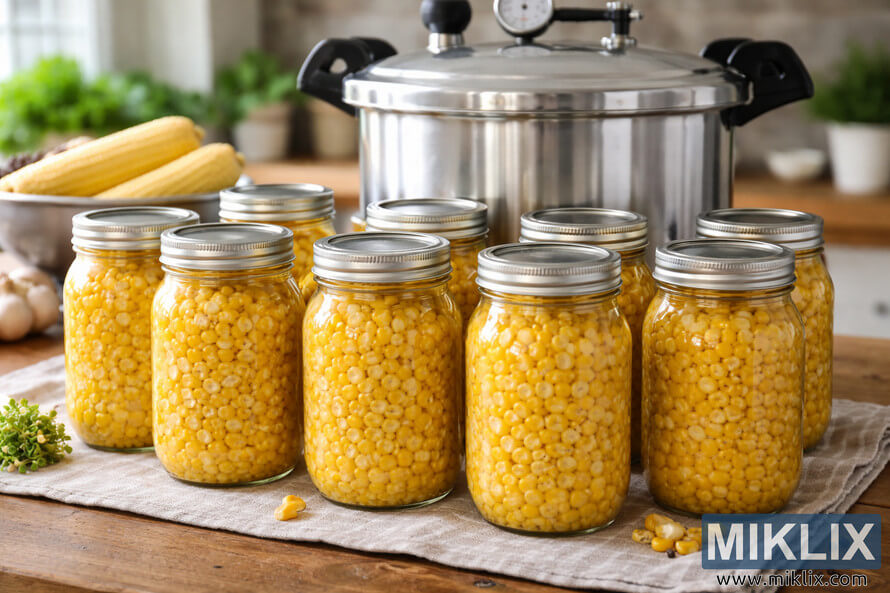
Canning creates shelf-stable corn lasting several years. This method requires pressure canner. Corn is low-acid food requiring high-temperature processing. Water bath canning is unsafe for corn. Pressure canning prevents botulism risk completely.
Whole Kernel Canning
Cut kernels from blanched ears. Pack raw kernels into clean pint jars. Leave 1-inch headspace at top. Add 1 teaspoon salt per pint if desired. Pour boiling water over kernels. Maintain 1-inch headspace. Remove air bubbles with knife or spatula.
Wipe jar rims clean. Apply lids and bands finger-tight. Process in pressure canner at 10 pounds pressure. Pints require 55 minutes. Quarts need 85 minutes. Adjust pressure for altitude. Allow canner to depressurize naturally. Remove jars and cool completely. Check seals before storing.
Safety Warning: Never attempt to can corn using water bath method. Corn requires pressure canning to reach temperatures that destroy dangerous bacteria. Always follow current USDA guidelines for safe home canning practices.
Cream-Style Corn Canning
Cut kernels from cob at half depth. Scrape remaining kernels and milk with back of knife. Combine with half volume water or corn liquid. Heat mixture to boiling. Pack hot into clean jars. Leave 1-inch headspace. Process pints 85 minutes at 10 pounds pressure.
Cream-style corn makes convenient winter side dish. Texture resembles commercial canned corn. Flavor surpasses store-bought versions dramatically. Use in casseroles, soups and traditional recipes calling for canned corn.
Click or tap the image for more information and higher resolutions.
Drying and Dehydrating
Dried corn creates concentrated flavor for specific uses. This preservation method produces entirely different product. Dried corn rehydrates for use in soups and stews. Grinding creates cornmeal for baking. Dehydrating saves significant freezer space.
Dehydrator Method
Blanch corn as for freezing. Cut kernels from cobs completely. Spread in single layer on dehydrator trays. Set temperature to 125 degrees Fahrenheit. Dry until kernels feel hard and brittle. This requires 8 to 12 hours typically. Rotate trays periodically for even drying.
Cool dried corn completely before packaging. Store in airtight containers. Glass jars work excellently. Keep in cool, dark location. Properly dried corn stores 1 year or longer. Rehydrate by soaking in water several hours before using.
Oven Drying Alternative
Set oven to lowest temperature setting. Spread blanched kernels on baking sheets. Place in oven leaving door slightly open. This allows moisture to escape. Stir kernels every hour. Drying takes 6 to 10 hours depending on oven temperature. Test for brittleness before removing.
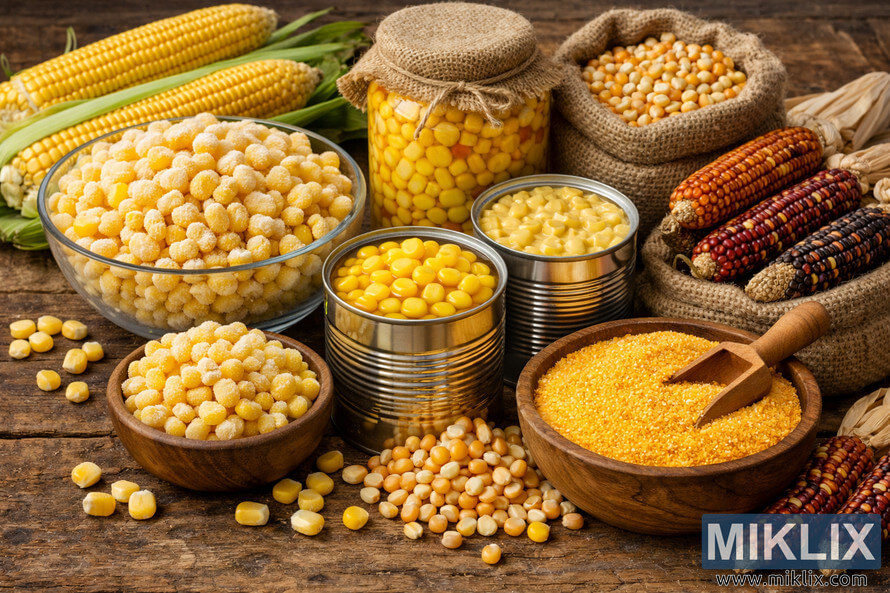
Creative Uses for Preserved Corn
Preserved corn brings summer flavors to winter meals. Each preservation method suits different preparations. Understanding best uses for each type maximizes your stored harvest value.
Frozen Whole Ears
- Thaw and grill for summer flavor anytime
- Roast in oven for side dish
- Microwave for quick corn on the cob
- Cut from cob while frozen for stir-fry
- Add to summer vegetable medleys
Best for: Recipes requiring corn on the cob presentation or grilled corn flavor.
Frozen Cut Kernels
- Add directly to soups without thawing
- Mix into cornbread or muffin batter
- Create corn salsa or relish
- Include in casseroles and pot pies
- Make succotash with lima beans
Best for: Recipes requiring measured amounts of corn kernels or quick preparation.
Canned Corn
- Emergency food supply requiring no power
- Traditional corn casseroles
- Quick side dish for weeknight meals
- Camping and travel food
- Corn chowder base ingredient
Best for: Shelf-stable storage and traditional home-canned corn recipes.
Dried Corn
- Rehydrate for hearty winter soups
- Grind into fresh cornmeal
- Make traditional posole
- Add to trail mix combinations
- Create unique popcorn alternatives
Best for: Space-efficient storage and specialty corn products like cornmeal.
Click or tap the image for more information and higher resolutions.
Troubleshooting Common Corn Growing Problems
Even experienced gardeners encounter challenges growing corn. Understanding common problems helps you respond effectively. Quick diagnosis prevents minor issues from becoming crop failures. Most problems have simple solutions when caught early.
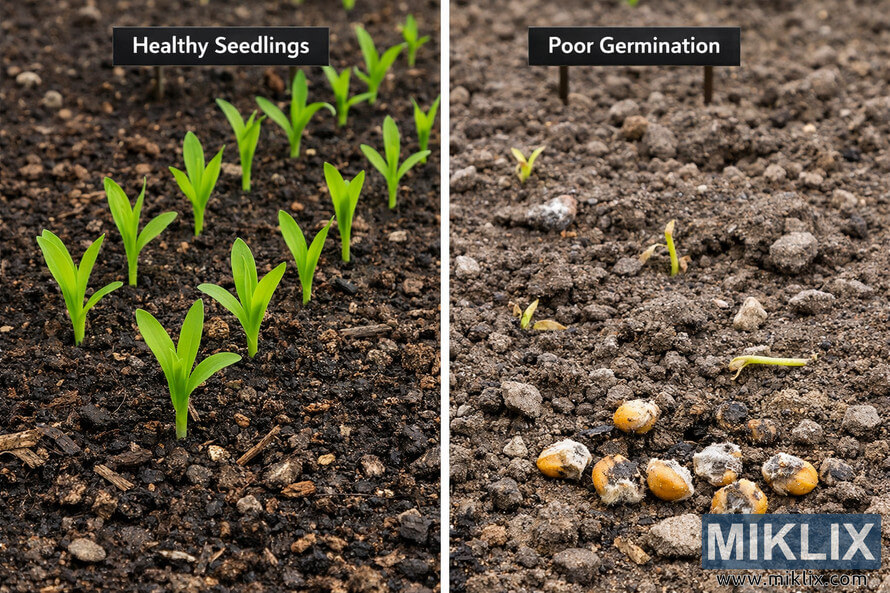
Poor Germination Issues
Seeds fail to emerge for various reasons. Cold, wet soil causes most germination failures. Corn seeds rot before sprouting in these conditions. Soil temperature below 60 degrees Fahrenheit creates problems. Seeds may sit dormant for weeks without germinating.
Solutions for Germination Problems
Wait for proper soil temperature before planting. Test with soil thermometer at 2-inch depth. Take readings in morning when soil is coolest. Plant only when temperature consistently reaches 60 degrees or higher. Use black plastic mulch to warm soil faster in spring.
Improve soil drainage in areas where water stands. Raised beds solve many cold, wet soil problems. Work organic matter into heavy clay soils. This improves both drainage and warming characteristics. Consider starting supersweet varieties indoors. Transplant carefully when outdoor conditions improve.
Click or tap the image for more information and higher resolutions.
Incomplete Ear Fill and Missing Kernels
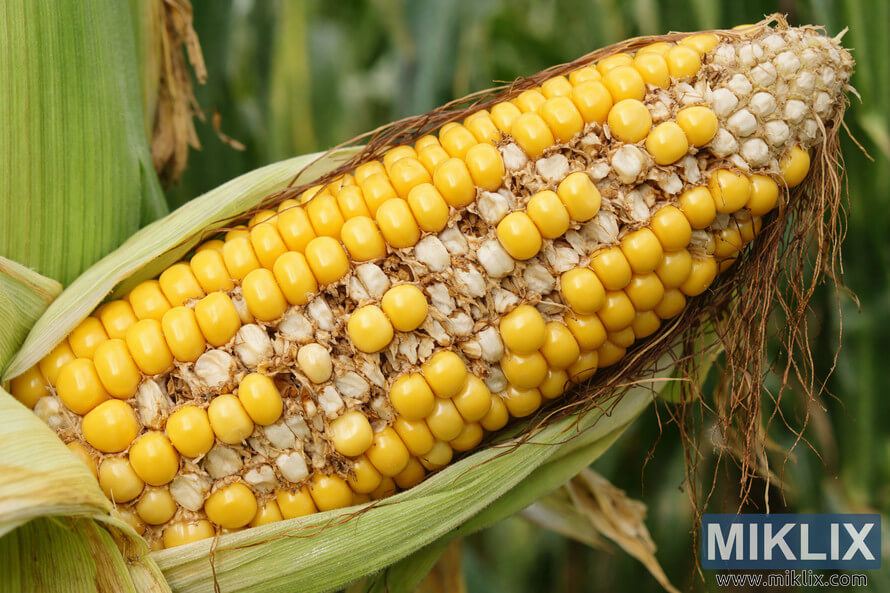
Ears with gaps or missing kernels indicate pollination failure. This ranks among most disappointing corn problems. Several factors interfere with successful pollination. Understanding causes helps prevent future occurrences.
Pollination Problem Causes
Poor block configuration creates insufficient pollen availability. Single rows lack adequate pollination sources. Wind must carry pollen from nearby tassels to silk. Isolated plants or long rows reduce successful pollination. Drought stress during pollination period interferes with pollen viability and silk receptiveness.
Extreme heat above 95 degrees damages pollen. Cool temperatures below 55 degrees reduce pollen release. Each of these conditions creates gaps in kernel development. Timing mismatches between pollen shed and silk emergence cause problems. Early silk emerges before pollen releases. Late silk appears after pollen finishes.
Preventing Pollination Failures
Always plant corn in blocks rather than single rows. Minimum block should contain 4 rows with 4 plants each. Larger blocks improve pollination success rates. Space plants properly allowing good air circulation. Crowded plants interfere with pollen movement.
Maintain consistent soil moisture during tasseling and silk stages. This 2-week period determines kernel development. Even brief drought stress reduces pollination success. Water deeply twice weekly during this critical time. Mulch helps maintain even soil moisture.
Hand pollinate during unfavorable weather conditions. Collect pollen from tassels in paper bag. Shake tassels vigorously to release pollen. Immediately sprinkle pollen onto fresh silk. Repeat daily for 3 days. This ensures pollination despite weather challenges.
Click or tap the image for more information and higher resolutions.
Stunted Plant Growth
Plants remaining small despite adequate time indicate problems. Multiple factors cause stunted growth. Identifying specific cause guides proper correction. Most causes relate to soil conditions or nutrient deficiencies.
Diagnosing Growth Problems
Check soil pH first when plants appear stunted. Corn grows poorly outside the 6.0 to 6.8 pH range. Nutrients become unavailable at incorrect pH levels. Test soil and adjust if necessary. Lime raises pH. Sulfur lowers pH. Both require time to take effect.
Nitrogen deficiency causes most growth stunting. Lower leaves turn yellow while upper leaves remain green. Growth slows dramatically. Apply nitrogen-rich fertilizer immediately. Blood meal or fish emulsion provides quick results. Side-dress along rows away from stems. Water thoroughly after application.
Compacted soil restricts root development. Roots cannot penetrate hard layers. Plants remain stunted regardless of fertility. Work organic matter deeply into soil. This improves structure over time. Use broadfork to break up compacted layers without inverting soil.
Stalk Breakage and Lodging
Corn stalks breaking or falling over ruins crops. This problem increases as ears mature and plants get heavier. Several factors contribute to weak stalks. Prevention works better than trying to salvage fallen plants.
Causes of Weak Stalks
Nitrogen excess creates lush, weak growth. Plants develop thick leaves but thin stalks. They cannot support their own weight. Reduce nitrogen application rates. Focus on balanced fertilization. Potassium strengthens cell walls and stalk structure.
Shallow root development makes plants unstable. This results from frequent shallow watering. Roots stay near surface seeking moisture. Deep, infrequent watering encourages deep roots. These anchor plants better against wind. Water thoroughly wetting soil 12 inches deep.
Corn borers tunnel into stalks weakening structure. Damaged stalks break easily. Control borers with Bt spray applications. Start treatments early before larvae enter stalks. Prevention stops damage before it begins.
Supporting Fallen Plants
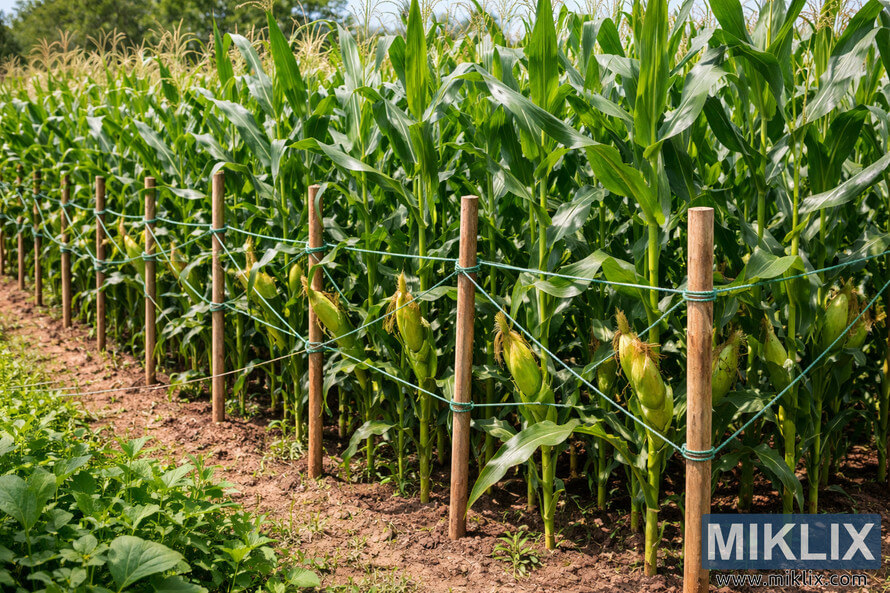
Stake individual plants if they begin leaning. Drive stakes near plants without damaging roots. Tie stalks loosely to stakes using soft material. This prevents constriction as stalks grow. Hill soil around base of plants. Extra soil coverage encourages additional support roots to develop.
Click or tap the image for more information and higher resolutions.
Unusual Ear Development Problems
Sometimes ears develop abnormally even with proper care. Understanding these oddities helps you respond appropriately. Most unusual developments don't indicate serious problems. However, some signal conditions requiring attention.
Multiple Ear Development
Some plants produce two or even three ears. The primary ear develops normally. Secondary ears often remain smaller. This occurs on vigorous plants with excellent growing conditions. Allow both ears to mature if plant appears healthy. Remove extra ears only if plant shows stress. Removing secondary ears doesn't improve primary ear quality significantly.
Tassels on Ears
Occasionally tassels emerge from developing ears. This results from environmental stress during ear formation. Temperature extremes, drought or nutrient imbalance triggers this. Ears usually develop normally despite tassel presence. The unusual development rarely affects quality. Remove tassels if they interfere with silk emergence.
Nubbin Ears
Tiny ears with few kernels develop from pollination failure. Poor weather during critical period causes nubbins. Drought stress prevents normal ear development. Plants under severe stress produce only tiny ears. These nubbins won't improve with time. Remove them to redirect plant energy. Focus on preventing stress during next season.
Why do my corn leaves have brown edges?
Brown leaf edges typically indicate potassium deficiency or drought stress. Potassium deficiency causes yellowing followed by browning on leaf margins. Older leaves show symptoms first. Apply greensand or kelp meal to correct deficiency. Drought stress creates similar symptoms. Ensure consistent deep watering, especially during hot weather. Check soil moisture regularly at 4 to 6 inch depth.
Can I save seeds from my hybrid corn for next year?
Saving seeds from hybrid corn produces unpredictable results. Hybrids result from crossing two parent varieties. Second generation plants revert to parent characteristics. Ears will vary in size, maturity and quality. Yields typically decrease significantly. Open-pollinated and heirloom varieties breed true from saved seed. Choose these if seed saving interests you. Hybrid vigor benefits only last one generation.
How do I know if my corn has corn smut?
Corn smut creates distinctive grayish galls on any plant part. Galls appear on ears, stalks, tassels or leaves. They start small and swell dramatically. Young galls look whitish-gray and feel firm. Mature galls turn black as spores develop. Galls eventually burst releasing powdery black spores. Remove and destroy galls before they open. This prevents spreading spores to other plants. Some cultures consider young galls a delicacy.
Why are my corn plants growing tillers?
Tillers are shoots growing from plant base. Some varieties naturally produce more tillers than others. Adequate spacing and fertility increase tiller production. Tillers rarely produce harvestable ears. They do contribute pollen for main stalk pollination. Leave tillers attached unless they crowd neighboring plants. Removing tillers doesn't improve main stalk ear production. Extra tillers indicate healthy, vigorous plants.
What causes purple-colored corn seedlings?
Purple coloration in young corn indicates phosphorus deficiency. This commonly appears in cold soil conditions. Cool temperatures prevent roots from absorbing phosphorus effectively. Seedlings often grow out of purple stage as weather warms. Apply phosphorus-rich fertilizer like bone meal if color persists. Ensure soil temperature reaches 60 degrees or higher. Purple coloration early in season usually doesn't affect final yield.
Your Journey to Corn Growing Success
Growing corn successfully combines science and art. Understanding plant requirements provides the foundation. Attention to detail during critical periods determines results. Each season teaches new lessons about your specific garden conditions. Success improves with experience and observation.
Start with proper variety selection for your region. Prepare soil thoroughly before planting time. Plant in blocks rather than single rows. Maintain consistent moisture throughout the growing season. Feed plants adequately to support rapid growth. Monitor for pests and diseases regularly. Harvest at peak ripeness for maximum quality.
Click or tap the image for more information and higher resolutions.
Fresh homegrown sweet corn rewards your efforts magnificently. The flavor difference compared to store-bought corn amazes most gardeners. This motivates continued cultivation and improvement. Share your success with neighbors and friends. Fresh corn makes welcome gifts during summer months.
Keep records of varieties planted and results achieved. Note planting dates, weather patterns and harvest dates. These records guide future season planning. Over time you'll identify varieties performing best in your specific conditions. Your corn growing skills will improve each year.
The satisfaction of growing your own food extends beyond taste. You control growing methods completely. Organic production becomes simple in home gardens. You know exactly what went into raising your crop. This knowledge brings peace of mind with every ear consumed.
Further Reading
If you enjoyed this post, you may also like these suggestions:
- A Guide to the Best Varieties of Serviceberry Trees to Plant in Your Garden
- Growing Raspberries: A Guide to Juicy Homegrown Berries
- A Guide to Growing Fennel in Your Own Garden