
Hops in Beer Brewing: Eastern Gold
Published: December 25, 2025 at 11:12:59 AM UTC
Eastern Gold hops are a Super Alpha hop variety developed by Kirin Brewing Co. Ltd Hop Research Farm in Japan. This strain was bred to replace Kirin No. 2 with higher alpha-acid levels. It aims to preserve the clean bitterness brewers expect from Japanese hops.
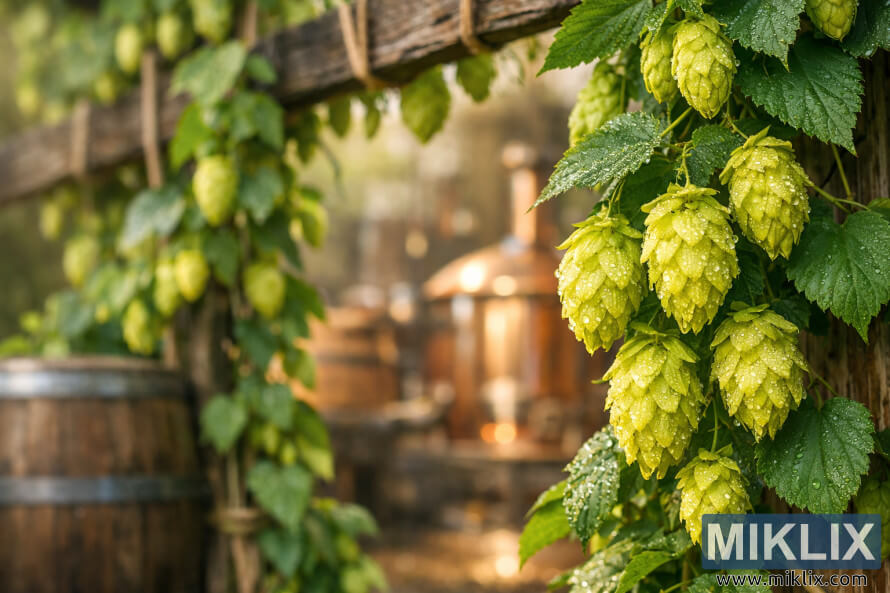
Click or tap the image for more information and higher resolutions.
The Eastern Gold hop variety traces its lineage to Kirin No. 2 and OB79, an open-pollinated wild American hop. Its parents include C76/64/17 and USDA 64103M. This genetic background reflects an effort to combine reliable bittering performance with robust agronomic traits.
Though the chemical and field attributes of Eastern Gold look promising for commercial brewing hops, the variety does not appear widely cultivated today. Still, its profile makes it worth examining for brewers interested in historic Japanese hops and high-alpha bittering options.
Key Takeaways
- Eastern Gold is a Super Alpha hop developed by Kirin in Japan for bittering precision.
- The pedigree includes Kirin No. 2 and open‑pollinated American wild hop lines.
- It was bred as a higher-alpha replacement while keeping Japanese hops' clean bitterness.
- Commercial plantings are limited despite solid agronomic and chemical traits.
- Brewers exploring Japanese hops or high-alpha bittering varieties should study Eastern Gold.
Overview of Eastern Gold hops
Eastern Gold hails from Iwate, Japan, and was bred by Kirin Brewery Ltd. Hop Research Farm. This brief overview underscores its status as a high-alpha bittering hop among Japanese varieties.
Alpha acids range from 11.0–14.0%, categorizing Eastern Gold as a super alpha hop ideal for early boil additions. Beta acids are near 5.0–6.0, with cohumulone making up about 27% of total alpha acids.
Oils are present in about 1.43 mL per 100 g. It matures late in the season, with vigorous growth and good to very good yield potential in trials.
Disease tolerance is moderate, showing relative resistance or tolerance to downy mildew. Commercial status remains limited, with little large-scale cultivation and sparse flavor documentation.
- Origin: Iwate, Japan; Kirin Brewery research
- Primary purpose: bittering hop
- Alpha acids: 11.0–14.0% (super alpha hops)
- Beta acids: 5.0–6.0
- Total oil: 1.43 mL/100 g
- Growth: very high rate, good yield potential
- Disease tolerance: moderately resistant to downy mildew
- Commercial use: limited historical cultivation and notes
This hop profile summary is a concise guide for brewers. It's useful for assessing Eastern Gold for bittering roles, experimental batches, or blending with more aromatic varieties.
Botanical lineage and development history
Eastern Gold's origins are rooted in Kirin Brewing Co. Ltd Hop Research Farm in Iwate, Japan. The goal was to create a hop with higher alpha acids, mirroring Kirin No. 2's flavor. Breeders crossed Kirin No. 2 with various lines to achieve this.
Significant crosses included OB79, a wild American hop, and C76/64/17 selections. USDA 64103M, a wild American hop from Wye College in England, was also used. These inputs defined Eastern Gold's lineage and genetic profile.
The breeding of Eastern Gold was part of a broader effort by Kirin. This included the development of Toyomidori and Kitamidori. The aim was to create a reliable bittering hop with high alpha acids for brewers. Trials focused on yield, alpha stability, and adaptability to Japanese conditions.
Records on Eastern Gold's development come from USDA variety descriptions and ARS/USDA cultivar files. It was primarily released for research and breeding, not for widespread commercial use. Thus, cultivation records are limited.
Though its historical use in brewing is rare, Eastern Gold's lineage is crucial for breeders seeking bittering alternatives. The blend of Kirin No. 2, OB79, and USDA 64103M showcases a strategic mix of Japanese and wild American traits. This blend is key to its development history and future breeding possibilities.
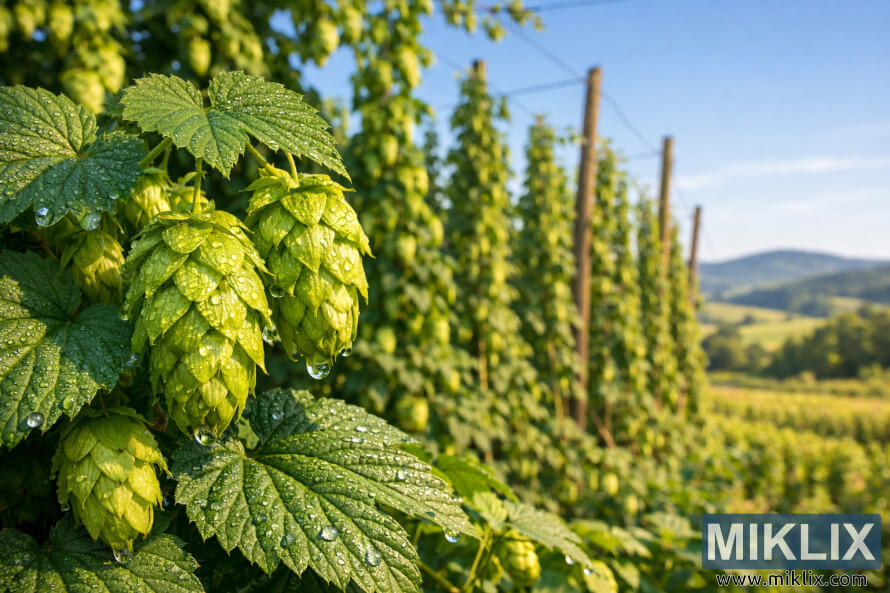
Click or tap the image for more information and higher resolutions.
Chemical composition and bittering potential
Eastern Gold falls into the high-alpha category, with alpha acids ranging from 11.0% to 14.0%. This makes it ideal for achieving precise IBU levels in various beer styles. It's particularly useful in pale ales, lagers, and large commercial batches.
The cohumulone fraction, about 27% of total alpha acids, significantly impacts bitterness perception. It provides a clean, firm backbone without harshness, especially when used at standard bittering rates.
Beta acids range from 5.0% to 6.0%. These contribute to aging stability and play a role in flavor evolution as beers mature in kegs or bottles.
Total oil content is roughly 1.43 mL per 100 g of hops. This modest oil level ensures the aroma is present but not overpowering. It aligns with its role as a bittering hop rather than a primary aroma hop.
Storage tests indicate Eastern Gold retains about 81% of its alpha acid content after six months at 68°F (20°C). This retention is crucial for brewers who need consistent bittering potency over time.
- Alpha acid range: 11.0%–14.0% supports steady IBUs.
- Cohumulone ~27% affects bitterness character.
- Beta acids 5.0%–6.0% aid stability and aging.
- Total oil 1.43 mL/100 g favors subtle flavor contributions.
- ~81% alpha retention at six months enhances predictability.
Understanding these hop chemistry details is key for brewers. It helps them choose Eastern Gold for stages where consistent bittering and predictable hop performance are crucial. The clear data on Eastern Gold alpha acids and related compounds simplifies formulation and reduces batch-to-batch variation.
Aroma and oil profile
The Eastern Gold aroma is shaped by a distinct hop oil profile. It leans towards bittering hops, enhancing the beer's aroma. With a total oil content of nearly 1.43 mL per 100 g, it strikes a balance. This balance supports alpha-acid performance while allowing for some aromatic presence.
Breaking down the oil composition reveals the sensory notes. Myrcene, making up about 42%, contributes resinous, herbal, and light citrus notes. Humulene, at around 19%, adds woody and mildly spicy traits, reminiscent of noble hops.
Caryophyllene, present at 7–8%, introduces peppery and clove-like nuances. Farnesene, at just 3%, adds faint floral or green tones. These tones help soften the sharpness from myrcene.
As a late-boil or whirlpool addition, Eastern Gold's aroma is subtle. Its hop oil profile emphasizes backbone and balance over bold floral notes. Blending it with more aromatic varieties can enhance the beer's aroma.
Practical tasting notes rely on measured chemistry rather than abundant historical descriptions. Brewers should view the hop oil profile as a reliable guide. It helps in setting expectations and pairing in recipes where a subtle aromatic presence is sought.

Click or tap the image for more information and higher resolutions.
Agronomic traits and cultivation notes
Eastern Gold exhibits high vigor in the field, making it appealing to hop growers. Its rapid row development in spring necessitates strong trellis systems and timely training. This ensures optimal light and airflow.
Experimental plots and the Iwate hop farm report good to very good yield potential. While exact cone size and density figures are lacking, anecdotal evidence suggests robust yield and maturity. This is especially true when soil and nutrition are well-managed.
Given its late-season maturation, harvest timing is crucial. Growers must monitor alpha acids and cone feel late in the season to prevent overripening. Staggered sampling aids in predicting final yield and maturity across different blocks.
- Growth rate: very high vigor; needs robust support.
- Yield and maturity: strong potential; late-season harvest window.
- Disease resistance: moderate tolerance to downy mildew reported.
Disease resistance to downy mildew is favorable, reducing spray needs and crop loss risk. However, other susceptibilities are not well-documented. Thus, routine scouting and integrated pest management are crucial in hop agronomy.
Details on ease of harvest and cone handling are scarce in public sources. Mechanical harvest behavior and cone density data are best gathered on-site before large-scale planting.
Practical notes for growers: Eastern Gold's vigorous growth, promising yield and maturity, and downy mildew tolerance make it attractive for trials. Limited commercial propagation hints at licensing, regulatory, or market factors limiting widespread planting. This is beyond breeding programs and specialized farms like the Iwate hop farm.
Storage stability and commercial availability
Eastern Gold storage stands out for its ability to maintain bittering compounds. Trials reveal about 81% hop alpha acid retention after six months at 68°F (20°C). Brewers can count on consistent bittering when using pellets or cones stored in typical cellar conditions for short to medium periods.
For optimal preservation, cold, dark storage is recommended. This slows down aroma loss and extends the life of hop alpha acids. Vacuum-sealed packaging and refrigeration at near-freezer temperatures further enhance longevity. Even with adequate alpha acids, dry hopping and late additions benefit from fresher material.
Commercial availability of Eastern Gold is scarce. Most hop databases and grower catalogs list it as no longer grown commercially or show limited active listings. Brewers looking for original stocks may find them in research institutions rather than through standard market channels.
In the United States, hop suppliers rarely list Eastern Gold in their current catalogs. Procurement often requires direct contact with university programs, USDA/ARS archives, or specialty brokers. Many buyers opt for readily available alternatives when immediate supply is necessary.
- Common substitute: Brewer’s Gold for bittering and general flavor match.
- When fresh aroma is required, choose modern aromatic cultivars and adjust hop schedules.
- For recipe preservation, monitor hop alpha acid retention and adjust utilization accordingly.
Given the limited availability of hops, plan your sourcing early and confirm inventory with hop suppliers. Institutional stocks may become available for research or limited production runs. Commercial-scale brewing often defaults to substitutes that match the intended profile.
Brewing uses and recommended applications
Eastern Gold is prized for its high alpha acids, making it ideal for bittering hop applications. With alpha values ranging from 11% to 14%, it's a go-to hop for ales, stouts, bitters, brown ales, and the bittering parts of IPAs. Its role in calculating IBUs is crucial.
For clean, stable bitterness, use Eastern Gold in the early boil. This method ensures wort clarity and predictable hop utilization. In most recipes, late additions should be minimal, as the hop's aroma contribution is limited due to moderate total oil levels.
When using it for late additions or dry hopping, expect resinous, herbal, and spicy notes. These are driven by myrcene, humulene, and caryophyllene. They can enhance darker, malt-forward beers with a subtle woody or herbal edge. However, extraction should be monitored to avoid overpowering woodiness.
- Primary role: bittering hop in IBU calculations.
- Secondary role: restrained late addition or dry hop for herbal/spicy nuance.
- Style fit: English-style bitters, American and English ales, stouts, brown ales, and bittered IPAs.
For recipe recommendations, begin with a straightforward bittering charge for 60-minute boils. If late additions are planned, keep them to a small percentage of total hop weight. It's important to track hop age and alpha level, as small changes can affect bitterness and flavor.
Blend Eastern Gold with higher-aroma hops like Cascade, Citra, or East Kent Goldings for both high-alpha bittering and layered aroma. Use it sparingly as a late-hop adjunct to add herbal spice without overpowering delicate citrus or floral top notes in complex recipes.
Substitutes and blending partners
When Eastern Gold is scarce, Brewer’s Gold is a viable substitute. It matches alpha acid levels and offers resinous, herbal notes. These qualities mimic Eastern Gold’s bittering profile.
However, adjustments are necessary. Recalculate IBUs when substituting with Brewer’s Gold. Be mindful of cohumulone and total oil content. These factors impact bitterness and mouthfeel.
- For modern ales, pair with citrus hops like Cascade, Citra, or Centennial. This adds a lively aroma while maintaining bitterness.
- For traditional styles, blend with noble or spicy hops like Hallertau or East Kent Goldings. This creates a balanced floral and spice profile.
Hop pairing is all about balance. Use substitutes like Brewer’s Gold to maintain structure. Then, add blending partners to enhance aroma and flavor.
- Before swapping, check alpha acids and recalculate utilization.
- Reduce boil additions if cohumulone is higher than expected.
- Increase late additions of aroma hops to compensate for lower total oil in older or dried stock.
Practical brewing tips prevent surprises. Always conduct small-scale trials when switching to Brewer’s Gold. These trials help understand how blending partners interact with the base. They guide the final recipe adjustments.
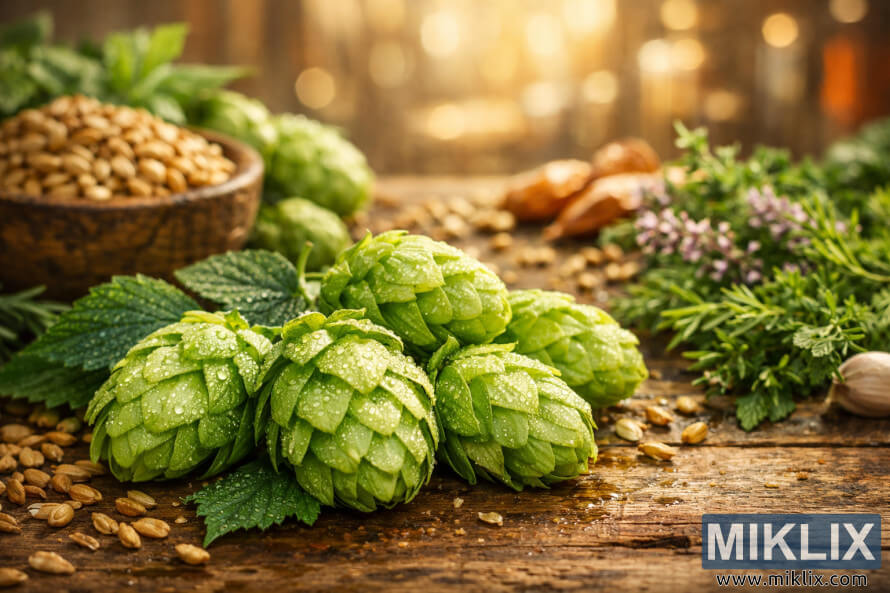
Click or tap the image for more information and higher resolutions.
Recipe examples and formulation tips
Eastern Gold is ideal as the primary bittering hop for recipes needing 11%–14% alpha acids. Add the main bittering addition at 60 minutes to achieve the desired IBUs. For a 5-gallon (19 L) batch aiming for 40 IBUs, use an average 12% alpha value and standard utilization rates.
When calculating IBUs, consider hop age and storage loss. If hops have been stored for six months at about 68°F and retain 81% of their original alpha, adjust the added weight accordingly. This ensures consistent results when brewing with Eastern Gold.
For late additions, be conservative. Use 5–15 minute boil additions to preserve subtle herbal and woody notes. Small dry-hop trials are best for assessing aroma without overpowering the beer. Expect gentle aromatics rather than bold tropical or citrus character.
- Blend bittering Eastern Gold with aroma hops like Cascade, Centennial, Amarillo, or Citra for modern pale ales and IPAs.
- Pair with East Kent Goldings or Fuggle-style hops for traditional English ales.
- Monitor cohumulone at about 27% when predicting perceived bitterness; this level can give a firmer, slightly sharper bite.
Run test batches when adjusting hop addition timing to balance bitterness and aroma. For reproducible Eastern Gold recipes, document alpha value, hop age, boil time, and measured IBUs after each brew. This habit sharpens formula accuracy and improves repeatability across brews.
When scaling a recipe, recalculate additions using the same IBU calculations and utilization assumptions. Small changes in hop weight or timing can shift bitterness noticeably because of Eastern Gold’s moderate oil content and cohumulone profile.
Case studies and historical usage notes
Primary records for Eastern Gold history come from cultivar descriptions at USDA/ARS and from trade catalogs such as Freshops and HopsList. These sources frame the variety within hop breeding history rather than within brewery archives.
There is limited documentation of widespread commercial brewing with Eastern Gold. Early notes indicate the variety was developed to replace Kirin No. 2, a goal that speaks to Kirin hop use in breeding programs but did not lead to large-scale adoption.
Published hop case studies for Eastern Gold are scarce. Most practical information is retained in nursery and breeder records, not in brewery tasting reports. Brewers seeking replication often rely on small pilot batches to confirm expected sensory traits.
Compare this path with better-documented regional hops like East Kent Goldings, which show terroir-driven use and legal protections. Eastern Gold’s footprint remains rooted in hop breeding history and selection trials rather than in an extensive catalog of brewery examples.
- Sources: USDA/ARS cultivar notes and commercial hop catalogs.
- Practical note: limited hop case studies mean experimental brews are advised.
- Context: bred as a potential successor for Kirin No. 2, tied to Kirin hop use history.
For brewers in the United States, this background suggests a measured approach. Use small-scale trials, document results, and share findings to build a clearer record of Eastern Gold performance in modern recipes.

Click or tap the image for more information and higher resolutions.
Sourcing Eastern Gold hops in the United States
The commercial availability of Eastern Gold in the United States is scarce. Most hop suppliers in the country do not list Eastern Gold in their catalogs. Large-scale cultivation of this variety is uncommon.
Retail outlets like Freshops and HopsList maintain records of Eastern Gold. These listings confirm the variety's lineage. However, they rarely indicate immediate availability for brewers looking to buy Eastern Gold hops.
U.S. brewers often opt for alternatives like Brewer’s Gold or American heritage hops. These options offer similar bittering characteristics. They serve as substitutes when Eastern Gold is not available for direct purchase.
For research or experimental purposes, contacting institutions like the USDA Agricultural Research Service or university hop breeding programs is advisable. Specialty breeders and germplasm collections may provide small quantities under license. However, there may be quarantine or import rules for live plants and pellets.
- Check hop suppliers United States listings for occasional releases or trial lots.
- Reach out to brewery networks and grower cooperatives for shared procurement.
- Plan for lead time and regulatory steps when you want to buy Eastern Gold hops for trial batches.
Securing Eastern Gold USA material involves a more intricate process than mainstream varieties. Direct outreach and patience are essential. This approach is necessary to obtain Eastern Gold through research channels or rare-stock vendors.
Experimental brewing with Eastern Gold
Design focused, repeatable hop trials for your experimental brewing with Eastern Gold. Run multiple small-batch testing runs. This allows you to isolate bitterness, late additions, and dry-hop character with limited inventory.
Begin with a 60-minute single-hop bittering trial. This trial gauges utilization and bittering quality. Record alpha acid at the time of use and note storage conditions. Remember, alpha variability and expected retention—about 81% after six months at 68°F—impact IBUs.
Next, conduct a paired late-addition versus dry-hop trial. This trial detects herbal, woody, and aromatic nuances. Use identical grists and fermentation schedules. This way, sensory evaluation highlights the effect of timing and contact method.
Include blend trials that pair Eastern Gold bittering with modern aroma hops like Citra and Mosaic, and classic hops like East Kent Goldings. Compare blends in small-batch testing. This reveals how resinous or floral notes interact with bright, fruity profiles.
- Trial 1: 60-minute single-hop bittering to assess utilization and bitterness quality.
- Trial 2: Late addition vs. dry-hop paired trial to reveal herbal and woody nuances.
- Trial 3: Blend trials combining Eastern Gold bittering with Citra, Mosaic, and East Kent Goldings.
During sensory evaluation, focus on resinous, herbal, spicy, and subtle floral impressions. These are tied to myrcene, humulene, caryophyllene, and farnesene proportions. Also, pay attention to perceived sharpness linked to a higher cohumulone fraction near 27%.
Document every variable: alpha at time of use, storage temperature and duration, hop form, and exact addition times. Maintain tasting sheets that capture aroma, bitterness quality, mouthfeel, and aftertaste. This dataset informs future formulations.
Conclusion
Eastern Gold summary: This Japanese-bred hop from Kirin is known for its high bittering strength and reliable growth. It boasts alpha acids of 11–14% and total oil of 1.43 mL/100 g. This makes it a top choice for brewers seeking consistent IBUs and alpha yield. Its good storage stability solidifies its role as a reliable bittering variety, not a primary aroma hop.
For those looking for a dependable bittering hop, Eastern Gold is a solid choice. It grows vigorously and yields well, making it a favorite among commercial growers. Its moderate downy mildew tolerance also reduces field risks. However, due to limited commercial supply and flavor records, it's wise to conduct small-scale trials to gauge its flavor impact. Brewer’s Gold can serve as a suitable substitute when Eastern Gold is hard to find.
Eastern Gold's high-alpha profile makes it an intriguing option for both brewing and breeding. Its cohumulone level of ~27% and beta acids contribute to stable bitterness. Its lineage opens up possibilities for further experimentation. Brewers and breeders who delve into its potential will uncover its full value in contemporary brewing.
Further Reading
If you enjoyed this post, you may also like these suggestions: