
Growing Blackberries: A Guide for Home Gardeners
Published: November 30, 2025 at 9:55:42 PM UTC
Blackberries are one of the most rewarding fruits to grow in your home garden. With their juicy, sweet-tart flavor and impressive nutritional profile, these versatile berries offer an abundant harvest with relatively minimal effort. Whether you have a spacious backyard or just a small patio, blackberries can thrive in various settings with the right care.
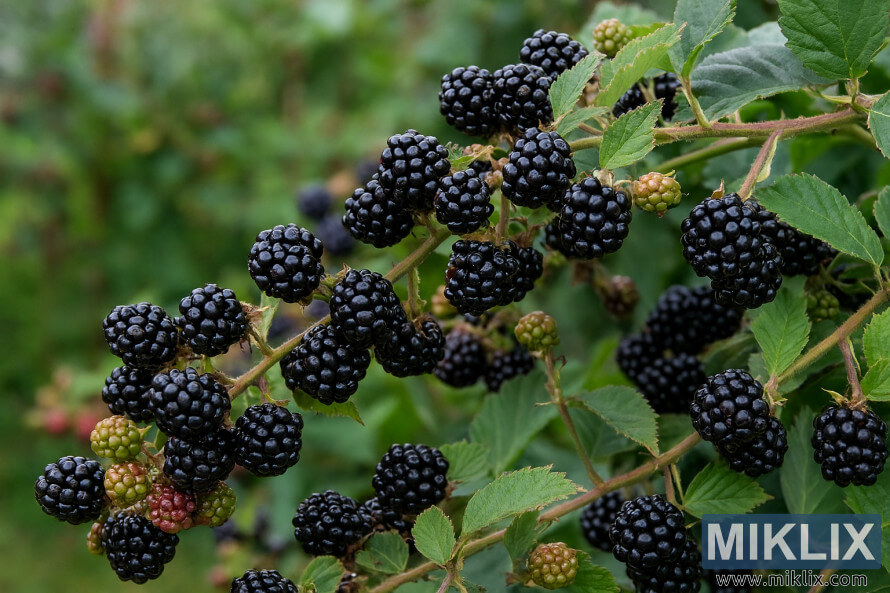
Click or tap the image for more information and higher resolutions.
This comprehensive guide will walk you through everything you need to know about selecting, planting, maintaining, and harvesting blackberries for years of delicious homegrown fruit.
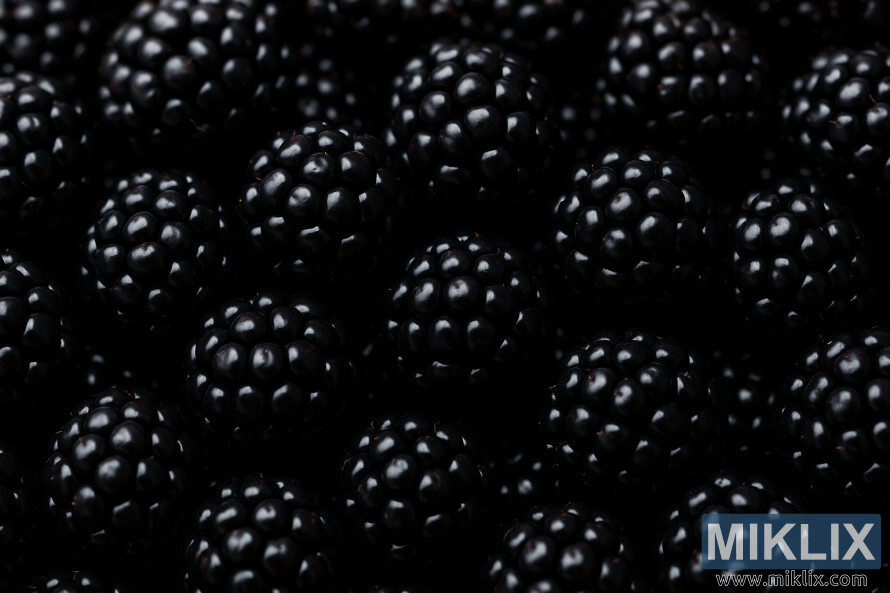
Fresh blackberries are packed with antioxidants and make a delicious addition to any garden
Understanding Blackberry Varieties
Before you start growing blackberries, it's important to understand the different types available and which might work best for your garden. Blackberries are divided into several categories based on their growth habits and characteristics.
Growth Habit Types
Erect Blackberries
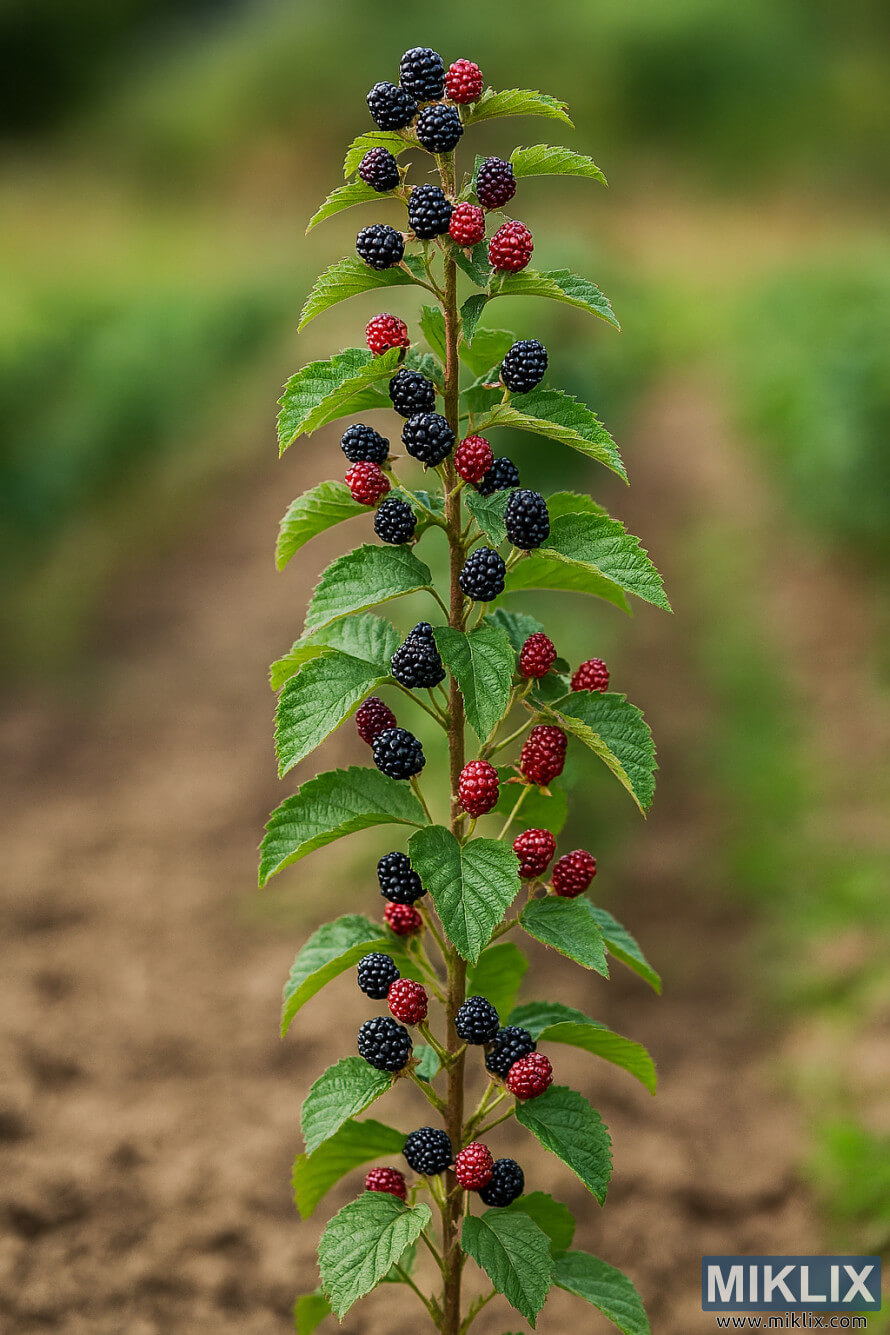
Erect blackberries produce stiff, upright canes that can generally support themselves, though they benefit from some trellising. These varieties are the most cold-hardy and can be grown in all regions of the country. They typically fruit in mid-season (early July through August) and produce firm, glossy berries with a milder flavor.
Click or tap the image for more information and higher resolutions.
Semi-Erect Blackberries
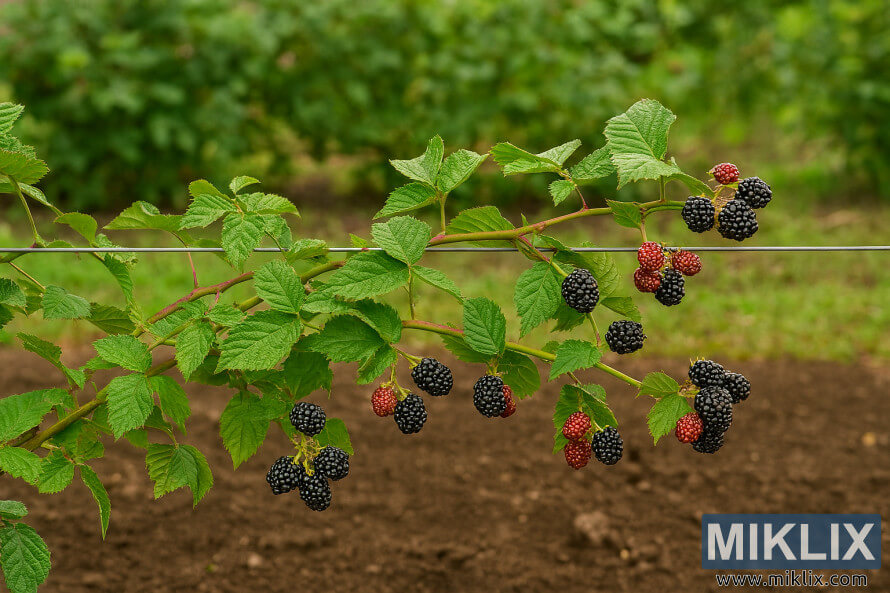
Semi-erect varieties produce vigorous, thick canes that arch and require trellising. They're typically thornless and produce the highest yields of all blackberry types. These varieties fruit late in the season (August through September) and are moderately cold-hardy, suitable for most growing regions.
Click or tap the image for more information and higher resolutions.
Trailing Blackberries
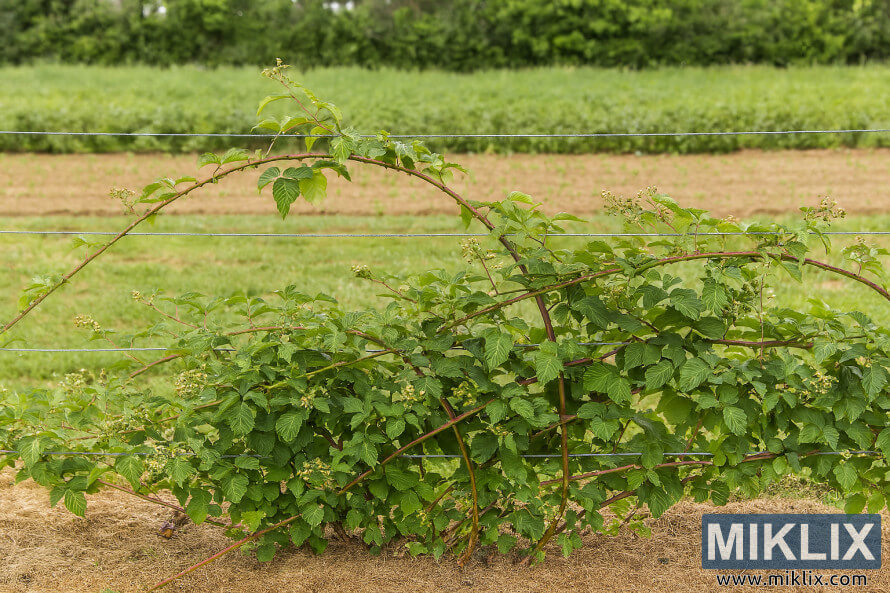
Trailing blackberries produce long, flexible canes that require trellising. These varieties, which include the popular 'Marion' (marionberry), typically produce fruit with the best flavor and smallest seeds. They fruit early (late June through early August) but are the least cold-hardy type, best suited to milder climates.
Click or tap the image for more information and higher resolutions.
Thorny vs. Thornless
Another important distinction is whether the blackberry variety has thorns.
Thorny Varieties
Traditional blackberry varieties have thorns along their canes. While these can make harvesting more challenging, thorny varieties often produce excellent fruit quality and are typically very vigorous. Examples include 'Marion' and 'Cherokee'.
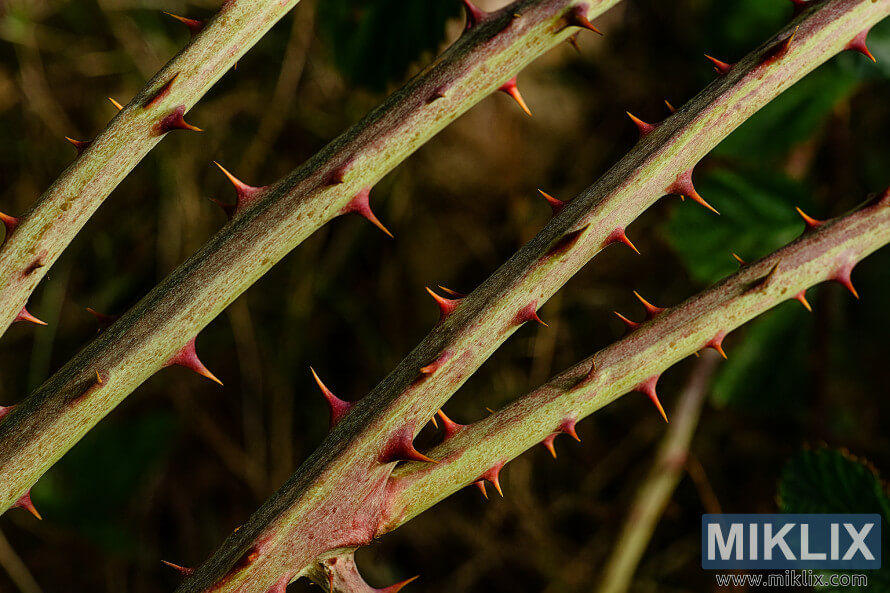
Click or tap the image for more information and higher resolutions.
Thornless Varieties
Modern breeding has produced many excellent thornless varieties that are much easier to handle and harvest. Popular thornless options include 'Triple Crown', 'Navaho', and 'Columbia Star'. These varieties maintain excellent fruit quality while eliminating the painful thorns.
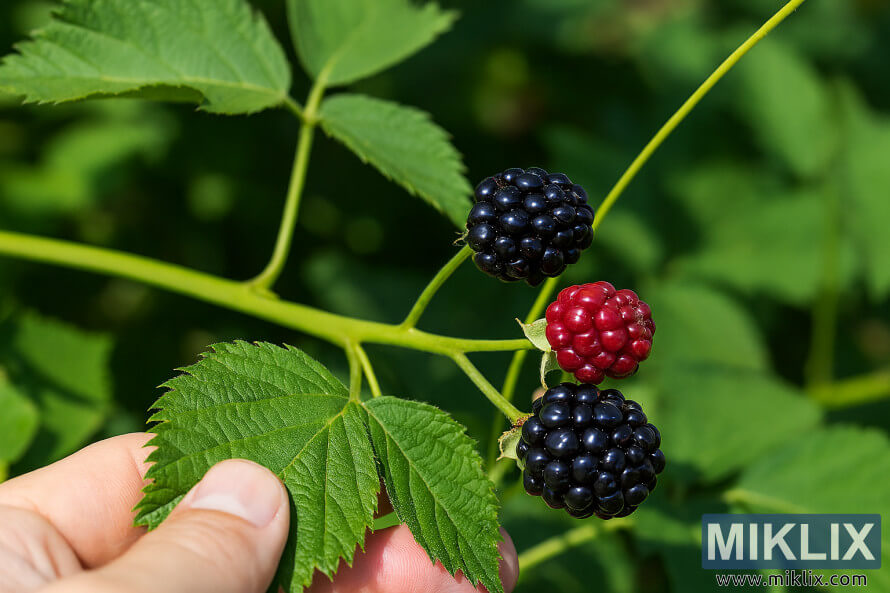
Click or tap the image for more information and higher resolutions.
Fruiting Habits
Floricane-Fruiting (Summer-Bearing)
Most blackberry varieties are floricane-fruiting, meaning they produce vegetative canes (primocanes) in their first year, which then overwinter and produce fruit on these same canes (now called floricanes) in their second year. After fruiting, these canes die, while new primocanes grow for next year's crop.
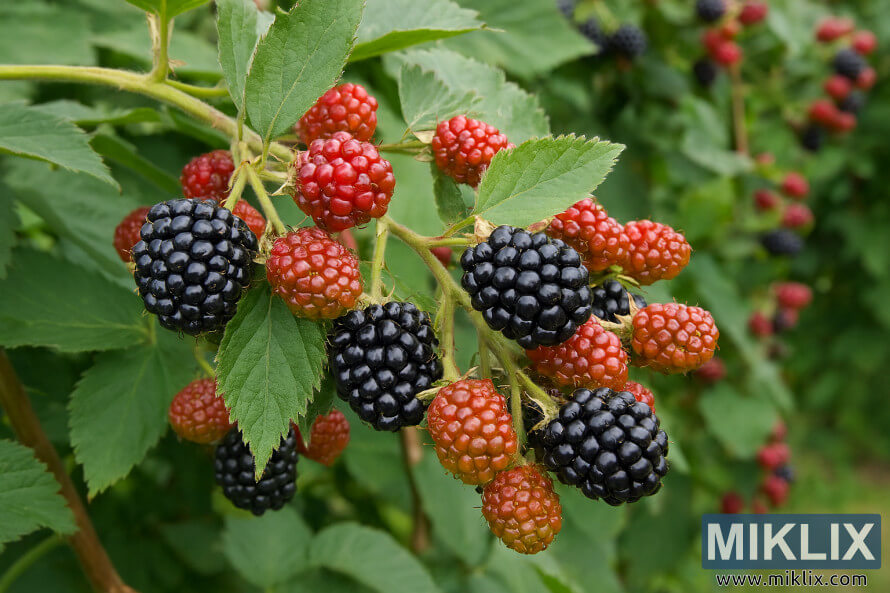
Click or tap the image for more information and higher resolutions.
Primocane-Fruiting (Everbearing)
Newer primocane-fruiting varieties can produce fruit on first-year canes (primocanes) in late summer and fall. These can be pruned to produce either one crop (on primocanes only) or two crops (on both primocanes and floricanes). Examples include 'Prime-Ark Freedom' and 'Black Gem'.
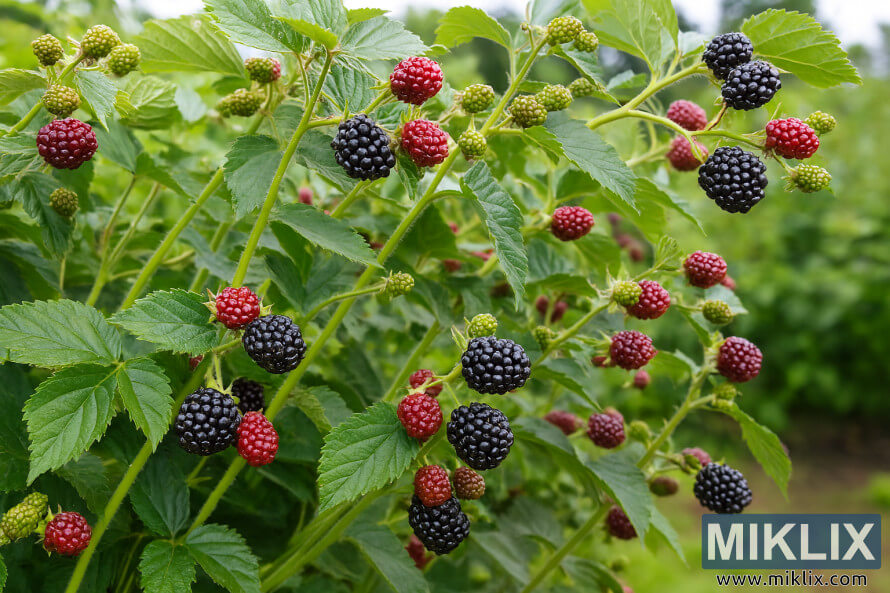
Click or tap the image for more information and higher resolutions.
Selecting the Perfect Site for Growing Blackberries
Blackberries are perennial plants that can produce for 15-40 years with proper care, so selecting the right planting site is crucial for long-term success. Consider these key factors when choosing where to grow your blackberries:
Sunlight Requirements
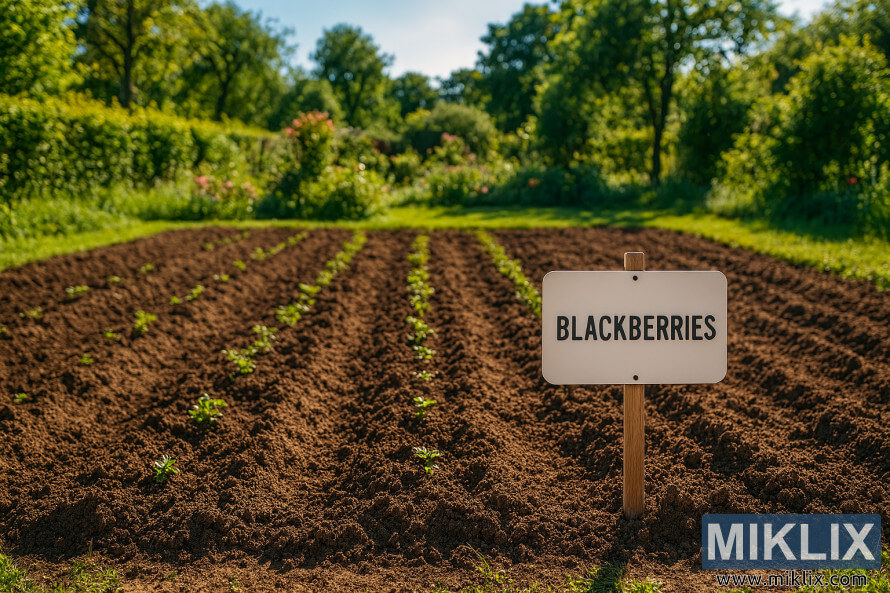
Blackberries require full sun for optimal growth and fruit production. Choose a location that receives at least 6-8 hours of direct sunlight daily. While plants can tolerate partial shade, fruit yield and quality will be significantly reduced in shadier spots.
Click or tap the image for more information and higher resolutions.
Soil Conditions
Blackberries prefer well-drained, fertile soil with a pH between 5.5 and 6.5. They can tolerate a range of soil types but perform best in sandy loam or clay loam soils with good organic matter content. Before planting, it's advisable to test your soil and amend it as needed:
Soil Testing
Collect soil samples from the top 12-18 inches where roots will grow. A standard soil test will provide information on pH, phosphorus, potassium, calcium, magnesium, and organic matter content. In some regions, testing for boron is also recommended as deficiency can affect blackberries.
Soil Amendments
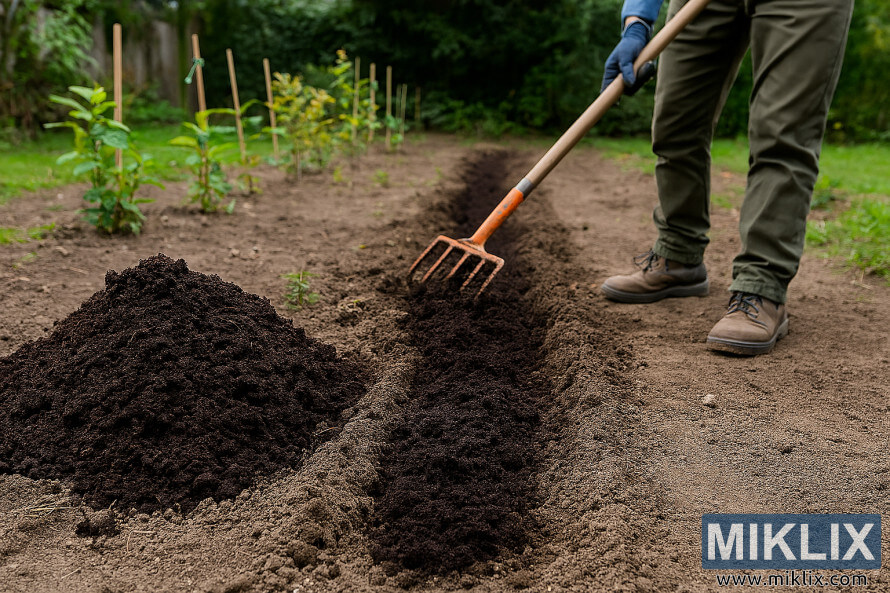
Based on test results, you may need to adjust soil pH or add nutrients. To raise pH, incorporate lime at approximately 5-10 pounds per 100 square feet. To lower pH, add elemental sulfur. Increase organic matter by adding compost, aged manure, or other organic materials at a rate of 1-2 inches deep across the planting area.
Click or tap the image for more information and higher resolutions.
Drainage and Water Access
While blackberries need consistent moisture, they cannot tolerate waterlogged conditions. Ensure your planting site has good drainage. If your soil drains poorly, consider creating raised beds. Also, choose a location with convenient access to water, as blackberries require regular irrigation, especially during fruit development.
Space Considerations
Blackberries need adequate space to grow and proper air circulation to reduce disease problems. Plan for the following spacing based on blackberry type:
- Erect blackberries: 3-4 feet between plants, 8-10 feet between rows
- Semi-erect blackberries: 5-6 feet between plants, 10-12 feet between rows
- Trailing blackberries: 5-8 feet between plants, 8-10 feet between rows
Protection from Elements
If possible, avoid sites exposed to strong winds, which can damage canes and increase winter injury risk. In colder regions, a location with some winter protection (such as near a south-facing wall) can be beneficial for less cold-hardy varieties.
Tip: Avoid planting blackberries where tomatoes, potatoes, peppers, eggplants, or other caneberries (like raspberries) have grown in the past 3-4 years. These plants can harbor soil-borne diseases that affect blackberries.
Planting Your Blackberries
When to Plant
The ideal time to plant blackberries depends on your climate:
- In mild climates (USDA zones 7-10), plant in late fall or winter when plants are dormant.
- In colder regions (USDA zones 5-6), plant in early spring as soon as the soil can be worked.
- Avoid planting during hot summer months, which can stress young plants.
Purchasing Plants
Blackberries are typically sold as either bare-root plants or in containers:
Bare-Root Plants
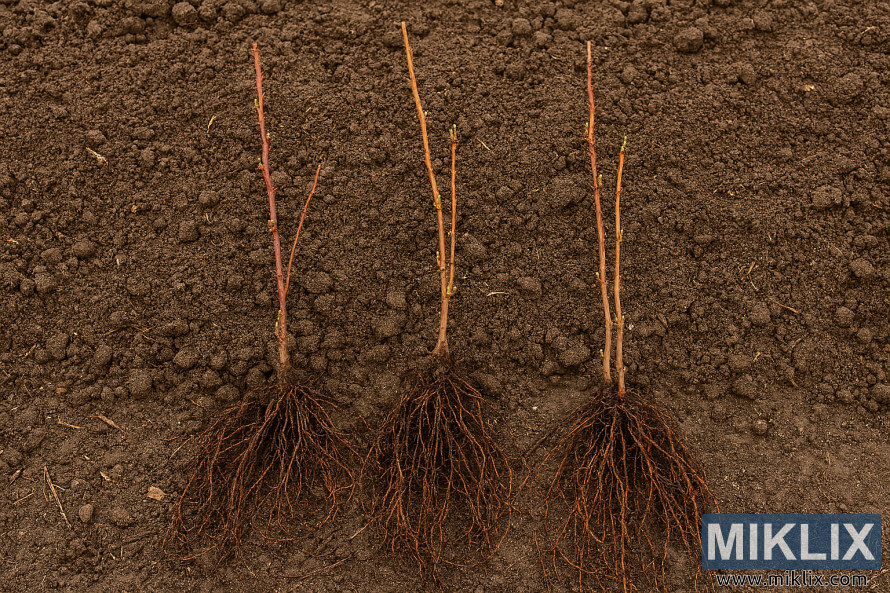
These dormant plants consist of a short cane section with roots attached. They're typically less expensive and available in late winter to early spring. If you can't plant immediately, keep roots moist by temporarily covering them with damp soil or sawdust.
Click or tap the image for more information and higher resolutions.
Potted Plants
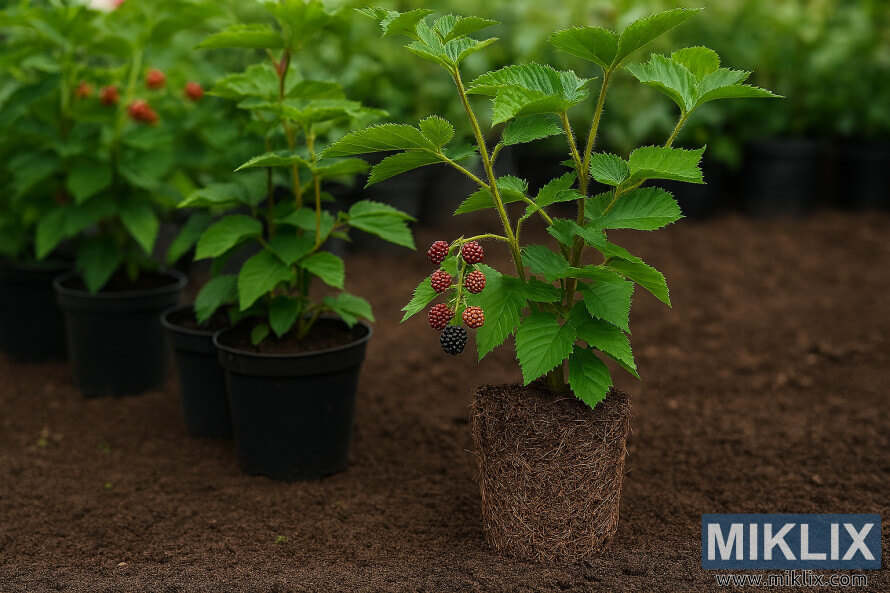
Container plants may be available year-round and can be easier for beginners. They typically establish more quickly but cost more than bare-root plants. Look for healthy plants with no signs of disease or pest damage.
Always purchase certified disease-free plants from reputable nurseries rather than transplanting suckers from existing plants, which can introduce diseases to your garden.
Click or tap the image for more information and higher resolutions.
Planting Process
- Prepare the soil by removing weeds and incorporating organic matter as needed based on soil test results.
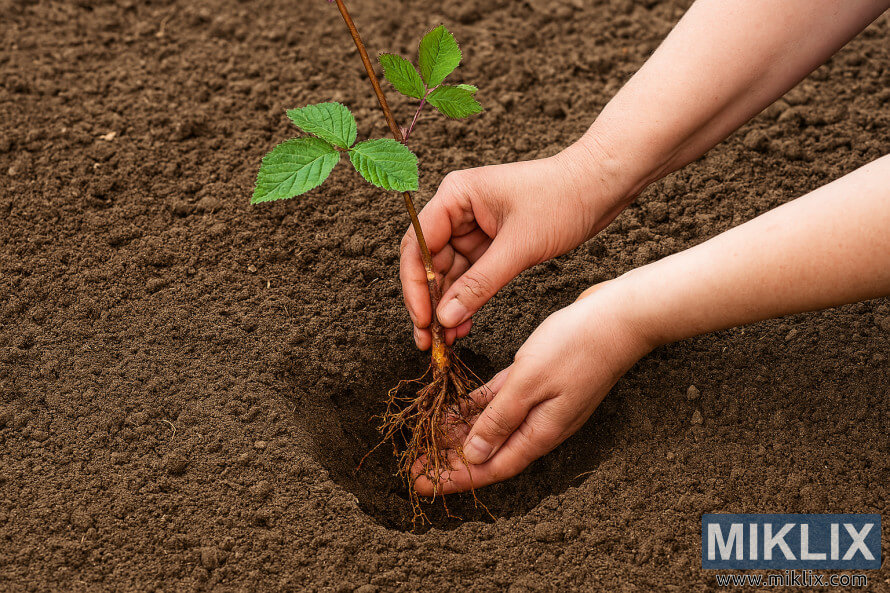
- Dig planting holes large enough to accommodate the roots. For bare-root plants, the hole should be wide enough to spread the roots out naturally.
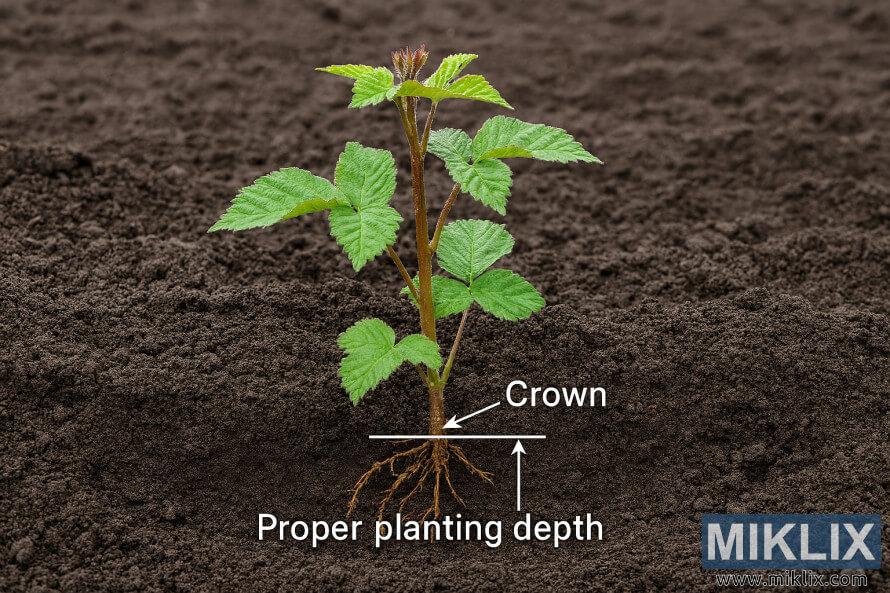
- Set plants at the proper depth:
- For trailing and semi-erect types, plant so the crown (where roots meet the cane) is 1-2 inches below soil level.
- For erect types, plant with the highest point of root attachment 1-2 inches below soil level.
- Fill the hole with soil, firming gently to remove air pockets.
- Water thoroughly after planting to settle the soil around roots.
- Prune newly planted bare-root plants to 6 inches in height to encourage strong root establishment.
Click or tap the image for more information and higher resolutions.
Click or tap the image for more information and higher resolutions.
Spacing Guidelines
Proper spacing is essential for healthy plants and easy maintenance:
| Blackberry Type | Between Plants | Between Rows | Growth Pattern |
| Erect | 3-4 feet | 8-10 feet | Hedgerow (12 inches wide) |
| Semi-erect | 5-6 feet | 10-12 feet | Individual plants |
| Trailing | 5-8 feet | 8-10 feet | Individual plants |
Trellising and Support Systems
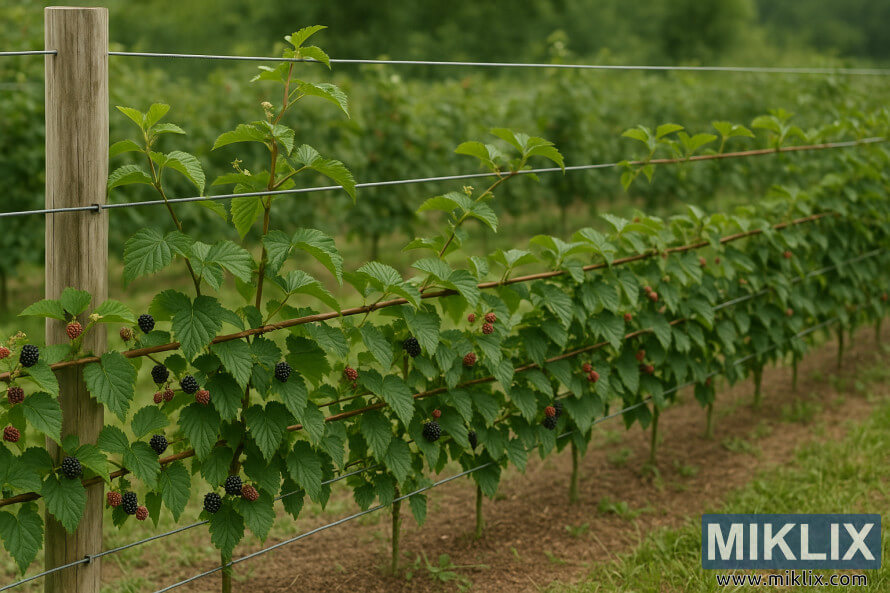
Most blackberry varieties require some form of support to keep fruit off the ground, improve air circulation, make harvesting easier, and protect canes from damage. The best trellis system depends on the type of blackberry you're growing.
Click or tap the image for more information and higher resolutions.
Trellis Options by Blackberry Type
Trailing Blackberry Trellis
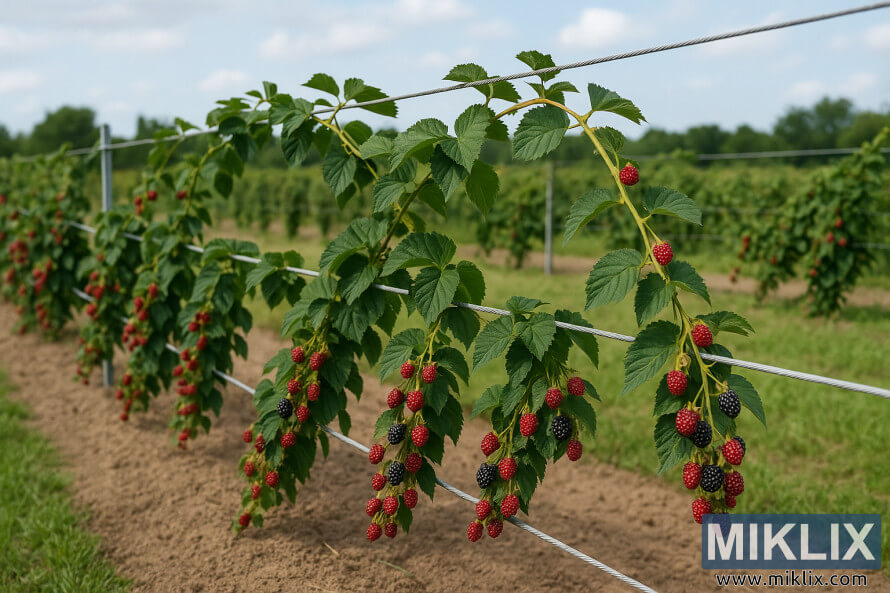
For trailing types, use a simple two-wire system with posts set 15-20 feet apart. Install one wire at 5-6 feet high and another at 4-4.5 feet. This allows primocanes to be trained in a fan pattern along the wires. For longer rows, add wire tighteners and anchors at the ends to maintain tension.
Click or tap the image for more information and higher resolutions.
Erect Blackberry Trellis
Erect blackberries benefit from a T-trellis with a 1.5-foot-wide cross piece at the top. Run wire down each side of the T to contain the canes. This design supports the fruit-laden canes and keeps the hedgerow narrow for easier access. Metal T-posts with attachable cross pieces work well for this system.
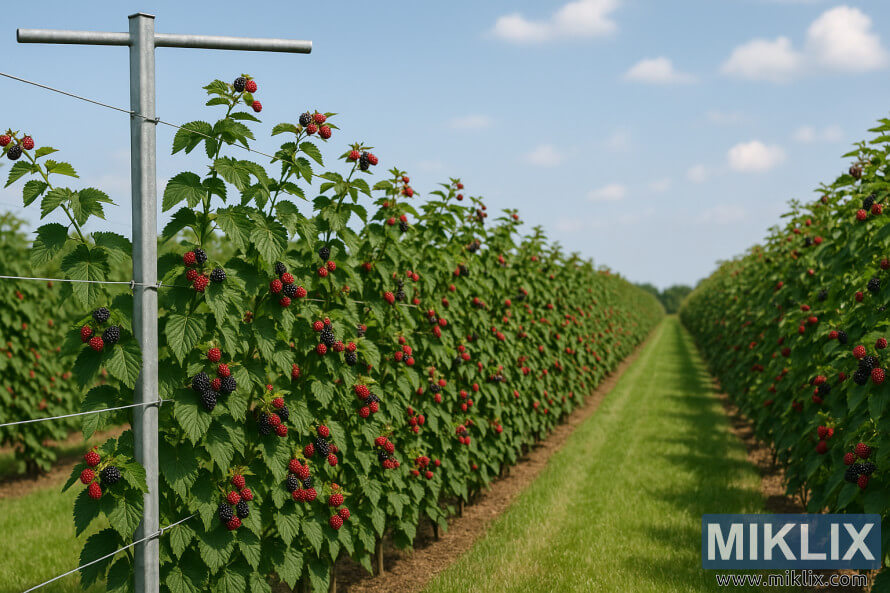
Click or tap the image for more information and higher resolutions.
Semi-Erect Blackberry Trellis
The vigorous growth of semi-erect blackberries requires a sturdier "double T" trellis. Install a 4-foot-wide cross arm at the top of each post (5-6 feet high) and a 2-3 foot cross arm about 2 feet below. Run wires along the outside of each cross arm for a total of four support wires.
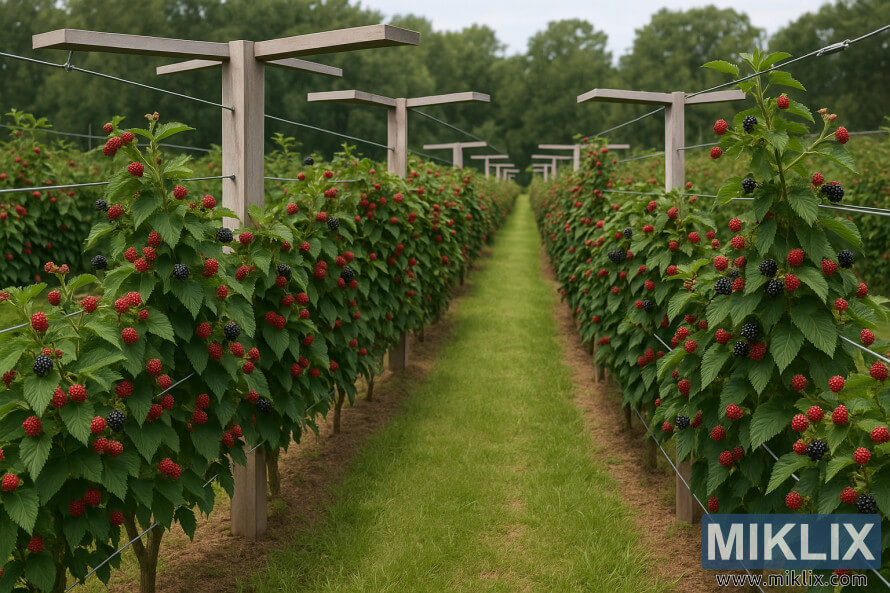
Click or tap the image for more information and higher resolutions.
Building Your Trellis
For a durable, long-lasting trellis system:
- Use treated wooden posts (4-6 inches in diameter) or metal T-posts for the main supports
- Choose 12-14 gauge high-tensile wire for durability
- Install wire tighteners to maintain proper tension
- Set end posts at least 2 feet deep and anchor them for stability
- Space interior posts every 15-20 feet
Trellis Timing: Install your trellis system at planting time or during the first growing season, before canes become too large to train easily.
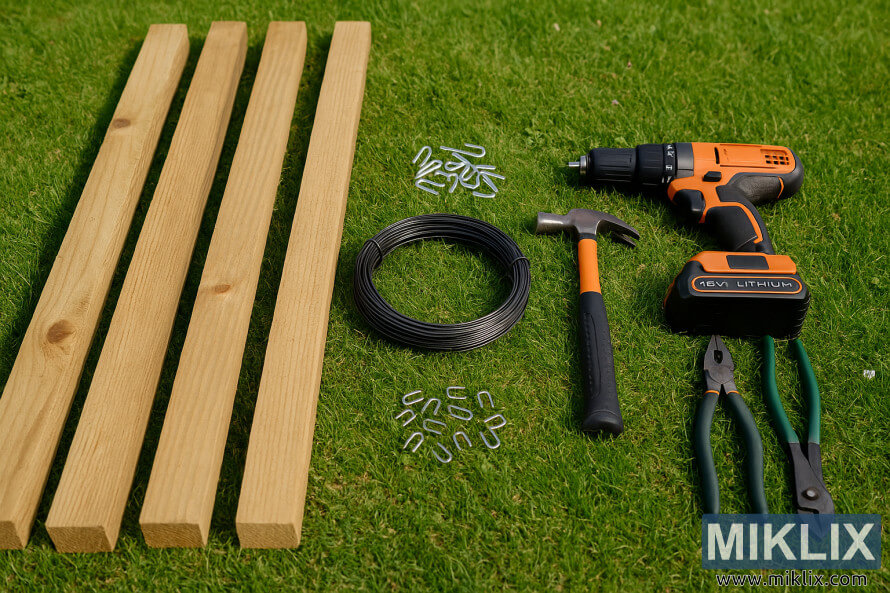
Click or tap the image for more information and higher resolutions.
Seasonal Care and Maintenance
Proper seasonal care is essential for healthy blackberry plants and abundant harvests. Follow this maintenance schedule throughout the year to keep your blackberries thriving.
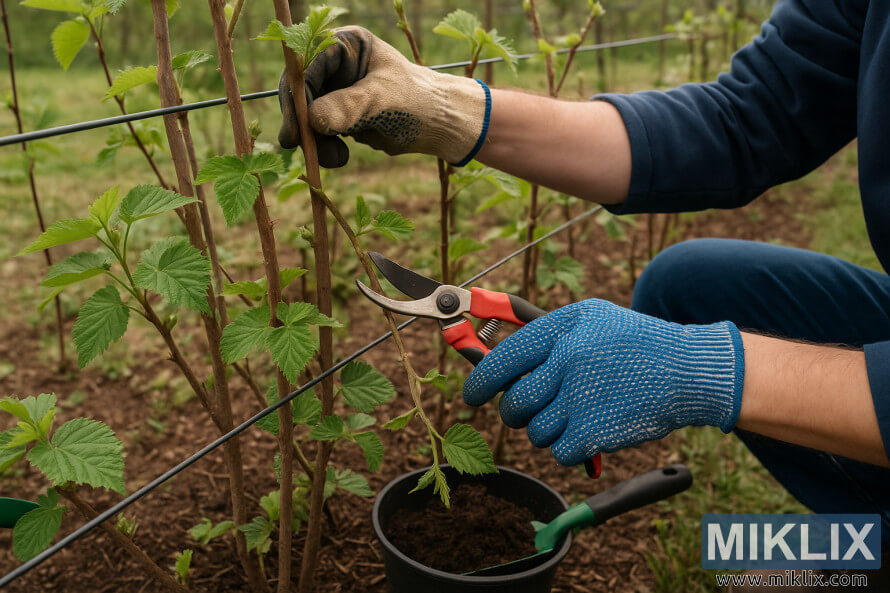
Click or tap the image for more information and higher resolutions.
Watering Requirements
Blackberries need consistent moisture, especially during fruit development. Established plants typically require:
- 1-1.5 inches of water per week during the growing season
- 2 gallons per plant daily during fruit development
- More frequent watering in sandy soils or hot weather
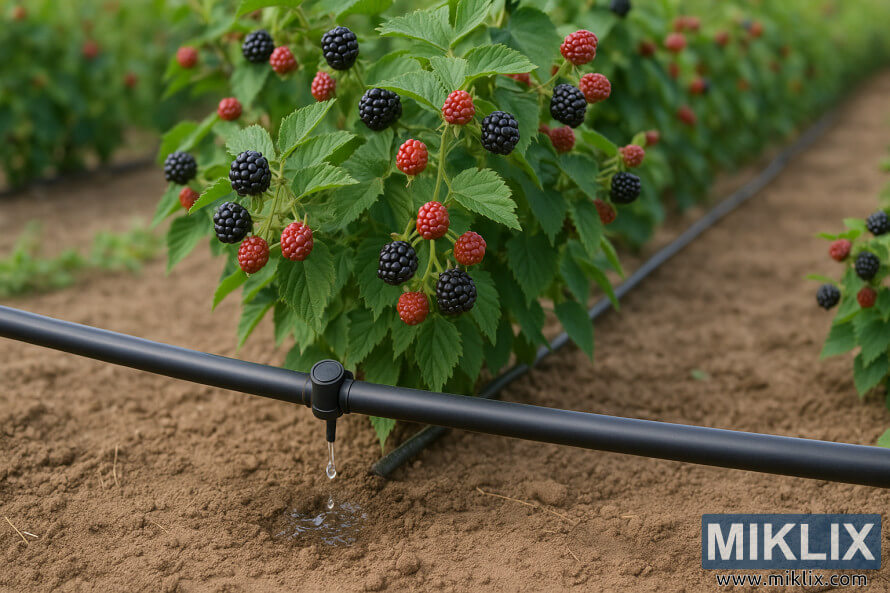
Drip irrigation is ideal for blackberries as it delivers water directly to the roots while keeping foliage dry, which helps prevent disease. A single line of drip irrigation with emitters spaced every 18 inches works well for most plantings.
Click or tap the image for more information and higher resolutions.
Fertilization Schedule
| Timing | Application Rate | Type of Fertilizer | Notes |
| Planting Year (2-4 weeks after planting) | 1-1.4 oz N per plant (divided into 3 applications) | Balanced fertilizer (10-10-10) | Apply in 3 equal portions, 4 weeks apart |
| Established Plants (Early Spring) | 1.5 oz N per plant or 3 oz N per 10 ft of row | Balanced fertilizer (10-10-10) | Apply when primocanes begin to emerge |
| Established Plants (Late Spring) | 1.5 oz N per plant or 3 oz N per 10 ft of row | Balanced fertilizer (10-10-10) | Apply 6-8 weeks after first application |
Broadcast granular fertilizer in a band about 12-18 inches wide along the row, keeping it a few inches away from the canes. Water thoroughly after application. Organic options include compost, fish emulsion, or specialized berry fertilizers.
Mulching Benefits
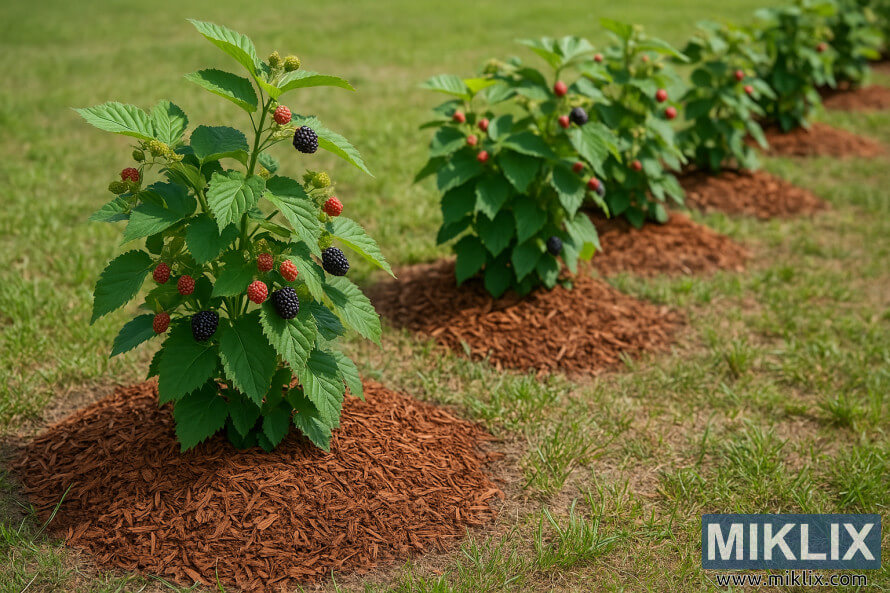
Apply a 2-3 inch layer of mulch around blackberry plants to:
- Conserve soil moisture and reduce watering needs
- Suppress weed growth
- Moderate soil temperature
- Add organic matter to the soil as it breaks down
Suitable mulch materials include wood chips, bark, pine needles, or straw. Keep mulch a few inches away from the crown of the plant to prevent rot. Refresh mulch annually as it decomposes.
Click or tap the image for more information and higher resolutions.
Weed Management
Controlling weeds is essential, especially for young blackberry plantings. Weeds compete for water and nutrients and can harbor pests and diseases. Regular shallow cultivation, hand pulling, and mulching are effective organic methods. For erect blackberries, maintain a narrow hedgerow (about 12 inches wide) by removing any suckers that emerge outside this area.
Pruning and Training Techniques
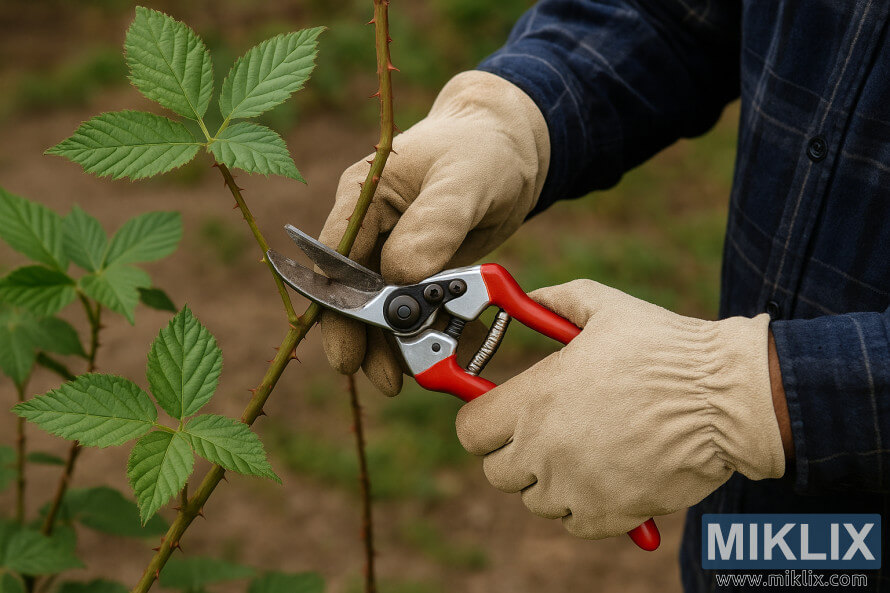
Proper pruning is crucial for blackberry productivity, plant health, and ease of harvest. Pruning methods vary by blackberry type and fruiting habit, but all follow the basic principle of removing old canes after they've fruited while managing new canes for the next season's crop.
Click or tap the image for more information and higher resolutions.
Understanding Blackberry Cane Types
Primocanes
First-year canes that emerge from the crown or roots. In most varieties, these are vegetative only (not fruiting) in their first year. They're typically green or reddish in color.
Floricanes
Second-year canes that produce flowers and fruit. After fruiting, these canes die naturally. They're typically brown or gray in color with side branches (laterals) that bear fruit.
Pruning by Blackberry Type
Trailing Blackberries
- Summer (after harvest): Remove spent floricanes by cutting at the base.
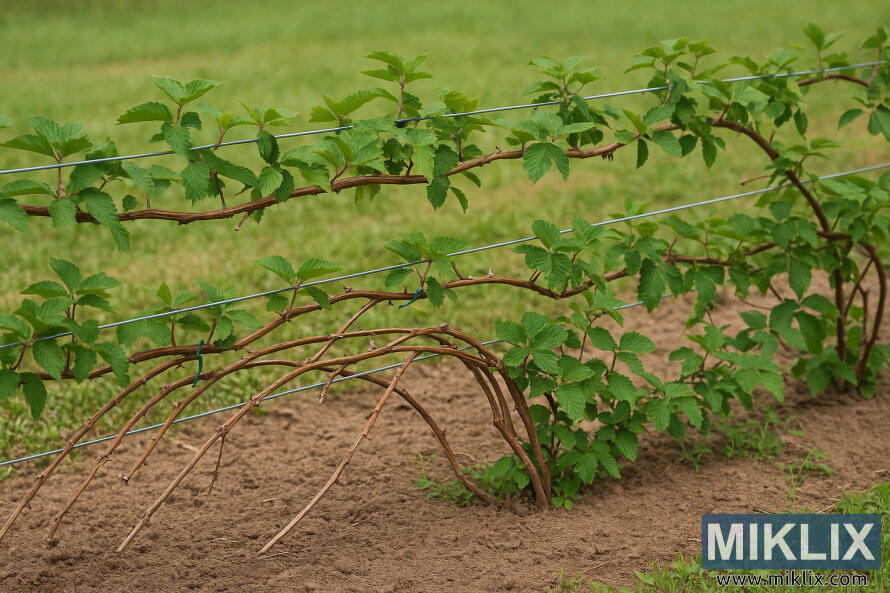
- Late summer/fall: Train new primocanes onto the trellis by dividing them into two bundles and wrapping in opposite directions along the wires.
- For cold areas: Leave primocanes on the ground until late winter, then train onto the trellis before bud break for winter protection.
Click or tap the image for more information and higher resolutions.
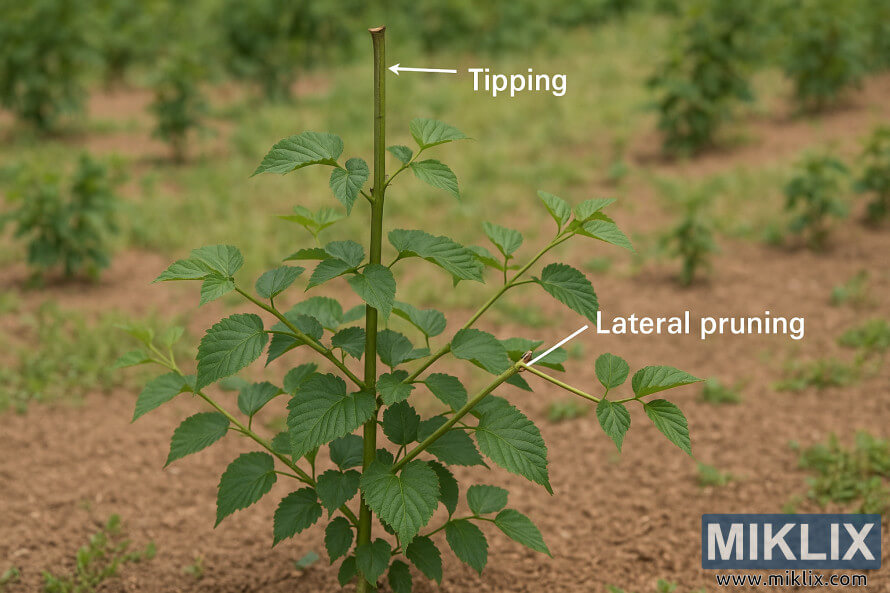
Erect Blackberries
- Summer: Tip primocanes at 3-4 feet tall by removing the top 3-6 inches to encourage branching.
- Summer/fall: Remove spent floricanes after harvest.
- Winter: Prune lateral branches on primocanes to 12-18 inches long.
- Year-round: Maintain a 12-inch-wide hedgerow by removing suckers outside this width.
Click or tap the image for more information and higher resolutions.
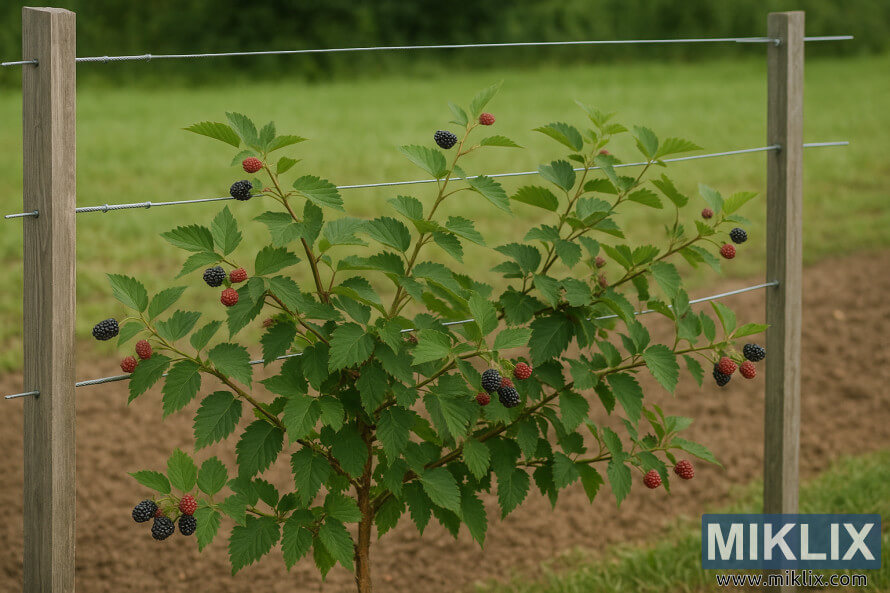
Semi-Erect Blackberries
- Summer: Tip primocanes at 4-5 feet tall to encourage branching.
- Winter: Remove spent floricanes and prune lateral branches to 2-3 feet long.
- Winter: Train remaining canes along the trellis wires, spreading them evenly.
Click or tap the image for more information and higher resolutions.
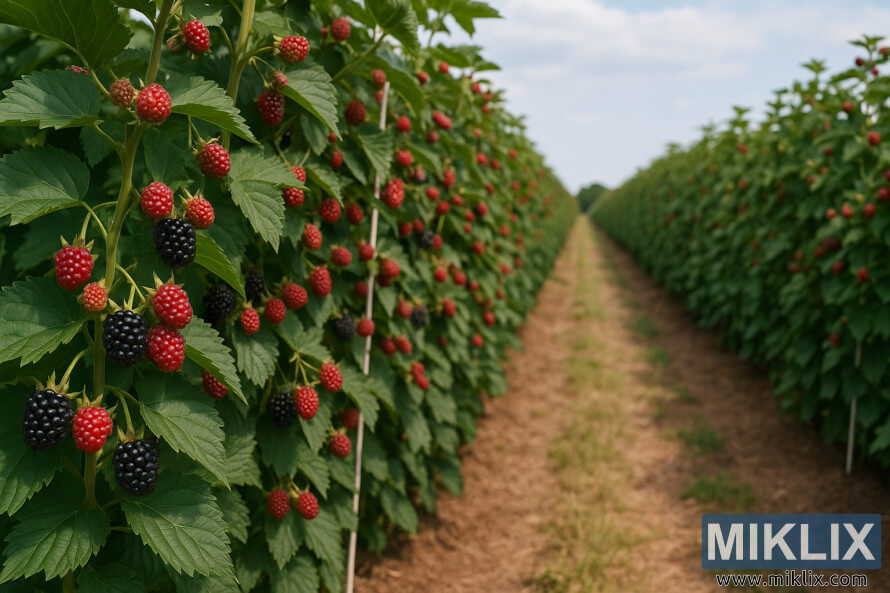
Primocane-Fruiting (Everbearing) Blackberries
Single-Crop System
For a simplified approach with one late-season crop:
- In late winter, cut all canes to ground level
- Allow new primocanes to emerge in spring
- Tip these primocanes at 3 feet tall in early summer
- Harvest fruit from late summer until frost
Click or tap the image for more information and higher resolutions.
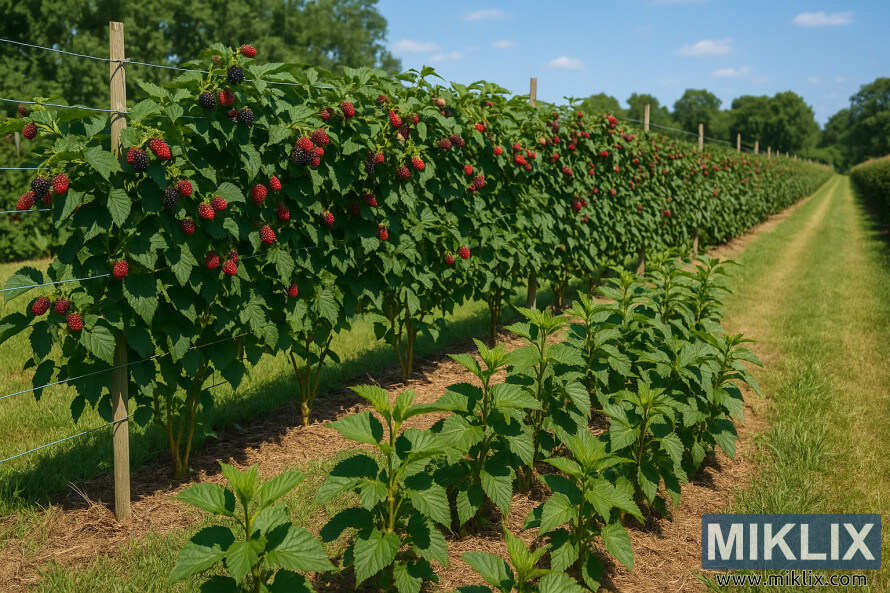
Double-Crop System
For two harvests per season:
- After fall harvest, leave the lower portions of fruited primocanes
- In winter, remove only the dead portions that fruited
- These overwintered canes will produce an early summer crop
- New primocanes will emerge and produce a second crop in fall
Click or tap the image for more information and higher resolutions.
Managing Pests and Diseases
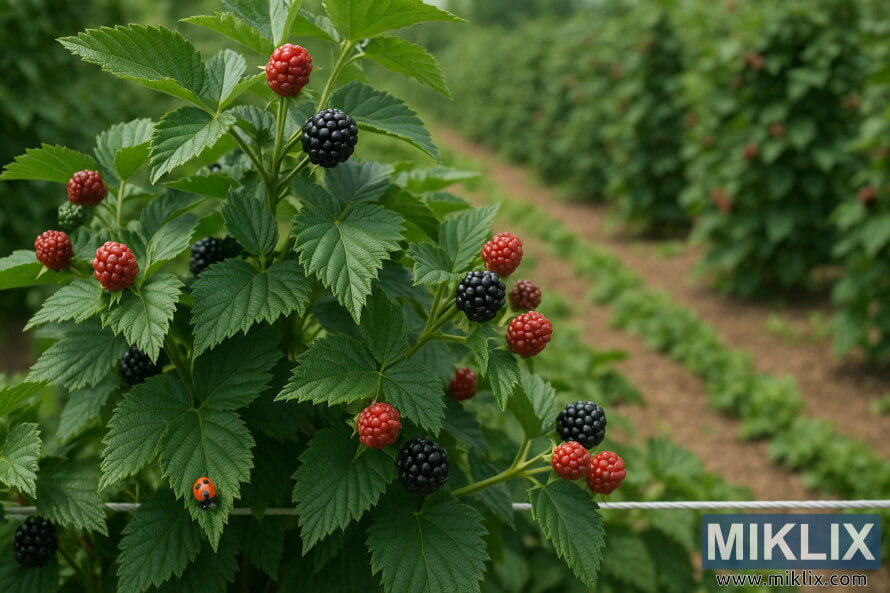
While blackberries are relatively hardy, they can face several pest and disease challenges. Using preventive practices and organic control methods can help maintain plant health without resorting to harsh chemicals.
Click or tap the image for more information and higher resolutions.
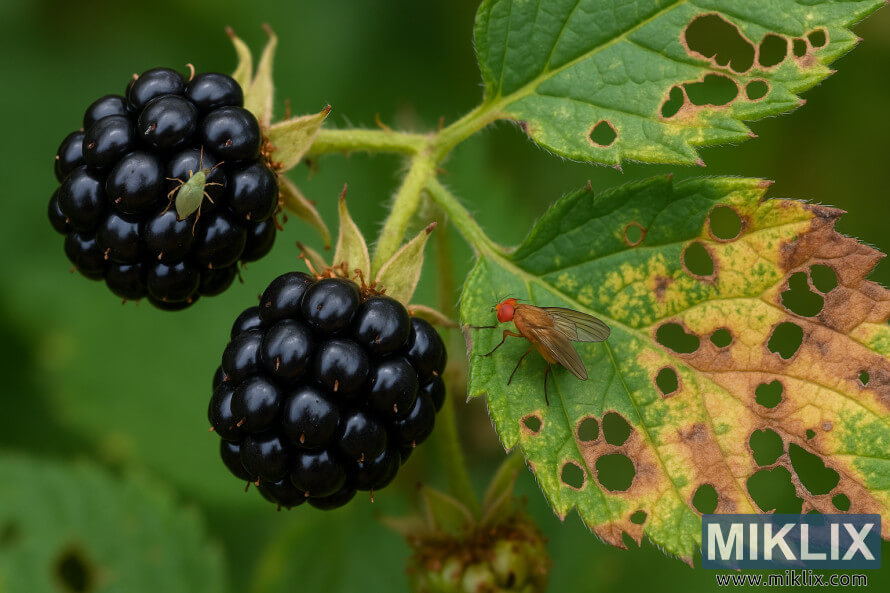
Common Pests
| Pest | Symptoms | Organic Prevention/Control |
| Spotted Wing Drosophila | Tiny white larvae in fruit; soft, collapsing berries | Harvest frequently; remove overripe fruit; use fine mesh netting; deploy traps with apple cider vinegar |
| Raspberry Crown Borer | Wilting canes; crown damage; reduced vigor | Remove and destroy infested canes; apply beneficial nematodes to soil in spring and fall |
| Spider Mites | Stippled yellowing leaves; fine webbing; bronzing | Strong water spray to undersides of leaves; insecticidal soap; predatory mites |
| Japanese Beetles | Skeletonized leaves; feeding damage on fruit | Hand-pick in morning; row covers during peak season; milky spore in soil for larvae |
Click or tap the image for more information and higher resolutions.
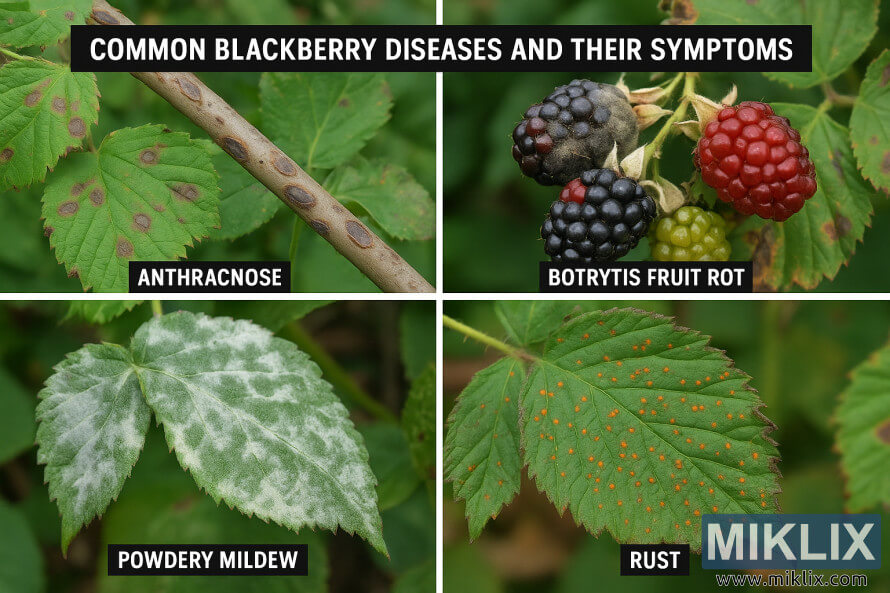
Common Diseases
| Disease | Symptoms | Organic Prevention/Control |
| Anthracnose | Purple spots on canes; sunken lesions; cracked bark | Improve air circulation; remove infected canes; apply copper fungicide in early spring |
| Gray Mold (Botrytis) | Gray fuzzy growth on fruit; rotting berries | Harvest frequently; improve air circulation; avoid overhead watering; remove infected fruit |
| Orange Rust | Bright orange pustules on leaf undersides; stunted growth | Remove and destroy infected plants entirely; plant resistant varieties |
| Crown Gall | Rough, irregular galls on roots and crown; reduced vigor | Plant disease-free stock; avoid wounding plants; remove infected plants |
Click or tap the image for more information and higher resolutions.
Integrated Pest Management (IPM)
Rather than reacting to problems as they occur, use these preventive practices to maintain healthy plants:
- Plant resistant varieties when available
- Maintain proper spacing for good air circulation
- Prune regularly to remove diseased canes and improve airflow
- Water at the base of plants to keep foliage dry
- Harvest promptly to prevent overripe fruit from attracting pests
- Clean up fallen leaves and fruit to reduce disease pressure
- Encourage beneficial insects by planting flowers nearby
Important: If you suspect a virus infection (symptoms include yellowing leaves, stunted growth, or deformed fruit), remove and destroy the entire plant to prevent spread to healthy plants. Always purchase certified virus-free plants from reputable nurseries.
Harvesting and Enjoying Your Blackberries
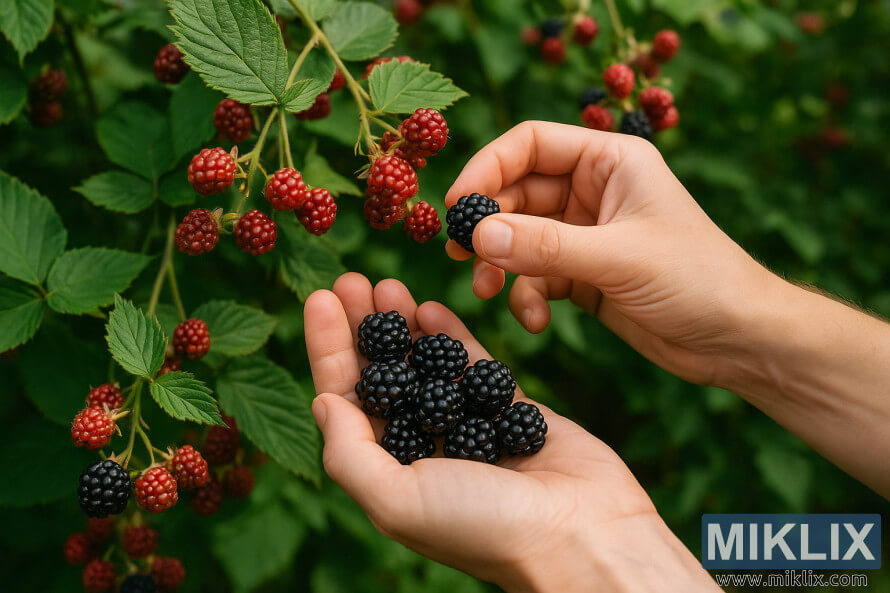
After all your hard work, harvesting is the rewarding part of growing blackberries. Knowing when and how to pick your berries will ensure the best flavor and longest shelf life.
Click or tap the image for more information and higher resolutions.
When to Harvest
Ripeness Indicators
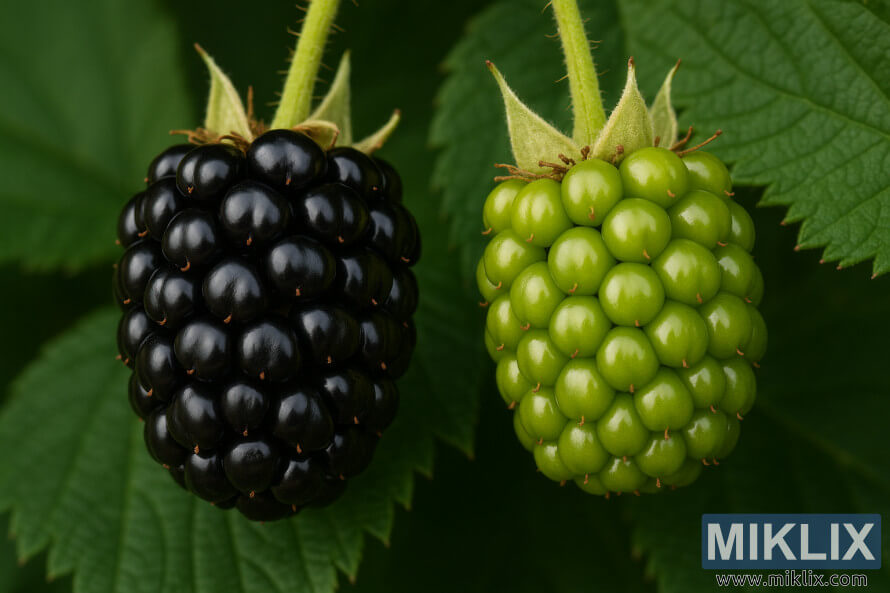
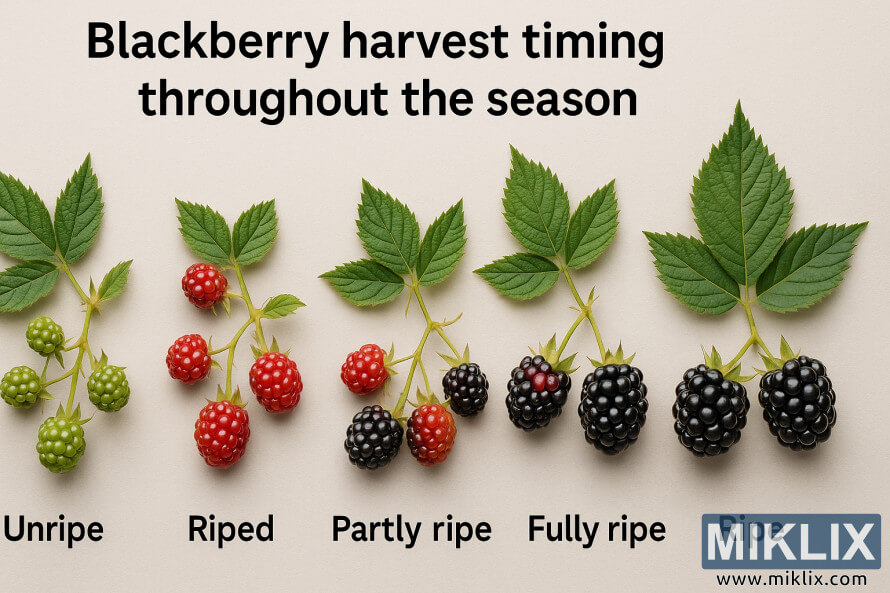
- Berries turn from red to black as they ripen
- Fully ripe berries have a dull black appearance (not shiny)
- Ripe berries detach easily with gentle pulling
- The receptacle (white core) remains in the fruit when picked
Click or tap the image for more information and higher resolutions.
Harvest Season
- Trailing varieties: Late June to early August
- Erect varieties: Early July to August
- Semi-erect varieties: August to September
- Primocane-fruiting: Late summer until frost
Click or tap the image for more information and higher resolutions.
Harvesting Tips
- Pick in the cool morning hours when berries are firm
- Harvest every 2-3 days during peak season
- Use both hands: one to hold the branch, one to gently pull berries
- Collect berries in shallow containers to prevent crushing
- Pick all ripe berries, as overripe fruit attracts pests and disease
- Avoid harvesting during or immediately after rain when possible
Storage and Preservation
Fresh Storage
- Refrigerate unwashed berries immediately
- Store in breathable containers lined with paper towels
- Use within 3-5 days for best quality
- Wash only just before using
Freezing
- Wash and dry berries thoroughly
- Spread in a single layer on a baking sheet
- Freeze until solid (about 2 hours)
- Transfer to freezer bags or containers
- Will keep for up to 10-12 months
Preserving
- Make jam or jelly with pectin
- Create blackberry syrup for pancakes
- Prepare blackberry vinegar
- Dehydrate for blackberry "raisins"
- Can in light syrup for year-round use
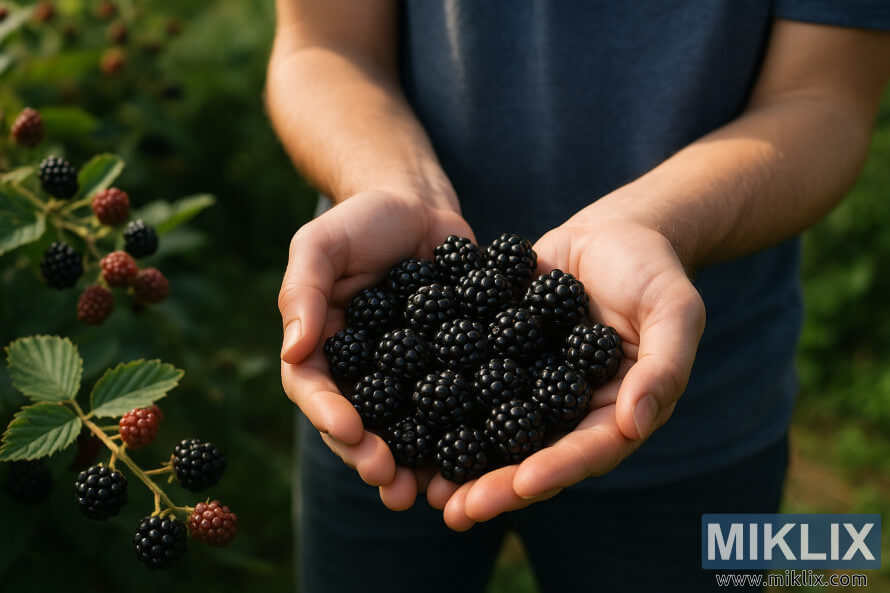
Yield Expectations: Mature blackberry plants can produce impressive harvests. Expect 10-13 pounds per plant for trailing varieties, 18-28 pounds per 10 feet of row for erect types, and 25-35 pounds per plant for semi-erect varieties when properly maintained.
Click or tap the image for more information and higher resolutions.
Growing Blackberries in Containers
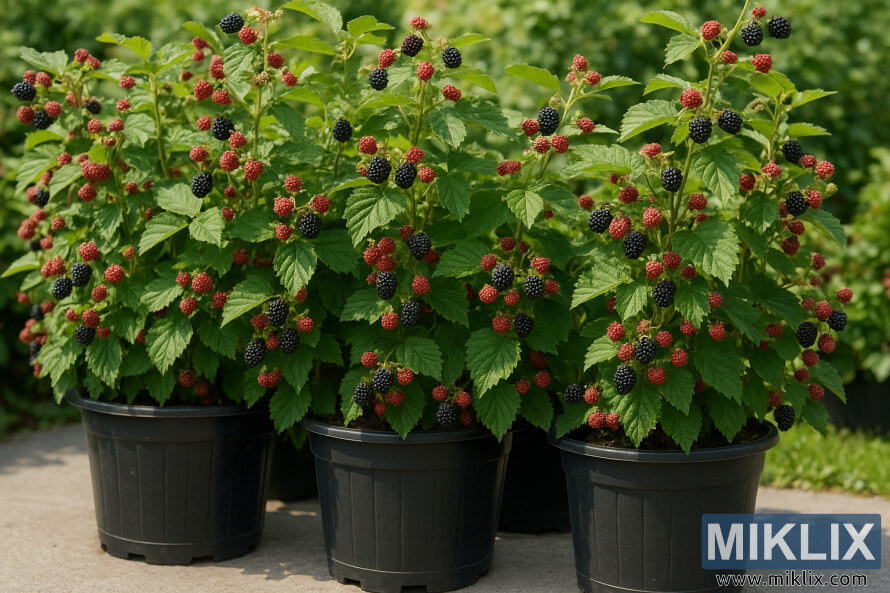
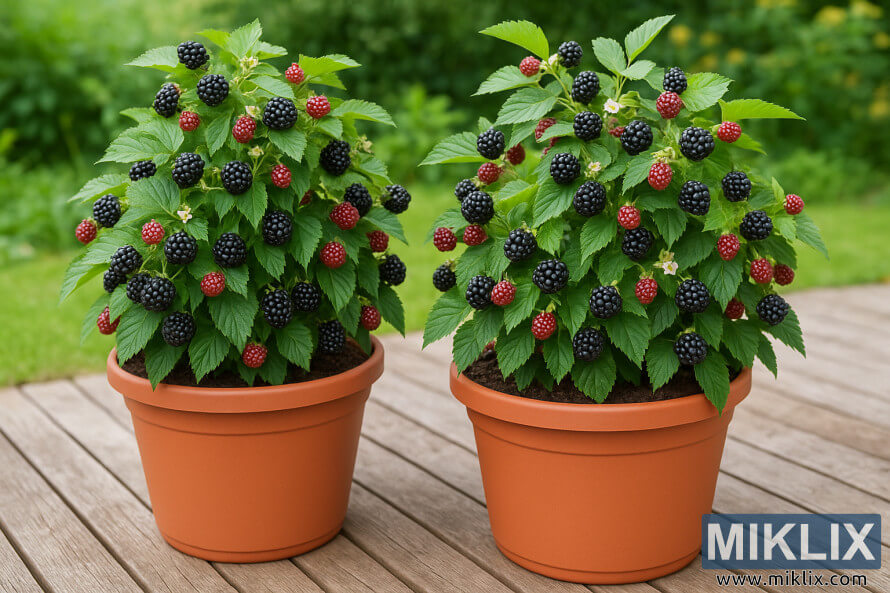
Limited space doesn't mean you can't enjoy homegrown blackberries. Container growing is an excellent option for patios, decks, or small yards, and it offers advantages like mobility and better control over growing conditions.
Click or tap the image for more information and higher resolutions.
Best Varieties for Containers
Some blackberry varieties are better suited to container growing than others:
- Primocane-fruiting erect varieties like 'Prime-Ark Freedom' and 'Black Gem' are ideal due to their compact growth habit
- Dwarf varieties like 'Baby Cakes' are specifically bred for container growing
- Thornless varieties are easier to manage in the confined space of a container
Click or tap the image for more information and higher resolutions.
Container Requirements
Container Size and Type
- Use a 20-30 gallon container (minimum 16 inches in diameter)
- Ensure a minimum depth of 24 inches for root development
- Choose containers with multiple drainage holes
- Consider half-barrels, large grow bags, or dedicated fruit planters
Growing Medium
- Use high-quality potting mix, not garden soil
- Ideal mix: 1 part perlite, 1 part bark, 2 parts potting soil
- Ensure good drainage while maintaining moisture retention
- Add slow-release fertilizer to the mix at planting time
Container Care Tips
Watering
- Check moisture levels daily during growing season
- Water when top 1-2 inches of soil feels dry
- Ensure thorough watering until water drains from bottom
- Use self-watering containers or drip irrigation for consistency
Fertilizing
- Apply liquid fertilizer every 2-3 weeks during growing season
- Use balanced fertilizer (10-10-10) or specialized berry fertilizer
- Supplement with compost tea monthly
- Reduce feeding in late summer/fall
Support and Pruning
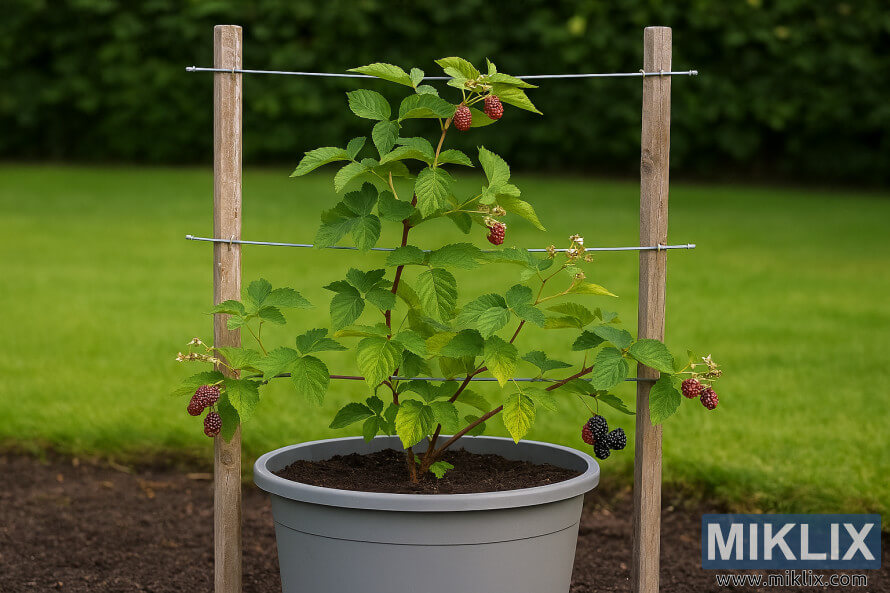
- Install a small trellis or stakes in the container
- Limit to 4-5 canes per container
- Prune more aggressively than in-ground plants
- Consider single-crop system for primocane-fruiting types
Click or tap the image for more information and higher resolutions.
Winter Protection
Container-grown blackberries are more vulnerable to winter cold than in-ground plants because their roots are less insulated. In colder regions (zones 5-6):
- Move containers to a protected location (unheated garage, against a south-facing wall)
- Wrap containers with bubble wrap or burlap for insulation
- Apply a thick layer of mulch over the soil surface
- Avoid overwatering during dormancy, but don't let roots dry out completely
Container Lifespan: Plan to refresh the growing medium every 2-3 years by removing about 1/3 of the old soil and replacing it with fresh potting mix. Every 4-5 years, consider repotting entirely with fresh medium.
Troubleshooting Common Problems
Even with proper care, blackberry plants can sometimes develop problems. Here's how to identify and address common issues:
Poor Fruit Production
Possible causes:
- Insufficient sunlight (less than 6 hours daily)
- Inadequate pollination
- Improper pruning (too many or too few canes)
- Nutrient deficiencies
- Water stress during fruit development
Solutions:
- Relocate plants to a sunnier location if possible
- Plant pollinator-attracting flowers nearby
- Follow proper pruning guidelines for your blackberry type
- Apply balanced fertilizer in spring and early summer
- Ensure consistent watering, especially during fruit development
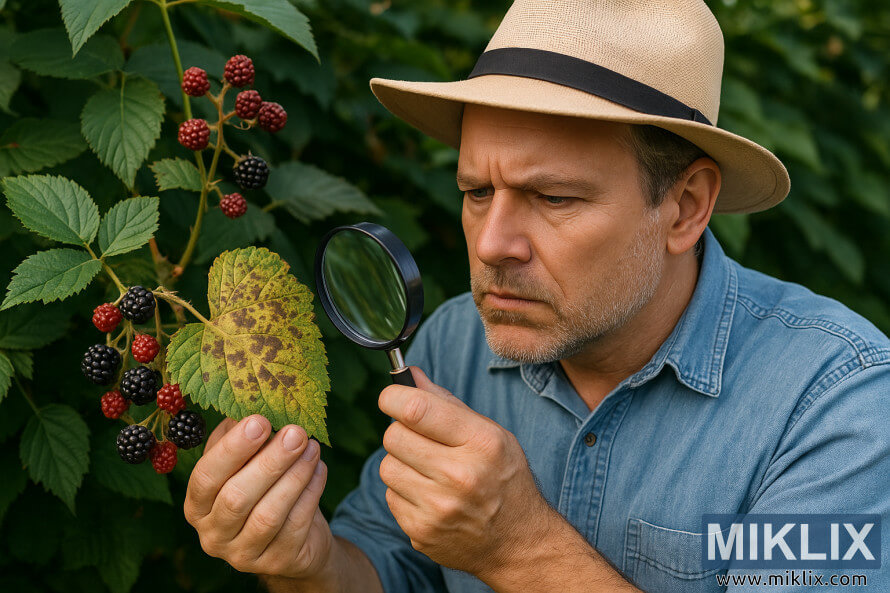
Yellowing Leaves
Possible causes:
- Nitrogen deficiency (older leaves yellow first)
- Iron chlorosis (yellowing between veins, often due to high pH)
- Poor drainage/waterlogged soil
- Spider mite infestation
- Virus infection
Solutions:
- Apply nitrogen fertilizer if older leaves are affected
- Add iron sulfate or acidifying fertilizer if pH is too high
- Improve drainage or consider raised beds
- Check for spider mites and treat with insecticidal soap if present
- Remove and destroy virus-infected plants
Cane Dieback
Possible causes:
- Fungal diseases (anthracnose, cane blight)
- Winter injury
- Insect damage (cane borers)
- Mechanical damage
Solutions:
- Prune out affected canes, cutting well below damaged areas
- Disinfect pruning tools between cuts
- Improve air circulation with proper spacing and pruning
- Apply copper-based fungicide in early spring
- Provide winter protection in colder regions
Small or Malformed Berries
Possible causes:
- Poor pollination
- Drought stress during fruit development
- Insect damage (tarnished plant bug)
- Nutrient deficiencies (especially potassium)
- Virus infection
Solutions:
- Encourage pollinators with companion plantings
- Maintain consistent soil moisture
- Monitor for insect pests and treat as needed
- Apply balanced fertilizer with adequate potassium
- Replace virus-infected plants with certified disease-free stock
When to Start Over: If your blackberry plants show severe disease symptoms, consistently poor production despite corrective measures, or are more than 10-15 years old with declining vigor, it may be time to remove them and start fresh with new, certified disease-free plants in a different location.
Click or tap the image for more information and higher resolutions.
Tips for Maximizing Yield and Berry Quality
Follow these expert tips to get the most from your blackberry plants in terms of both quantity and quality:
Site Optimization
- Choose a location with 8+ hours of direct sunlight
- Ensure excellent air circulation to prevent disease
- Plant in raised beds if drainage is questionable
- Orient rows north-south for maximum sun exposure
- Protect from strong winds that can damage canes
Plant Management
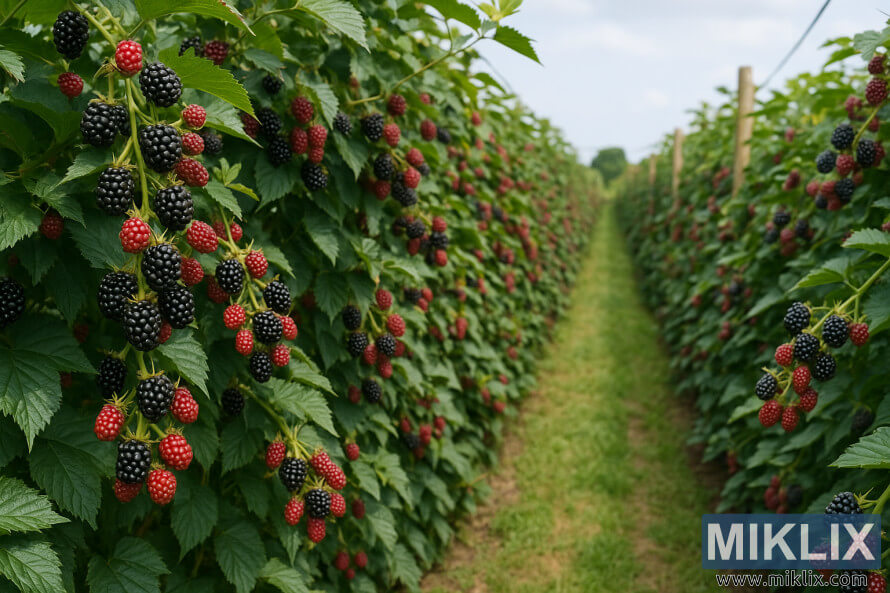
- Maintain optimal cane density (4-8 canes per plant or linear foot)
- Remove weak or spindly canes to focus energy on strong ones
- Summer tip erect and semi-erect varieties to increase branching
- Train canes properly on trellis systems
- Remove suckers outside the desired row width
Nutrition and Watering
- Apply compost annually in early spring
- Use balanced fertilizer with micronutrients
- Consider foliar feeding with seaweed extract
- Install drip irrigation for consistent moisture
- Increase watering during fruit development
Click or tap the image for more information and higher resolutions.
Enhancing Berry Sweetness and Flavor
Variety Selection
- Choose varieties known for superior flavor (like 'Triple Crown' or 'Marion')
- Select varieties suited to your climate for optimal development
- Consider trailing types for best flavor in suitable climates
- Plant multiple varieties to compare and enjoy different flavor profiles
Cultural Practices
- Allow berries to fully ripen on the plant (dull black color)
- Harvest in morning when sugar content is highest
- Avoid excessive nitrogen, which can reduce sweetness
- Apply potassium and phosphorus for improved fruit quality
- Maintain consistent soil moisture to prevent stress
Click or tap the image for more information and higher resolutions.
Recommended Varieties for Home Gardens
Best for Flavor
- 'Triple Crown' (thornless semi-erect)
- 'Marion' (thorny trailing)
- 'Navaho' (thornless erect)
- 'Boysen' (thornless trailing)
- 'Hall's Beauty' (thornless trailing)
Best for Cold Climates
- 'Darrow' (thorny erect)
- 'Illini Hardy' (thorny erect)
- 'Prime-Ark Freedom' (thornless primocane-fruiting)
- 'Chester' (thornless semi-erect)
- 'Navaho' (thornless erect)
Best for Containers
- 'Baby Cakes' (dwarf, thornless)
- 'Prime-Ark Freedom' (thornless primocane-fruiting)
- 'Black Gem' (thornless primocane-fruiting)
- 'Arapaho' (compact thornless erect)
- 'Bushel and Berry' series varieties
Conclusion: Enjoying the Fruits of Your Labor
Growing blackberries in your home garden offers tremendous rewards for relatively modest effort. With proper variety selection, site preparation, and ongoing care, you can enjoy abundant harvests of these nutritious berries for many years. The satisfaction of picking sun-warmed berries at the peak of ripeness is an experience that simply can't be matched by store-bought fruit.
Remember that blackberry plants improve with age, typically reaching full production in their third year. Be patient during the establishment phase, and you'll be rewarded with increasing yields as your plants mature. Whether you're growing blackberries in a spacious backyard or in containers on a patio, the principles of good care remain the same: adequate sunlight, consistent moisture, proper pruning, and timely harvesting.
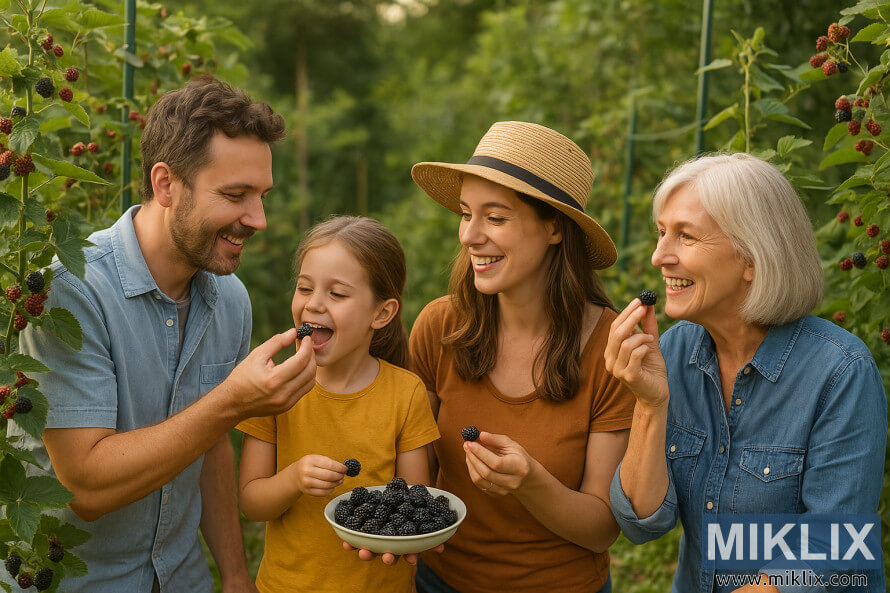
Beyond the delicious fresh berries, growing your own blackberries connects you to the seasonal rhythms of nature and provides opportunities to share both the experience and the harvest with family and friends. From fresh eating to preserves, smoothies to desserts, homegrown blackberries offer endless culinary possibilities that will have you eagerly anticipating each year's harvest.
Click or tap the image for more information and higher resolutions.
Further Reading
If you enjoyed this post, you may also like these suggestions:
- How to Grow Peaches: A Guide for Home Gardeners
- Growing Honeyberries in Your Garden: A Guide to a Sweet Spring Harvest
- Growing Carrots: The Complete Guide to Garden Success