
A Complete Guide to Growing Cauliflower in Your Home Garden
Published: December 22, 2025 at 7:58:23 PM UTC
Growing your own cauliflower can be incredibly rewarding. While this cool-season crop has a reputation for being somewhat finicky, the satisfaction of harvesting a perfect, snow-white head that you've nurtured from seed is unmatched.
Click or tap the image for more information and higher resolutions.
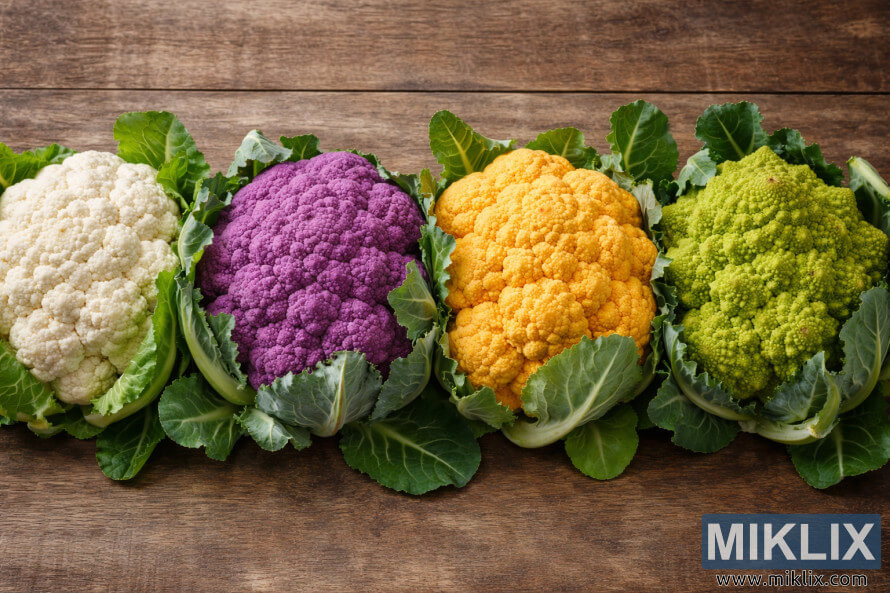
Not only will you enjoy superior flavor and freshness compared to store-bought options, but you'll also have access to unique varieties in purple, orange, and green that are rarely found in supermarkets. With the right knowledge and a bit of patience, you can successfully grow this nutritious vegetable in your own backyard.
Best Cauliflower Varieties for Home Gardens
Choosing the right cauliflower variety is crucial for success, especially if you're new to growing this vegetable. Some varieties are more forgiving than others and better suited to home gardens.
Popular cauliflower varieties for home gardens: white, purple, orange, and green Romanesco
Early Season Varieties
- Snow Crown - A reliable, early-maturing hybrid (50-60 days) with good heat tolerance and uniform white heads. Perfect for beginners.
- Amazing - Mid-season (65 days) variety that produces large, dense white heads and adapts well to various growing conditions.
- White Sails - Mid-season variety with dependable production and excellent flavor. Good disease resistance.
Colored Varieties
- Graffiti - Stunning purple heads that maintain some color when cooked. Late-season variety with excellent flavor.
- Cheddar - Beautiful orange heads rich in beta-carotene. Mild, sweet flavor and mid-season maturity.
- Vitaverde - Light green heads with a slightly nutty flavor. Best grown as a fall crop for optimal color development.
Heat-Tolerant Varieties
- Fremont - Mid-season hybrid with good heat tolerance and reliable white heads.
- Aquarius - Heat-tolerant variety that produces pure white heads even in less-than-ideal conditions.
- Self-Blanche - As the name suggests, this variety naturally protects its head with leaves, requiring less maintenance.
Growing Requirements for Cauliflower
Understanding cauliflower's specific growing requirements is essential for success. This cool-season crop has particular needs that must be met for proper head formation.
Climate and Timing
Cauliflower thrives in temperatures between 60°F and 70°F. It's frost-tolerant down to about 28°F but struggles in heat above 80°F. This narrow temperature window makes timing crucial:
Spring Planting
- Start seeds indoors 4-5 weeks before the last spring frost
- Transplant seedlings outdoors 2-4 weeks before the last frost
- Aim to harvest before summer heat arrives
- Best in regions with long, cool springs
Fall Planting (Recommended)
- Start seeds 10-12 weeks before the first fall frost
- Transplant seedlings when daytime temperatures are below 75°F
- Plants mature as temperatures cool in fall
- Often produces better quality heads than spring plantings
Soil Requirements
Cauliflower demands rich, well-draining soil with consistent moisture:
- Soil pH between 6.0 and 7.0 is ideal
- High in organic matter - incorporate compost before planting
- Good moisture retention while avoiding waterlogging
- Fertile soil with adequate nitrogen for leaf development
Sunlight and Spacing
Proper light and space are crucial for healthy cauliflower development:
- Full sun (6-8 hours daily) is required for proper head formation
- In hot climates, light afternoon shade can be beneficial
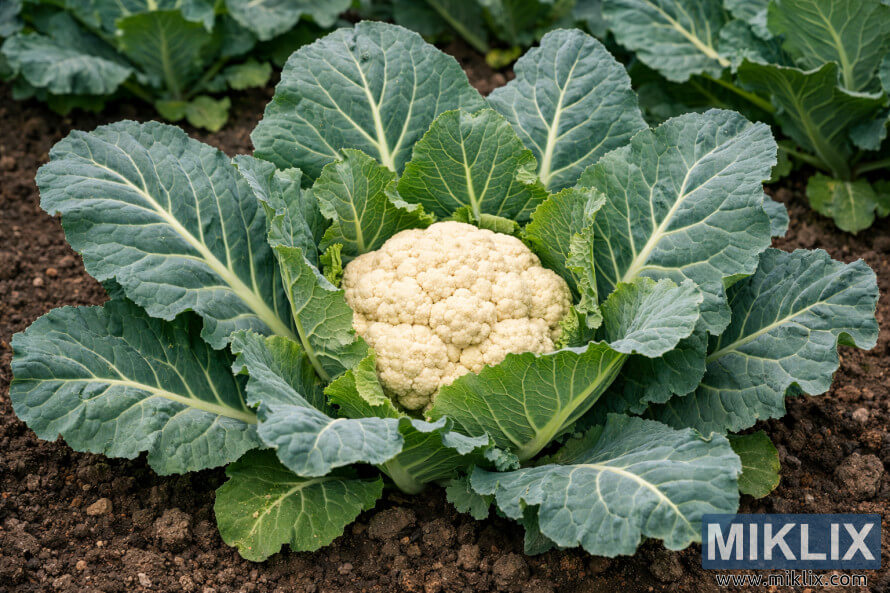
- Space plants 18-24 inches apart in rows
- Allow 30 inches between rows for good air circulation
- Crowded plants may not form proper heads
Click or tap the image for more information and higher resolutions.
Step-by-Step Planting Instructions
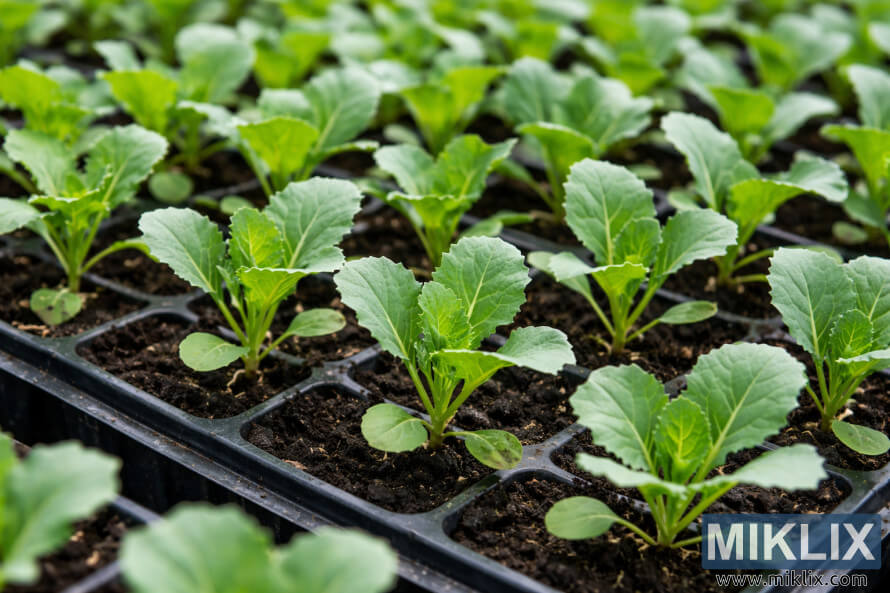
Cauliflower can be started from seeds indoors or purchased as transplants. Starting from seed gives you access to more varieties and ensures your plants haven't been stressed before planting.
Starting Seeds Indoors
Timing: Start seeds 4-5 weeks before planned transplant date. For spring crops, this is 6-7 weeks before the last frost. For fall crops, start seeds 10-12 weeks before the first fall frost.
Containers: Use seed-starting trays with good drainage. Fill with sterile seed-starting mix.
Planting: Sow seeds ¼ to ½ inch deep, 2-3 seeds per cell. Thin to the strongest seedling after germination.
Temperature: Maintain soil temperature around 70°F for germination. Seeds should sprout in 5-10 days.
Light: Once sprouted, provide 14-16 hours of light daily. Use grow lights if necessary.
Watering: Keep soil consistently moist but not soggy. Water from below when possible.
Fertilizing: When seedlings develop true leaves, feed with half-strength liquid fertilizer every two weeks.
Hardening Off Seedlings
Before transplanting, seedlings need to be gradually acclimated to outdoor conditions:
- Begin the hardening process 7-10 days before transplanting
- Start by placing seedlings outdoors in a sheltered location for 1-2 hours
- Gradually increase outdoor time by 1-2 hours daily
- Avoid direct sun and wind initially
- Bring plants in at night until they can tolerate overnight temperatures
- Reduce watering slightly, but don't allow plants to wilt
Click or tap the image for more information and higher resolutions.
Transplanting to the Garden
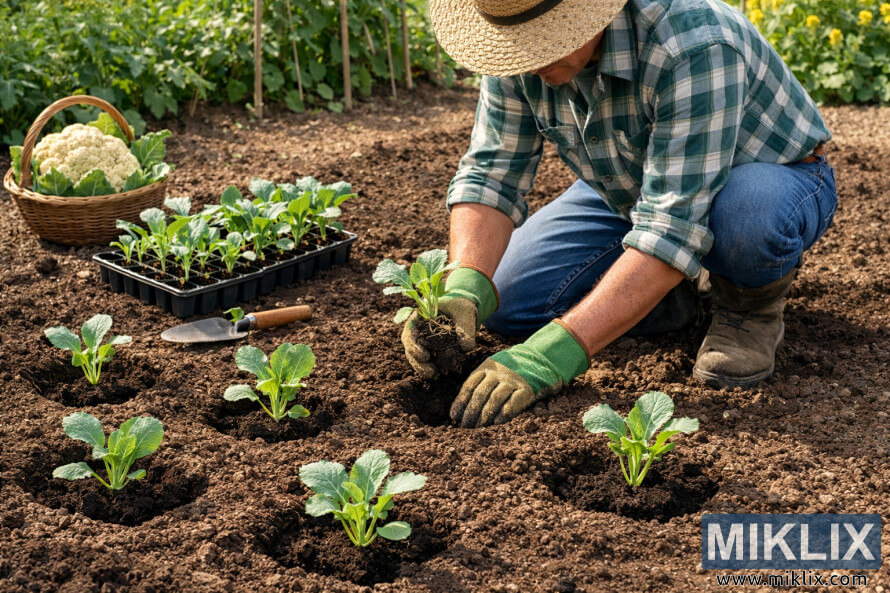
Timing: Transplant when seedlings have 4-6 true leaves and are 4-6 inches tall. For spring planting, this is 2-3 weeks before the last frost. For fall planting, when temperatures are consistently below 75°F.
Soil Preparation: Work 2-3 inches of compost into the soil. Add a balanced fertilizer according to package directions.
Spacing: Dig holes 18-24 inches apart in rows spaced 30 inches apart.
Planting Depth: Set plants at the same depth they were growing in containers. The top of the root ball should be level with the soil surface.
Watering: Water thoroughly after transplanting to eliminate air pockets around roots.
Protection: If frost threatens, cover young plants with row covers or cloches. In hot weather, provide temporary shade until established.
Click or tap the image for more information and higher resolutions.
Care and Maintenance
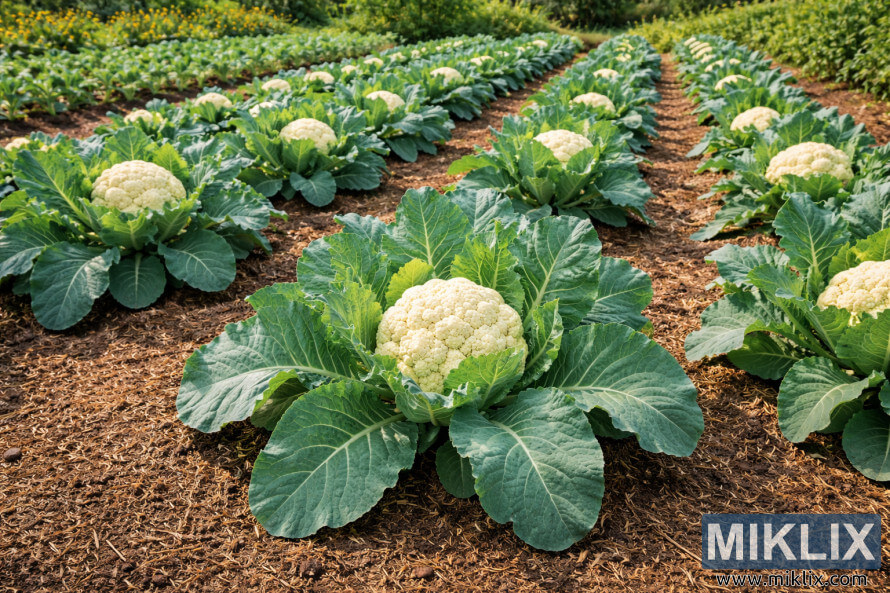
Consistent care is crucial for cauliflower success. Any stress from inconsistent watering, temperature fluctuations, or nutrient deficiencies can lead to small or poorly formed heads.
Click or tap the image for more information and higher resolutions.
Watering Schedule
Cauliflower has shallow roots and needs consistent moisture:
- Provide 1-1.5 inches of water per week, more during hot weather
- Water deeply to encourage root development
- Use drip irrigation or soaker hoses to keep foliage dry
- Maintain consistent soil moisture - fluctuations can cause buttoning or poor head development
- Apply mulch to conserve moisture and moderate soil temperature
Fertilization
Cauliflower is a heavy feeder that benefits from regular nutrient applications:
- Apply a balanced fertilizer (10-10-10) before planting
- Side-dress with nitrogen-rich fertilizer when plants are 4 inches tall
- Apply a second side-dressing when plants begin forming heads
- Use fish emulsion or compost tea for organic options
- Avoid high-nitrogen fertilizers late in the growing season
Blanching
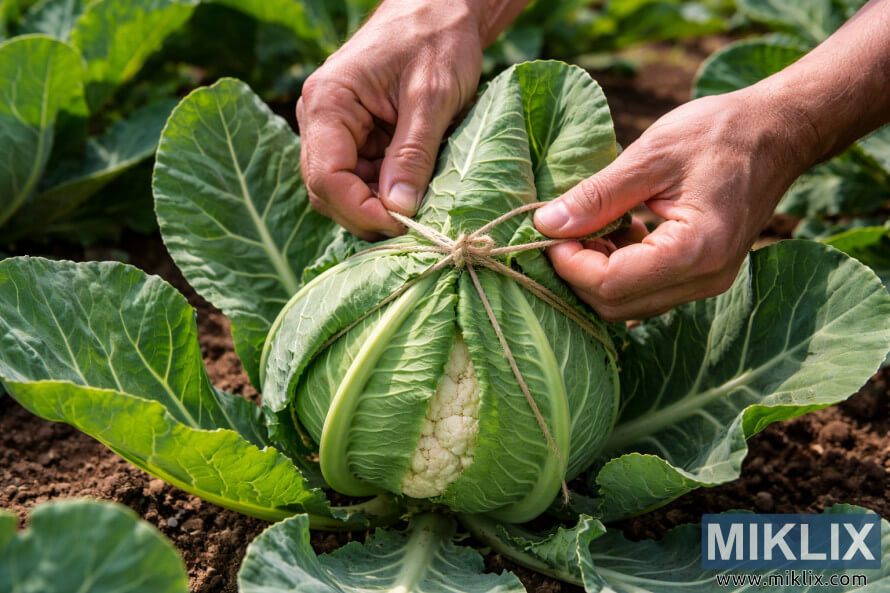
For white cauliflower varieties, blanching is necessary to prevent the head from turning yellow or green:
Blanching cauliflower by tying outer leaves over the developing head
Timing: Begin blanching when the head (curd) is about 2-3 inches in diameter
Method: Gently fold the outer leaves over the developing head
Securing: Loosely tie leaves with garden twine, rubber bands, or clothespins
Airflow: Ensure some air circulation to prevent rot
Monitoring: Check under the leaves every few days for pests or disease
Note: Colored varieties (purple, orange, green) do not require blanching and actually need sunlight to develop their vibrant colors.
Click or tap the image for more information and higher resolutions.
Pest Management
Cauliflower is susceptible to several common garden pests:
| Pest | Symptoms | Control Methods |
| Cabbage Worms | Holes in leaves, green caterpillars present | Handpick, use Bt (Bacillus thuringiensis), cover with row covers |
| Aphids | Curled leaves, sticky residue, clusters of small insects | Strong water spray, insecticidal soap, encourage beneficial insects |
| Flea Beetles | Small holes in leaves, stunted growth | Row covers, diatomaceous earth, keep garden clean |
| Cabbage Root Maggots | Wilting plants, damaged roots | Protective collars around stems, crop rotation, delayed planting |
Common Problems and Solutions
Even with proper care, cauliflower can develop various issues. Knowing how to identify and address these problems can save your crop.
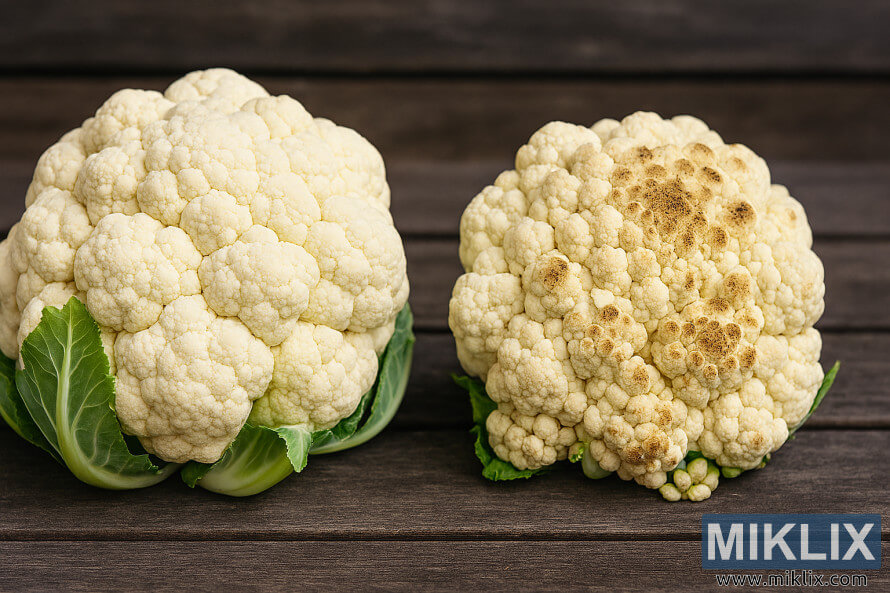
Left: Healthy cauliflower head; Right: Cauliflower showing signs of buttoning and browning
Problem: Buttoning (Small Premature Heads)
Causes: Temperature stress, transplant shock, nutrient deficiencies, root damage
Solutions:
- Avoid transplanting overly mature seedlings
- Ensure consistent watering and fertilization
- Protect young plants from temperature extremes
- Handle seedlings carefully to prevent root damage
Problem: Brown or Purple Spots on Heads
Causes: Boron deficiency, fungal diseases, sun exposure
Solutions:
- Test soil and correct boron deficiency if needed
- Ensure proper blanching of white varieties
- Improve air circulation to reduce fungal issues
- Apply compost tea or seaweed extract as a foliar spray
Problem: Loose, Spreading Heads
Causes: Heat stress, harvesting too late, inconsistent watering
Solutions:
- Harvest when heads are firm and compact
- Plant for harvest during cooler weather
- Maintain consistent soil moisture
- Provide temporary shade during heat waves
Problem: No Head Formation
Causes: Extreme temperatures, nitrogen imbalance, insufficient light
Solutions:
- Time planting for optimal temperature range (60-70°F)
- Balance nitrogen fertilization - not too much or too little
- Ensure plants receive at least 6 hours of sunlight
- Choose varieties suited to your climate
Disease Prevention
Preventing diseases is easier than treating them once established:
- Practice crop rotation - don't plant brassicas in the same spot for 3-4 years
- Ensure good air circulation between plants
- Water at the base of plants, keeping foliage dry
- Remove and destroy diseased plant material
- Use disease-resistant varieties when available
Click or tap the image for more information and higher resolutions.
Harvesting Guidelines
Knowing when and how to harvest cauliflower is crucial for optimal flavor and texture. Timing is everything with this vegetable.
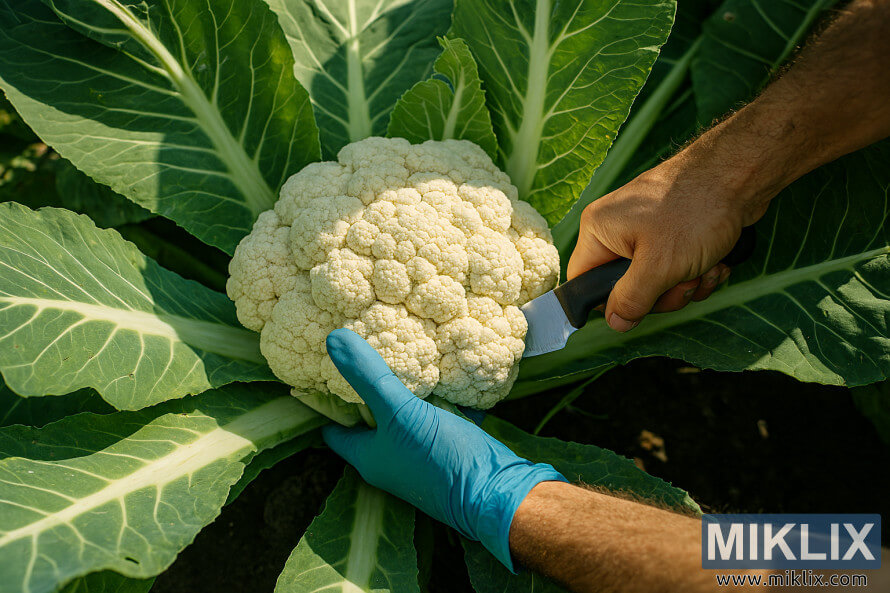
Harvesting a mature cauliflower head by cutting below the head with a sharp knife
When to Harvest
Timing your harvest correctly ensures the best quality cauliflower:
- Harvest when heads are firm, compact, and reach 6-8 inches in diameter
- Don't wait until the head begins to separate or "rice" (develop a grainy texture)
- Most varieties mature 50-100 days after transplanting, depending on variety and growing conditions
- For white varieties, heads should be fully blanched
- Colored varieties should have developed their full color
- Morning harvest is best for optimal freshness
How to Harvest
Use a sharp knife to cut the stem about 1-2 inches below the head
Leave a few of the wrapper leaves attached to protect the head
Handle heads carefully to avoid bruising
If heads begin to open or separate, harvest immediately regardless of size
After harvesting the main head, some varieties may produce small side shoots that can also be harvested
Expected Yield
With proper care, you can expect:
- One head per plant (unlike broccoli, which produces side shoots)
- Heads typically weighing 1-2 pounds each
- 3-5 plants per person for fresh consumption
- 8-10 plants if preserving for later use
Click or tap the image for more information and higher resolutions.
Storage and Preservation
Properly stored cauliflower maintains its quality and can be enjoyed long after harvest.
Fresh Storage
For short-term storage of fresh cauliflower:
- Refrigerate unwashed heads in a perforated plastic bag
- Store in the crisper drawer for maximum freshness
- Use within 1-2 weeks for best quality
- Keep heads dry - moisture promotes spoilage
- If the head is too large, cut into sections and use as needed
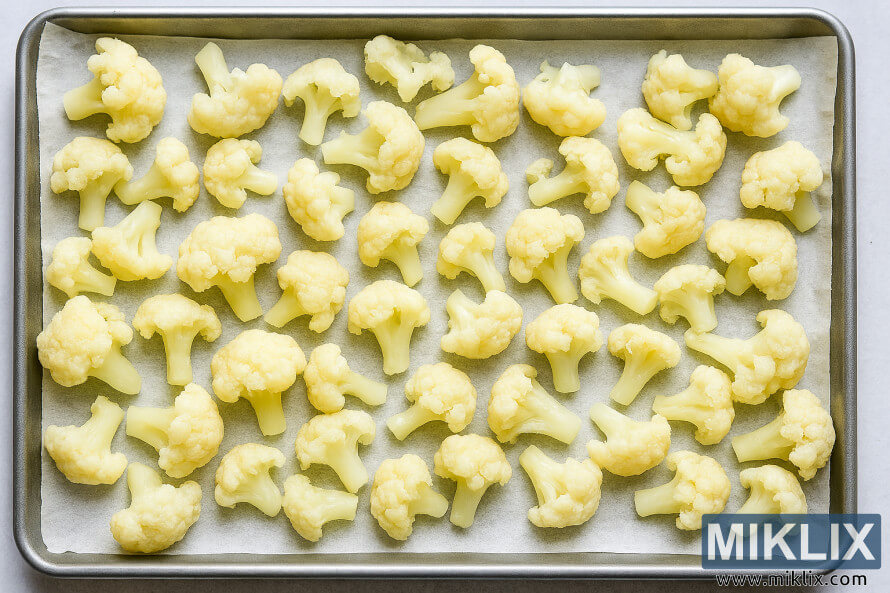
Freezing
Freezing is the best method for long-term preservation:
Cut the head into florets of uniform size
Blanch in boiling water for 3 minutes
Cool immediately in ice water for 3 minutes
Drain thoroughly and pat dry
Pack in freezer bags or containers, removing as much air as possible
Label with date and use within 10-12 months
Pickling
Pickled cauliflower makes a delicious condiment or snack:
- Cut into small florets
- Combine with other vegetables like carrots and peppers if desired
- Use a standard pickling brine with vinegar, salt, sugar, and spices
- Process in a water bath for shelf-stable pickles, or make refrigerator pickles
- Allow pickles to cure for at least a week before eating
Click or tap the image for more information and higher resolutions.
Simple Recipe Ideas
Your homegrown cauliflower deserves to be showcased in delicious recipes that highlight its fresh flavor and texture.
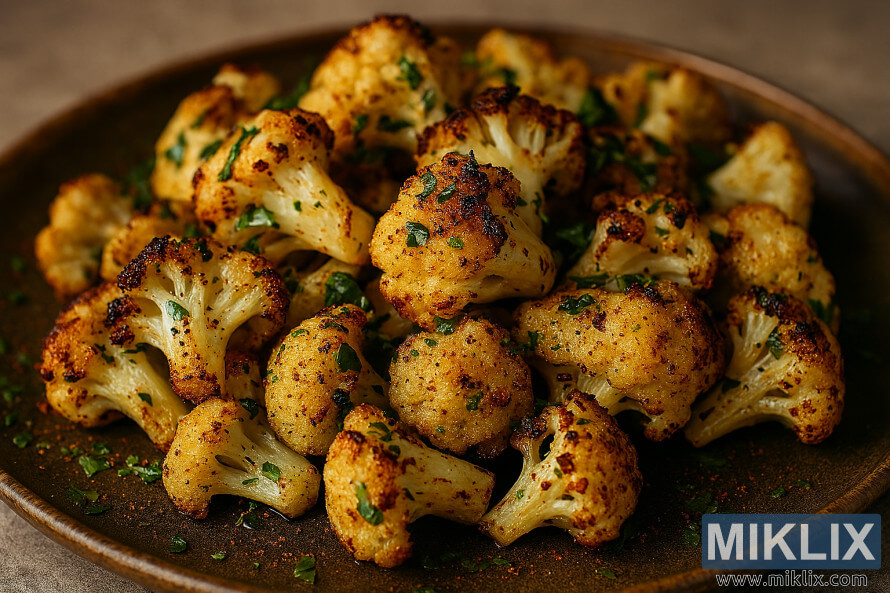
Roasted Cauliflower
Simple roasting brings out cauliflower's natural sweetness.
- Cut one head into florets
- Toss with 2-3 tablespoons olive oil
- Season with salt, pepper, and garlic powder
- Spread on baking sheet
- Roast at 425°F for 20-25 minutes until golden
- Finish with fresh herbs and lemon zest
Cauliflower "Rice"
A low-carb alternative to traditional rice.
- Pulse cauliflower florets in food processor until rice-sized
- Sauté in 1 tablespoon oil for 5-8 minutes
- Season with herbs and spices of choice
- Use as a base for stir-fries, bowls, or as a side dish
- Add sautéed vegetables and protein for a complete meal
Creamy Cauliflower Soup
A comforting way to enjoy your harvest.
- Sauté 1 onion and 2 garlic cloves in butter
- Add 1 head cauliflower florets and 4 cups broth
- Simmer until tender, about 15-20 minutes
- Blend until smooth
- Stir in 1/2 cup cream or milk
- Season with salt, pepper, and nutmeg
Click or tap the image for more information and higher resolutions.
Conclusion
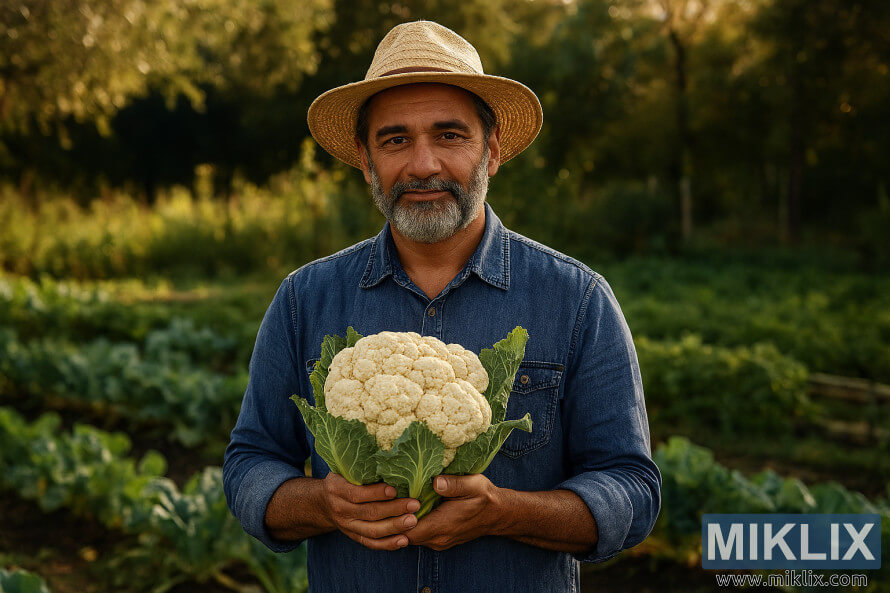
Growing cauliflower may require a bit more attention than some other vegetables, but the reward is well worth the effort. With proper timing, consistent care, and attention to detail, you can harvest beautiful, nutritious heads that far surpass anything available in stores. Don't be discouraged if your first attempt isn't perfect - each growing season brings new knowledge and experience. Start with easier varieties like 'Snow Crown' if you're a beginner, and expand to colorful varieties as you gain confidence. The satisfaction of serving a meal featuring cauliflower you've grown yourself is truly unmatched. Happy growing!
Click or tap the image for more information and higher resolutions.
Further Reading
If you enjoyed this post, you may also like these suggestions:
- A Complete Guide to Growing Kiwis at Home
- A Complete Guide to Growing Leeks at Home Successfully
- Growing Green Beans: A Complete Guide for Home Gardeners