
Image: Onions: Nutrition Profile and Health Benefits Infographic
Published: January 6, 2026 at 9:04:42 PM UTC
Last updated: January 6, 2026 at 9:07:50 PM UTC
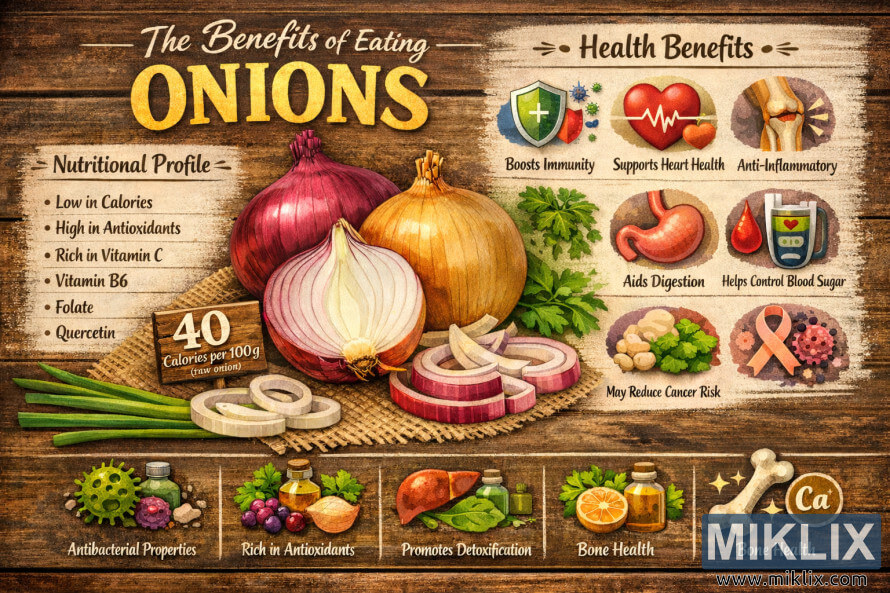
Rustic landscape onion infographic illustrating nutrition highlights such as vitamin C, B6, folate and quercetin with icons for key health benefits.
Available versions of this image
The image files available for download below are less compressed and higher resolution - and as a result of that, higher quality - than the images embedded in articles and pages on this website, which are more optimized for file size in order to reduce bandwidth consumption.
Regular size (1,536 x 1,024)
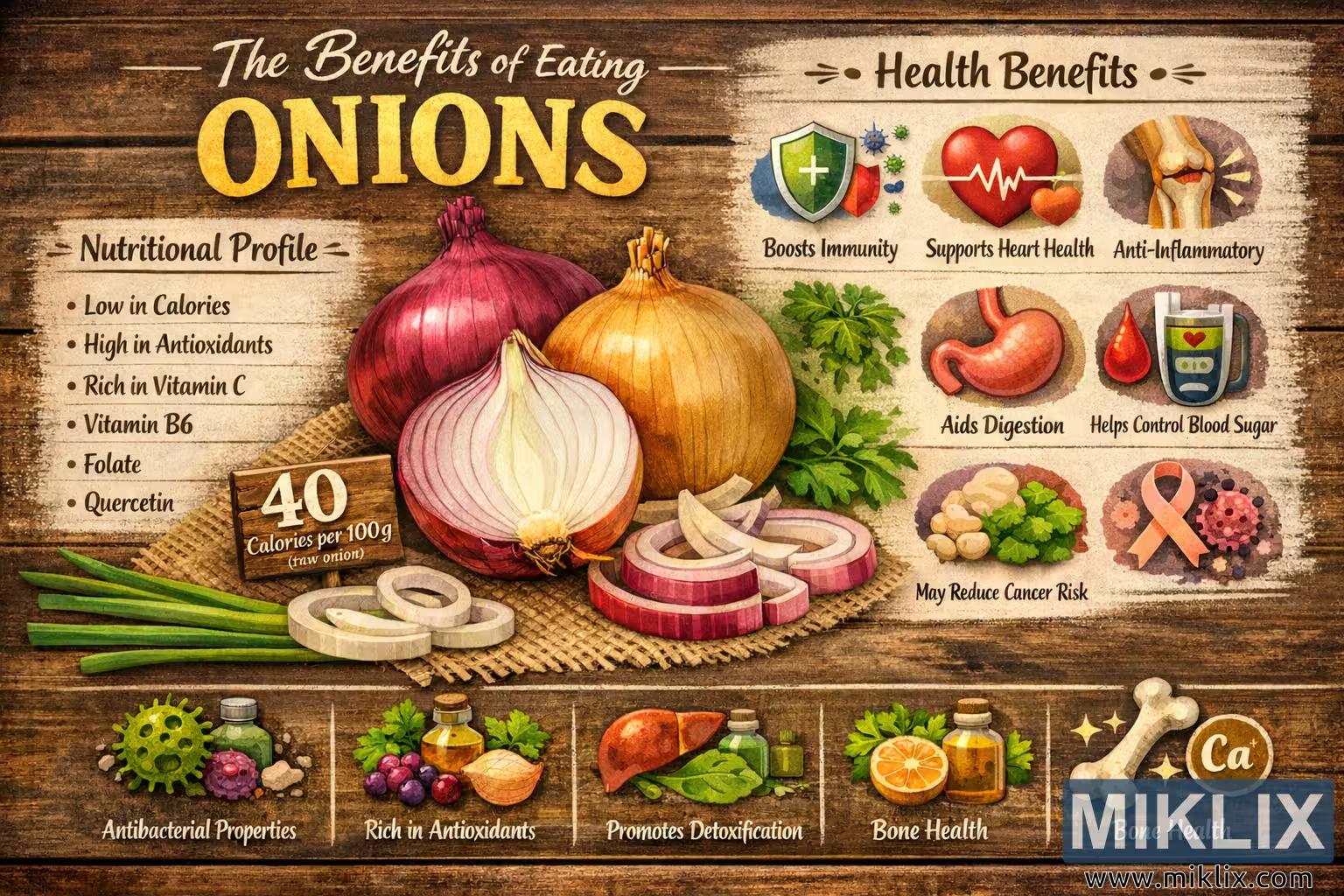
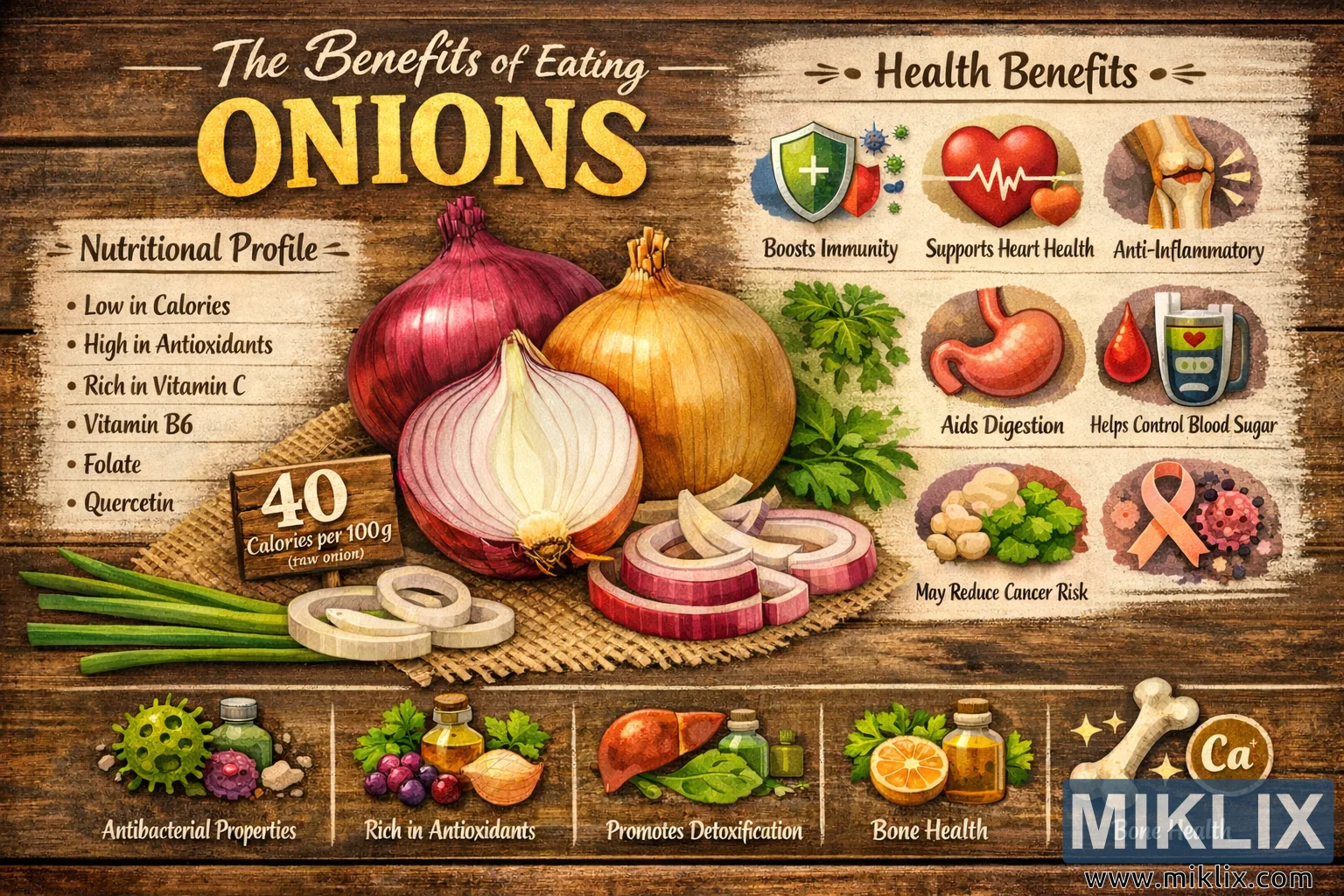
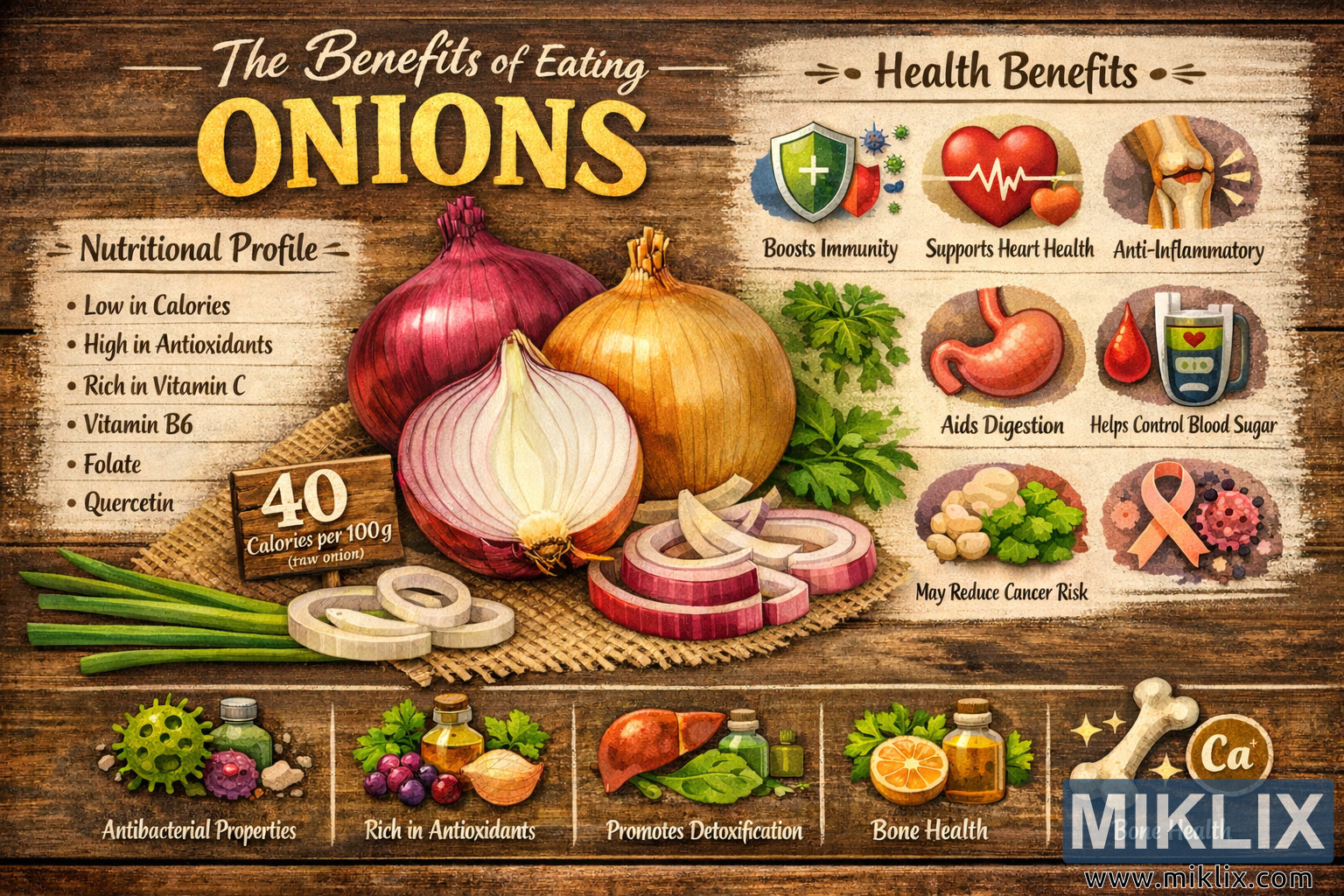
Large size (3,072 x 2,048)
Very large size (4,608 x 3,072)
Extra large size (6,144 x 4,096)
Comically large size (1,048,576 x 699,051)
- Still uploading... ;-)
Image description
A landscape, infographic-style illustration presents the nutritional profile and health benefits of eating onions on a warm, rustic tabletop backdrop. The entire scene sits on weathered wooden planks with soft vignetting at the edges, giving a farm-to-table feel. Across the top, a hand-lettered headline reads “The Benefits of Eating” above a large, textured, golden word “ONIONS,” centered slightly left. To the right of the headline, a matching banner titled “Health Benefits” introduces a tidy grid of icons and captions.
On the left third of the image, a parchment-like panel titled “Nutritional Profile” lists key points in a neat bullet column: “Low in Calories,” “High in Antioxidants,” “Rich in Vitamin C,” “Vitamin B6,” “Folate,” and “Quercetin.” The headings use brushy, handcrafted lettering while the bullets use a clean, readable serif, designed for quick scanning. Near the center-left, a small wooden placard acts as a calorie callout: a bold “40” with the caption “Calories per 100g” and a smaller note indicating it refers to raw onion.
Dominating the middle is a realistic, painterly still life of onions and fresh greens. A glossy red onion and a golden-brown onion stand upright behind a halved white onion that reveals pale rings and a tufted root. In the foreground, onion rings and sliced segments are arranged casually on a coarse burlap cloth, adding tactile texture. Long green onion stalks extend from the lower-left corner toward the center, while leafy herbs—resembling parsley or cilantro—fan out behind the onions to add freshness and contrast. Soft highlights and gentle shadows make the produce look three-dimensional against the flat infographic panels.
The right half is organized into a benefits panel with illustrated icons. Along the top row, three labels read “Boosts Immunity” (a shield with a cross and tiny germ shapes), “Supports Heart Health” (a red heart with an ECG line), and “Anti-Inflammatory” (a simplified joint graphic suggesting reduced swelling). Below them, two more icons appear: “Aids Digestion” (a stylized stomach) and “Helps Control Blood Sugar” (a blood droplet beside a meter-like device). Near the lower-right of the benefits area, a ribbon-and-cells style icon accompanies the text “May Reduce Cancer Risk,” adding a final headline benefit.
Along the bottom edge runs a segmented strip of mini-illustrations with captions separated by thin vertical dividers. From left to right, the labels include “Antibacterial Properties” (microbe-like shapes next to small bottles), “Rich in Antioxidants” (berries, a jar, and produce), “Promotes Detoxification” (a liver icon paired with leafy greens), and “Bone Health” (a citrus slice beside a supplement bottle). At the far right, “Bone Health” appears again with a large bone drawing and a circular “Ca+” symbol, reinforcing a calcium theme. Overall, the palette stays earthy—browns, creams, greens, and onion purples—while the layout balances decorative realism with clear infographic structure. Subtle grain, paper fibers, and painted edges tie the sections together, making the information feel approachable and kitchen-friendly.
The image is related to: Layers of Goodness: Why Onions Are a Superfood in Disguise