
A Complete Guide to Growing Grapes in Your Home Garden
Published: December 24, 2025 at 12:05:41 PM UTC
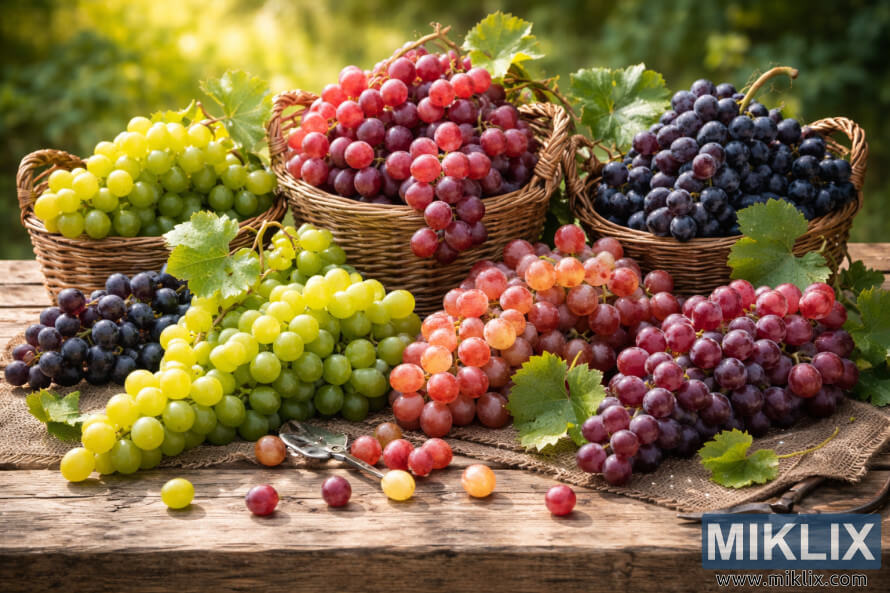
Growing your own grapes can be one of the most rewarding experiences in home gardening. Whether you dream of harvesting clusters of sweet table grapes for fresh eating, making homemade wine, or creating jellies and preserves, grape vines offer beauty and bounty that can last for decades.
Click or tap the image for more information and higher resolutions.
With proper care and attention, these versatile plants can produce 15-30 pounds of fruit per vine annually and thrive for 40+ years. This comprehensive guide will walk you through everything you need to know to successfully grow grapes in your backyard, from selecting the right varieties to harvesting your first delicious crop.
Choosing the Right Grape Varieties
Selecting appropriate grape varieties for your climate and intended use is the first crucial step to success. There are three main types of grapes to consider, each with different characteristics and growing requirements.
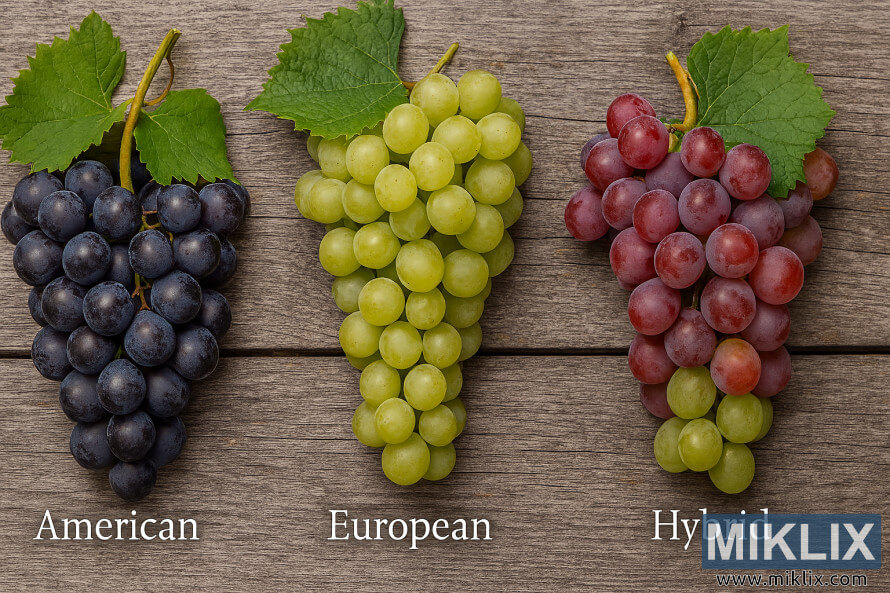
The three main types of grapes: American (left), European (center), and French-American hybrids (right)
American Grapes (Vitis labrusca)
American varieties are the most cold-hardy and disease-resistant options, making them ideal for beginners and gardeners in colder regions (USDA zones 4-7). These grapes typically have a distinctive "foxy" flavor and are excellent for juice, jelly, and fresh eating.
- Concord: The classic blue-black grape with that familiar grape juice flavor
- Niagara: A white grape with sweet, fruity flavor
- Catawba: A red grape suitable for wine, juice, or table use
- Bluebell: Blue berries with excellent winter hardiness (to zone 3)
European Grapes (Vitis vinifera)
European varieties are traditionally used for winemaking and prefer warm, dry Mediterranean-type climates (zones 7-10). They require more attention to disease prevention but offer excellent flavor profiles.
- Cabernet Sauvignon: Classic red wine grape
- Chardonnay: Popular white wine grape
- Flame Seedless: Red table grape with excellent flavor
- Thompson Seedless: Green table grape, also used for raisins
French-American Hybrids
These crosses between European and American varieties offer improved disease resistance while maintaining good flavor. They're an excellent middle ground for many home gardeners.
- Chambourcin: Blue-black grape for red wine
- Seyval Blanc: White wine grape with good cold hardiness
- Marquette: Cold-hardy red wine grape (to zone 3)
- Traminette: Aromatic white wine grape
Seedless Table Grapes
For fresh eating, consider these popular seedless varieties that perform well in home gardens:
- Mars: Blue seedless with Concord-like flavor, disease resistant
- Reliance: Red seedless with excellent flavor, cold-hardy
- Neptune: White seedless with fruity flavor
- Jupiter: Blue-red seedless with muscat flavor
Click or tap the image for more information and higher resolutions.
Site Selection and Preparation
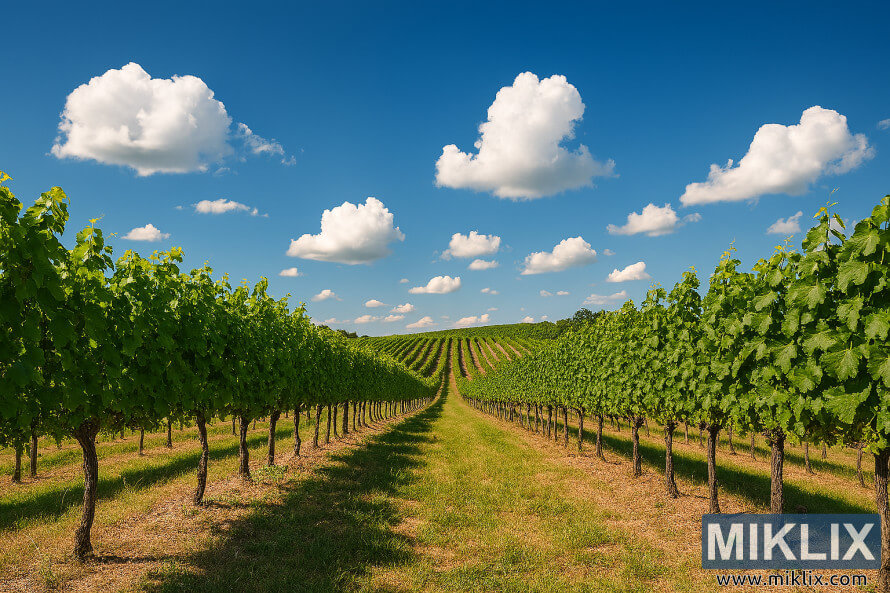
Grapes require specific growing conditions to thrive. Taking time to select and prepare the right site will set the foundation for years of successful harvests.
Essential Site Requirements
Sunlight
Grapes need full sun exposure—at least 7-8 hours of direct sunlight daily. Sunlight is crucial for ripening fruit and developing sugars. Eastern or southern exposures are ideal in most regions.
Soil Type
Grapes prefer well-drained, moderately fertile soil with a pH between 5.5 and 6.5. They can grow in various soil types from sandy loam to clay loam, but drainage is essential. Avoid waterlogged areas where roots might rot.
Air Circulation
Good air movement helps prevent fungal diseases. A gentle slope can provide both drainage and air circulation. Avoid frost pockets (low areas where cold air settles).
Space Requirements
Each vine needs about 6-8 feet of space in a row, with rows spaced 8-10 feet apart. For arbors or pergolas, vines can be spaced closer at 4-6 feet apart.
Soil Preparation Steps
- Soil Testing: Conduct a soil test through your local extension office to determine pH and nutrient levels.
- Weed Elimination: Remove all perennial weeds, especially grasses like Bermudagrass, before planting.
- Soil Amendment: Based on soil test results, incorporate any needed lime (to raise pH) or sulfur (to lower pH). Add compost to improve soil structure.
- Drainage Improvement: If drainage is poor, consider creating raised beds or installing drainage tiles.
- Trellis Installation: Set up your trellis system before planting to avoid disturbing roots later.
Tip: For optimal grape growth, prepare your site the fall before spring planting. This gives soil amendments time to integrate and allows you to address any drainage issues before planting.
Click or tap the image for more information and higher resolutions.
Planting Your Grapevines
Proper planting techniques establish the foundation for healthy, productive vines. In most regions, early spring is the ideal time to plant grapevines, after the threat of severe frost has passed but before hot weather arrives.
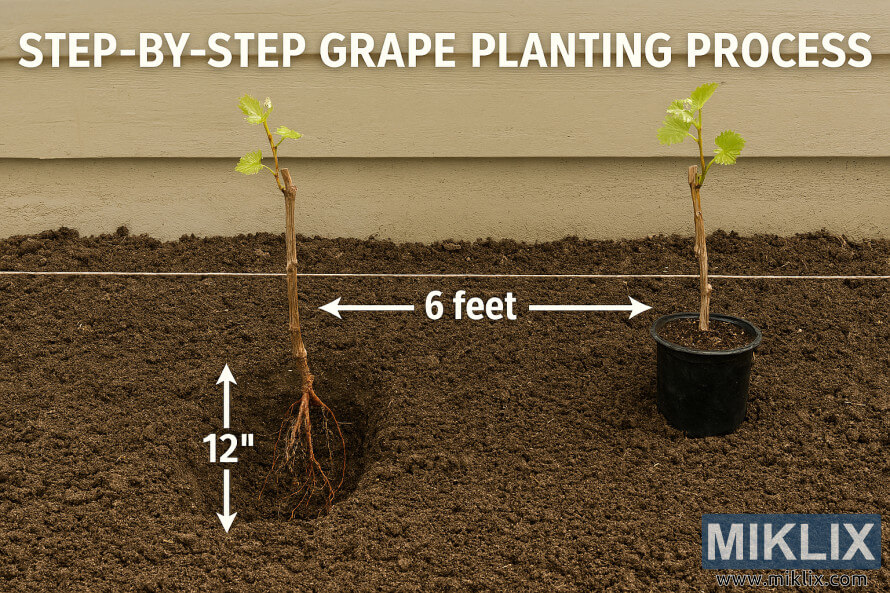
Proper planting technique ensures your grapevines get off to a strong start
Planting Steps
- Prepare the Vines: For bare-root vines, soak the roots in water for 2-3 hours before planting. For potted vines, water thoroughly before removing from the container.
- Dig the Hole: Create a hole approximately 12 inches deep and 12 inches wide. The hole should be large enough to accommodate the root system without bending or crowding.
- Position the Vine: Place the vine in the hole with the lowest bud on the cane about 2-3 inches above the soil surface. For grafted vines, ensure the graft union is 4-6 inches above the soil line.
- Spread the Roots: Fan out the roots in the hole rather than allowing them to circle or bunch.
- Backfill: Fill the hole with soil, gently firming it around the roots to eliminate air pockets. Water thoroughly after planting.
- Prune: Cut back the newly planted vine to just two strong buds to encourage vigorous root development.
Click or tap the image for more information and higher resolutions.
Spacing Guidelines
| Grape Type | Vine Spacing | Row Spacing | Plants per 100 ft |
| American Varieties | 8 feet | 10 feet | 12-13 |
| European Varieties | 6 feet | 8-9 feet | 16-17 |
| Hybrids | 7-8 feet | 9-10 feet | 12-14 |
| Muscadines | 16 feet | 12 feet | 6-7 |
First Year Care: During the first growing season, focus on establishing a strong root system. Remove all flower clusters that develop to direct energy toward vegetative growth. Keep the area around young vines weed-free and provide consistent moisture.
Trellising and Support Systems
Grapevines require sturdy support to grow properly and produce quality fruit. A well-designed trellis system improves air circulation, increases sun exposure, makes maintenance easier, and helps prevent disease.
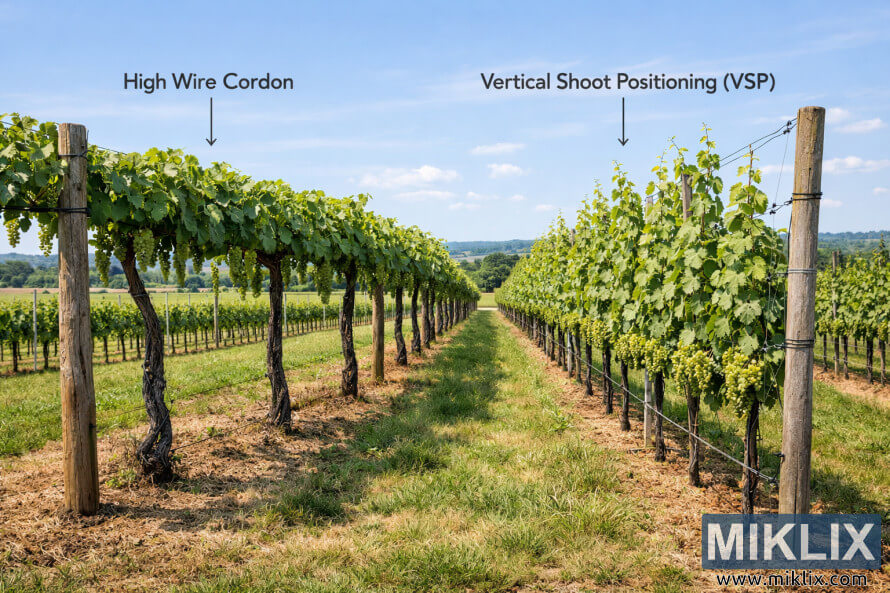
Common grape trellis systems: high wire cordon (left), vertical shoot positioning (center), and ornamental arbor (right)
Popular Trellis Systems
High Wire Cordon
This simple system features a single wire 5-6 feet above ground. The vine's trunk extends to the wire, with cordons (arms) trained along it. Shoots hang down, creating a curtain of vegetation. Ideal for vigorous American varieties and many hybrids.
Vertical Shoot Positioning (VSP)
Uses multiple horizontal wires (typically 3-4) with shoots trained upward. This system provides excellent sun exposure and air circulation. Best for less vigorous varieties, especially European wine grapes.
Arbors and Pergolas
Decorative options that combine ornamental value with fruit production. While less efficient for maximum yield, they create attractive landscape features and pleasant shaded areas.
Click or tap the image for more information and higher resolutions.
Building a Basic Trellis
- Materials Needed: Treated wooden posts (4-6 inches diameter), 12-gauge galvanized wire, wire tensioners, and staples.
- End Posts: Install 8-foot posts 2 feet into the ground at each end of your row. These must be sturdy and well-braced as they bear most of the tension.
- Line Posts: Place 7-foot posts every 20-24 feet along the row, set 1.5-2 feet deep.
- Wire Installation: For a high wire cordon system, attach a single wire at 5-6 feet height. For VSP, install wires at approximately 24, 36, 48, and 60 inches from the ground.
- Bracing: Brace end posts with angled supports or anchor wires to prevent leaning under the weight of mature vines.
Watering, Fertilizing, and Ongoing Maintenance
Proper maintenance practices are essential for healthy vines and quality fruit production. Grapes require regular attention throughout the growing season, with specific needs changing as the plants mature.
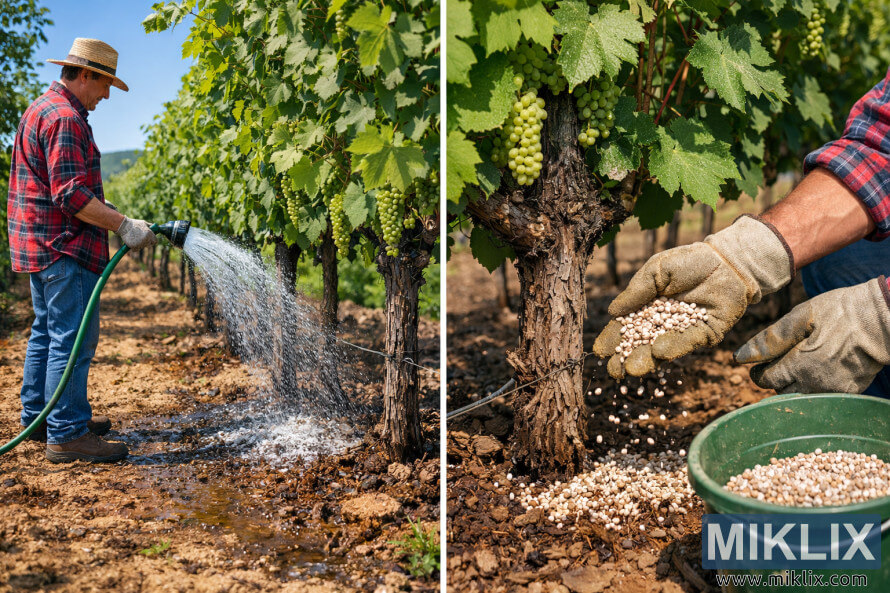
Proper watering and fertilizing practices are essential for grape vine health and productivity
Watering Guidelines
Grape watering needs change throughout the growing season and as vines mature:
- Young Vines (1-2 years): Water deeply once a week, providing about 1-2 gallons per vine. Ensure soil is moist but not waterlogged.
- Established Vines: Water less frequently but more deeply. Allow soil to dry between waterings to encourage deep root development.
- Flowering to Fruit Set: Consistent moisture is important during this critical period.
- Fruit Development: Reduce watering slightly after fruit set to control berry size.
- Ripening Period: Decrease watering as harvest approaches to concentrate flavors in the fruit.
Watering Tip: Drip irrigation is ideal for grapes as it delivers water directly to the root zone while keeping foliage dry, which helps prevent fungal diseases.
Fertilization Schedule
Grapes are not heavy feeders compared to many garden plants. Over-fertilization can lead to excessive vegetative growth at the expense of fruit production.
- First Year: Apply 2 ounces of 10-10-10 fertilizer about 7-10 days after planting.
- Second Year: Apply 4 ounces of 10-10-10 fertilizer in early spring before growth begins.
- Third Year and Beyond: Apply 8 ounces of 10-10-10 fertilizer per vine in early spring.
- Compost Application: Apply a layer of compost around vines in early spring to improve soil structure and provide slow-release nutrients.
Weed Control
Keeping the area around grape vines free of weeds is crucial, especially for young vines that face competition for water and nutrients.
- Maintain a weed-free zone extending at least 2 feet from the trunk in all directions.
- Shallow cultivation works well for weed control but avoid disturbing the soil deeper than 2-3 inches to prevent root damage.
- Organic mulch like straw or wood chips can help suppress weeds while conserving soil moisture.
- Avoid using lawn herbicides near grape vines, as they are extremely sensitive to drift from products containing 2,4-D and dicamba.
Click or tap the image for more information and higher resolutions.
Pruning Techniques for Optimal Growth
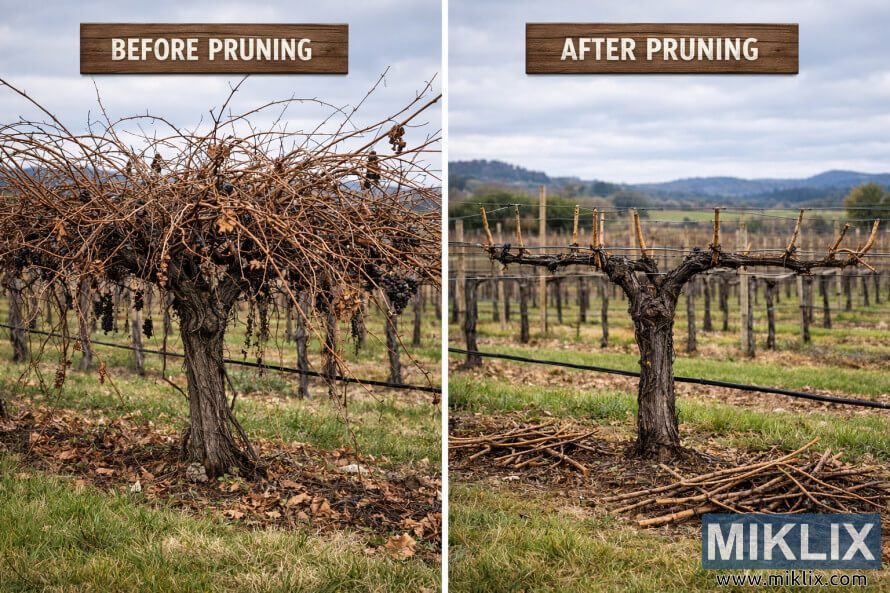
Pruning is perhaps the most crucial skill in grape cultivation. Proper pruning balances vegetative growth with fruit production, improves air circulation, and maintains vine health. Most home gardeners are surprised by how aggressively grapes must be pruned—removing 80-90% of the previous year's growth is common.
Proper pruning transforms an overgrown vine (left) into a well-structured, productive plant (right)
When to Prune
The best time to prune grapes is during the dormant season, after the risk of severe cold has passed but before buds begin to swell. In most regions, this means late February to early March. Avoid pruning during freezing weather when vines are brittle and susceptible to damage.
Understanding Grape Growth
To prune effectively, you need to understand how grapes grow and produce fruit:
- Grapes produce fruit on new growth that emerges from one-year-old wood.
- Older wood (two years or more) will not produce fruit directly.
- Each bud on one-year-old wood has the potential to produce 1-3 clusters of grapes.
- Without pruning, vines produce too many buds, resulting in small, poor-quality fruit.
Pruning by Year
First Year
The goal in year one is to establish a strong root system and straight trunk:
- At planting, prune the vine back to just two strong buds.
- As growth begins, select the strongest shoot and remove all others.
- Train this shoot vertically to form the trunk, tying it to a stake or trellis wire.
- Remove any flower clusters that form to direct energy to vegetative growth.
Second Year
Now you'll establish the permanent structure of the vine:
- If the vine reached the top wire, prune to leave a single cane with 8-10 buds.
- If using a bilateral cordon system, select two canes to extend in opposite directions along the wire.
- Remove all other growth.
- Continue to remove most or all flower clusters to strengthen the vine.
Third Year and Beyond
Now you'll focus on maintaining the established structure and managing fruit production:
- Identify one-year-old canes (reddish-brown, pencil-diameter wood).
- For each cane you want to keep, cut back to 3-4 buds to create "spurs."
- Space spurs evenly along the cordons, about 6-8 inches apart.
- Remove all other growth, including old, thick wood and weak, spindly canes.
- For mature vines, leave approximately 50-80 buds total, depending on vine vigor.
Important: Don't be afraid to prune aggressively. Under-pruning is a common mistake that results in poor fruit quality and overcrowded vines. Remember, you'll be removing 80-90% of the previous year's growth each winter.
Click or tap the image for more information and higher resolutions.
Managing Pests and Diseases
Grapes can be susceptible to various pests and diseases, but with proper preventive measures and early intervention, most problems can be managed effectively, especially in home gardens.
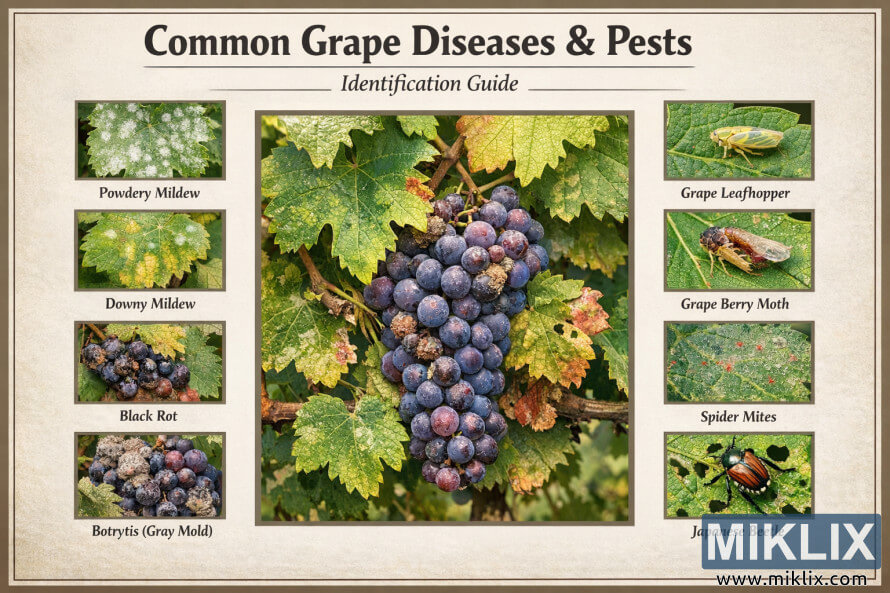
Common grape problems: powdery mildew, black rot, Japanese beetles, and bird damage
Common Diseases
Powdery Mildew
Symptoms: White powdery coating on leaves, shoots, and fruit.
Prevention: Good air circulation, proper pruning, and selecting resistant varieties.
Treatment: Sulfur-based fungicides, potassium bicarbonate, or neem oil applications.
Downy Mildew
Symptoms: Yellow spots on upper leaf surfaces with white, downy growth underneath.
Prevention: Proper spacing, pruning for airflow, and avoiding overhead watering.
Treatment: Copper-based fungicides or organic alternatives like copper soap.
Black Rot
Symptoms: Brown circular lesions on leaves and black, shriveled fruit.
Prevention: Remove infected material, ensure good air circulation.
Treatment: Fungicides containing myclobutanil or captan.
Anthracnose
Symptoms: Small dark spots on leaves, shoots, and berries that develop gray centers.
Prevention: Good sanitation, proper pruning, and resistant varieties.
Treatment: Lime sulfur during dormancy, followed by regular fungicide applications.
Common Pests
Japanese Beetles
Symptoms: Skeletonized leaves with only the veins remaining.
Control: Hand-picking into soapy water, row covers, or organic insecticides like neem oil.
Grape Berry Moths
Symptoms: Webbing in clusters and damaged berries with entry holes.
Control: Pheromone traps, Bacillus thuringiensis (Bt), or well-timed insecticide applications.
Leafhoppers
Symptoms: Stippled, pale leaves and sticky honeydew on leaf undersides.
Control: Insecticidal soaps, neem oil, or introducing beneficial insects.
Birds
Symptoms: Pecked or missing berries, especially as fruit ripens.
Control: Netting over vines, visual deterrents, or reflective tape.
Organic Prevention Strategies
- Select Resistant Varieties: American grapes and many hybrids offer better disease resistance than European varieties.
- Maintain Proper Spacing and Pruning: Good air circulation reduces humidity around foliage.
- Practice Good Sanitation: Remove fallen leaves, pruned material, and diseased fruit from the vineyard area.
- Use Companion Planting: Certain herbs like garlic, chives, and marigolds can help repel some insect pests.
- Apply Preventive Sprays: Organic options include compost tea, diluted milk spray (for powdery mildew), and neem oil.
Integrated Pest Management (IPM): Rather than spraying on a fixed schedule, monitor your vines regularly and only treat when necessary. This approach reduces chemical use and preserves beneficial insects that help control pests naturally.
Click or tap the image for more information and higher resolutions.
Harvesting and Storage
After all your hard work, harvesting your homegrown grapes is the most rewarding part of the process. Knowing when and how to harvest ensures you'll enjoy the best possible flavor and quality from your crop.
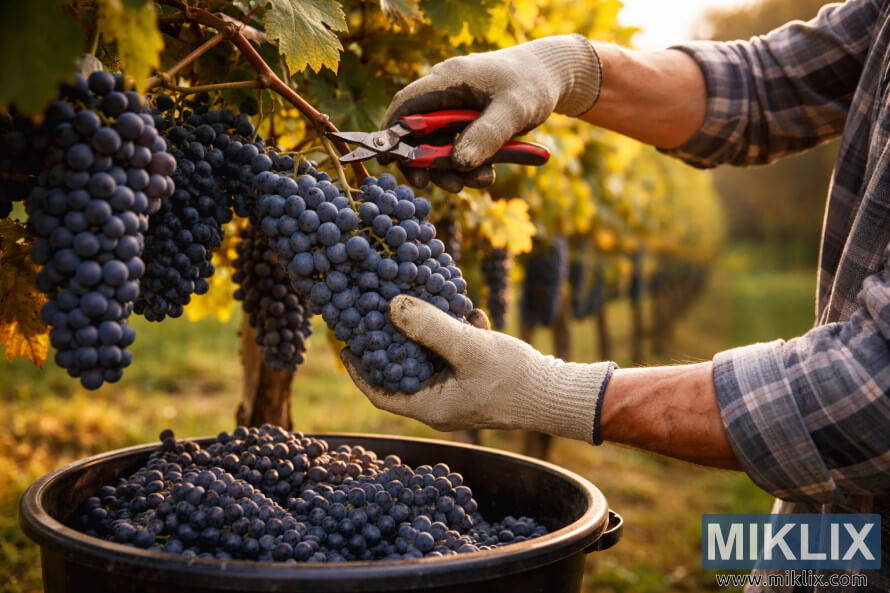
Harvest grapes by cutting entire clusters with pruning shears, leaving a small portion of stem attached
When to Harvest
Determining the perfect harvest time requires attention to several indicators:
- Color Development: Grapes reach full color (depending on variety) before they're fully ripe. Color alone is not a reliable indicator.
- Taste Test: The most reliable method is simply tasting the grapes. They should be sweet and flavorful, without excessive tartness.
- Seed Color: In seeded varieties, the seeds turn from green to brown when ripe.
- Berry Firmness: Ripe grapes are firm but yield slightly to gentle pressure.
- Easy Removal: Ripe berries detach easily from the stem when gently pulled.
Most table grapes will be ready to harvest in late summer to early fall, depending on your climate and the variety. Wine grapes are often harvested later to develop higher sugar content.
Harvesting Technique
- Harvest during the cool part of the day—early morning is ideal.
- Use clean, sharp pruning shears or scissors to cut entire clusters.
- Leave a small portion of stem attached to the cluster to help preserve freshness.
- Handle clusters gently to avoid bruising the fruit.
- Place harvested clusters in a shallow container to prevent crushing.
Storage Guidelines
Fresh grapes don't continue to ripen after harvest, so pick them at peak ripeness for best quality.
- Short-term Storage: Refrigerate unwashed grapes in a perforated plastic bag for up to 1-2 weeks.
- Washing: Only wash grapes just before consuming them.
- Freezing: Remove grapes from stems, wash, dry, and freeze in a single layer before transferring to freezer containers.
- Processing: For juice, jelly, or wine, process grapes soon after harvest for best results.
Harvest Tip: If birds are a problem, harvest grapes as soon as they're ripe rather than leaving them on the vine. Alternatively, protect ripening clusters with lightweight netting.
Click or tap the image for more information and higher resolutions.
Using Your Grape Harvest
Your homegrown grape harvest offers numerous culinary possibilities beyond fresh eating. Here are some popular ways to enjoy and preserve your bounty.
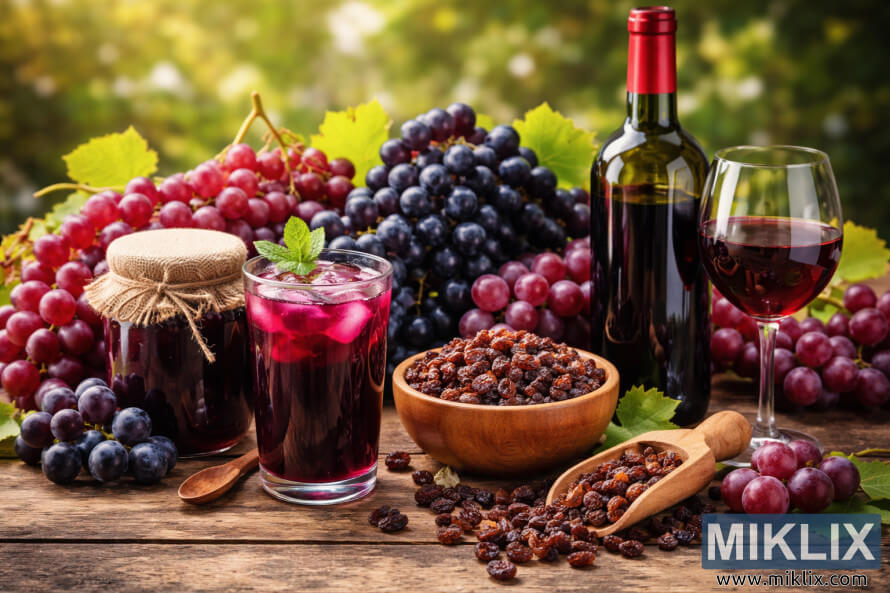
Homegrown grapes can be transformed into juice, jelly, wine, raisins, and more
Fresh Eating
Table grapes are delicious eaten fresh off the vine. They make excellent additions to fruit salads, cheese boards, and desserts. Seedless varieties are particularly popular for fresh consumption.
Juice and Jelly
American varieties like Concord and Niagara make exceptional juice and jelly with their distinctive flavors. To make juice:
- Wash and stem the grapes.
- Crush grapes and heat gently until juice flows freely.
- Strain through a jelly bag or cheesecloth.
- Sweeten if desired and can or freeze for storage.
Winemaking
Making wine from homegrown grapes can be a rewarding hobby. While detailed winemaking instructions are beyond the scope of this guide, the basic process involves:
- Crushing the grapes to release juice.
- Adding wine yeast and allowing fermentation.
- Racking (transferring) the wine to remove sediment.
- Aging the wine before bottling.
Drying for Raisins
Seedless varieties like Thompson, Flame, and Neptune make excellent raisins:
- Wash and remove stems from fully ripe grapes.
- Spread in a single layer on drying trays.
- Dry in a food dehydrator, oven on low setting, or in the sun (in hot, dry climates).
- Store in airtight containers once fully dried.
Preserving the Harvest
Other preservation methods include:
- Freezing: Freeze whole grapes for smoothies or snacking.
- Canning: Preserve grape juice or make grape pie filling.
- Vinegar: Use juice to make homemade grape vinegar.
Click or tap the image for more information and higher resolutions.
Conclusion
Growing grapes requires patience and attention to detail, but the rewards are well worth the effort. With proper care, your grapevines can provide decades of beautiful foliage, delicious fruit, and the satisfaction of harvesting your own crop year after year.
Remember that grape growing is both a science and an art. Each season brings new learning opportunities as you observe how your vines respond to different conditions and care practices. Don't be discouraged by challenges—even experienced growers face occasional setbacks from weather, pests, or diseases.
As your vines mature and you become more familiar with their needs, you'll develop an intuitive understanding of grape cultivation that no guide can fully convey. Enjoy the journey of becoming a grape grower, and savor the sweet rewards of your garden's bounty.
Further Reading
If you enjoyed this post, you may also like these suggestions:
- Growing Onions: A Complete Guide for Home Gardeners
- A Complete Guide to Growing Brussels Sprouts Successfully
- A Guide to Growing the Best Figs in Your Own Garden