
Image: Yeast Pitching Rates for Belgian Stout (Scientific Infographic)
Published: January 4, 2026 at 4:04:47 PM UTC
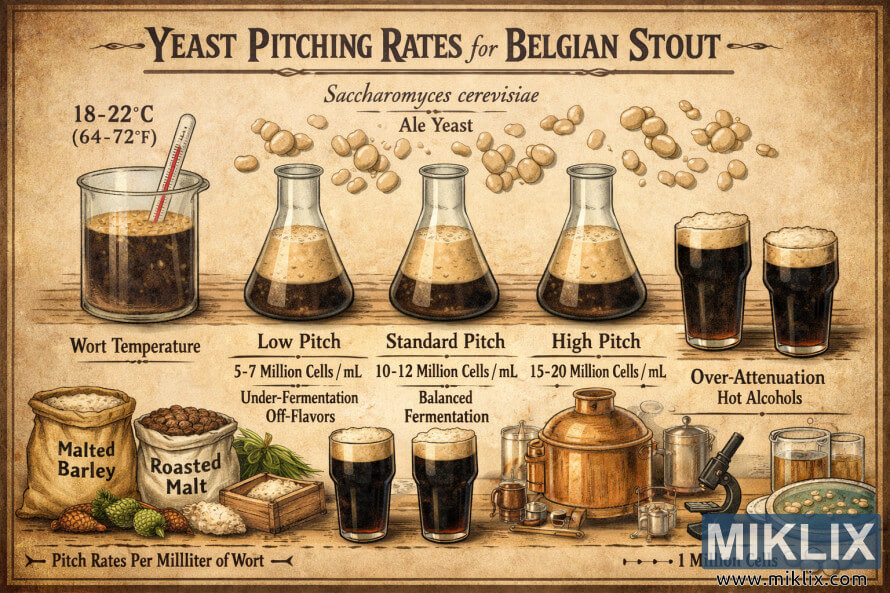
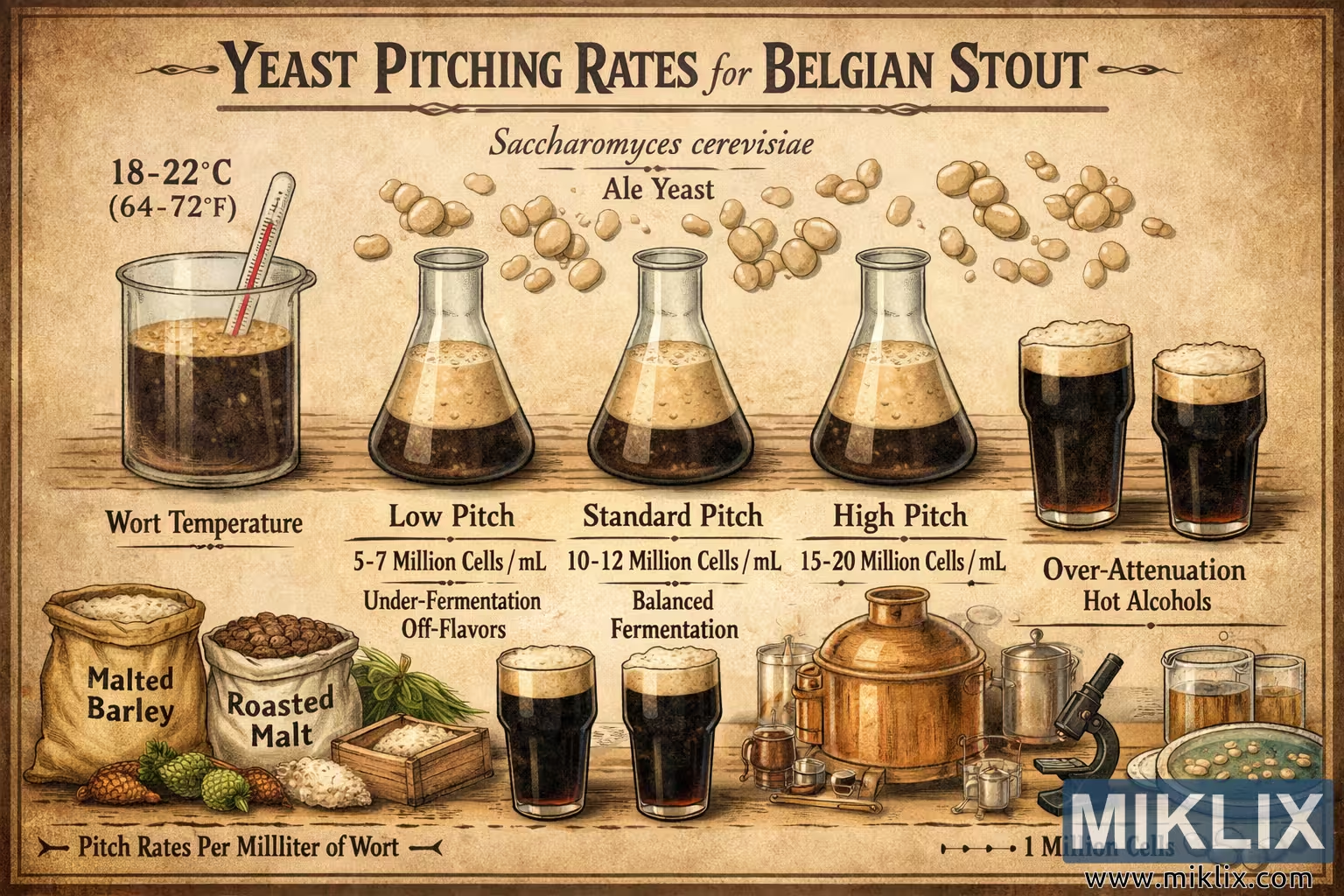
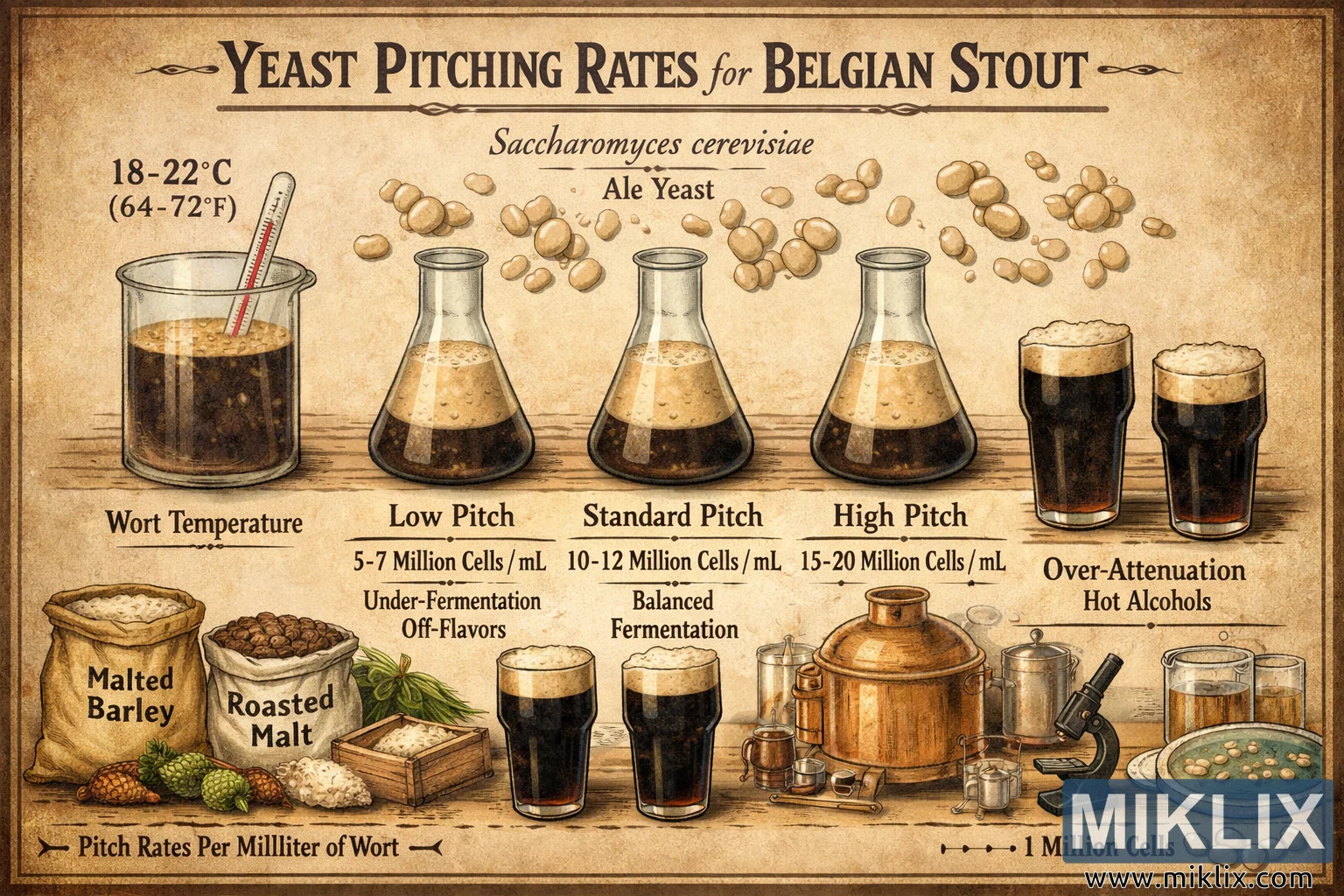
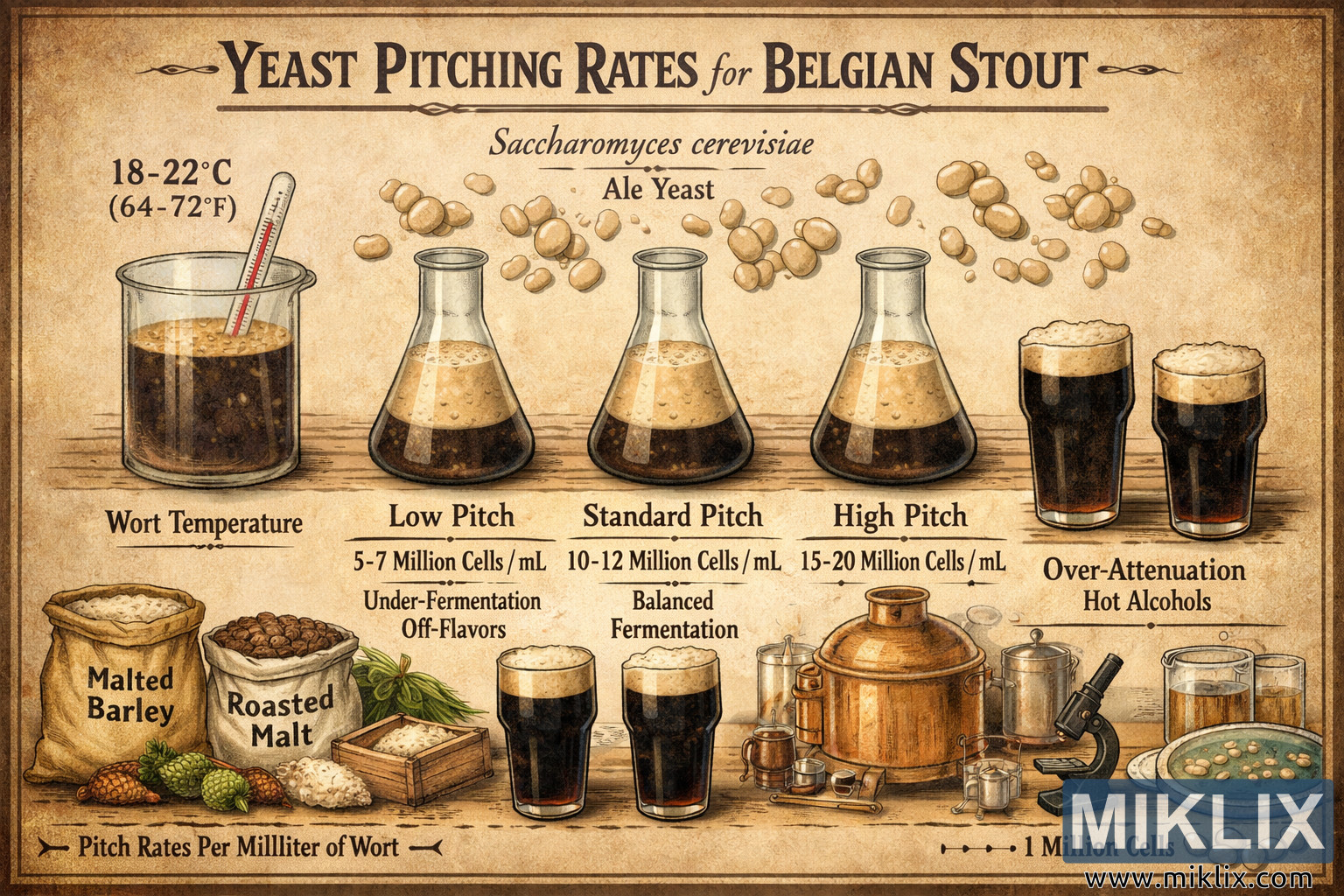
Landscape scientific infographic on Belgian stout fermentation showing recommended wort temperature and yeast pitching-rate ranges, comparing low, standard, and high pitches with notes on balanced fermentation and potential off-flavors.
Available versions of this image
The image files available for download below are less compressed and higher resolution - and as a result of that, higher quality - than the images embedded in articles and pages on this website, which are more optimized for file size in order to reduce bandwidth consumption.
Regular size (1,536 x 1,024)
Large size (3,072 x 2,048)
Very large size (4,608 x 3,072)
Extra large size (6,144 x 4,096)
Comically large size (1,048,576 x 699,051)
- Still uploading... ;-)
Image description
A wide, landscape-format scientific infographic titled "Yeast Pitching Rates for Belgian Stout" sits on an aged parchment background with a dark decorative border and vintage, ornate typography. Beneath the title, an italic subheading reads "Saccharomyces cerevisiae" with "Ale Yeast" centered below it, framing the subject as a brewing science overview. Across the upper half of the illustration, tan, oval yeast cells float in clusters, visually suggesting active culture and cell density. On the far left, a clear glass beaker filled with dark, foamy wort holds a thermometer; a label above it states a recommended range of 18–22°C (64–72°F). A caption below identifies this panel as "Wort Temperature," emphasizing fermentation temperature control.
Centered along the main row are three identical glass Erlenmeyer flasks containing dark liquid with creamy foam heads, each representing a different pitching regime. The first is labeled "Low Pitch" and specifies 5–7 Million Cells/mL, with a note warning of "Under-Fermentation" and "Off-Flavors." The middle flask is labeled "Standard Pitch" and shows 10–12 Million Cells/mL, accompanied by the reassurance "Balanced Fermentation." The third flask is labeled "High Pitch" and lists 15–20 Million Cells/mL; nearby, two illustrated pints of stout with thick, pale foam are used to communicate sensory outcomes. To the right, text notes "Over-Attenuation" and "Hot Alcohols," implying that overly aggressive pitching can push fermentation too far and produce harsher alcohol character.
The lower band of the infographic adds brewing context through detailed still-life drawings. On the left are sacks and bins of ingredients labeled "Malted Barley" and "Roasted Malt," surrounded by small green hops and scattered grains to connect the stout style to darker malt character. Near the center-bottom, two full stout glasses stand as reference pours, reinforcing the intended result of a properly managed fermentation. Toward the right, copper brewing equipment—a rounded kettle or small still-like vessel and adjacent tools—sits beside lab and measurement motifs, including a small microscope, glassware, and a shallow dish holding yeast-like pellets, blending craft brewing with microbiology.
Along the very bottom, a banner-style caption reads "Pitch Rates Per Milliliter of Wort," and a small scale indicator at the lower right pairs the text "1 Million Cells" with a few enlarged yeast cell icons to clarify the unit concept. The overall composition combines educational labels, measured ranges, and illustrative cues—temperature, cell counts, and flavor consequences—to explain how low, standard, and high yeast pitching rates influence Belgian stout fermentation outcomes in a visually cohesive, antique textbook style.
The image is related to: Fermenting Beer with Wyeast 1581-PC Belgian Stout Yeast