
Hops in Beer Brewing: Satus
Published: January 2, 2026 at 3:39:20 PM UTC
Satus is typically added early in the boil to provide a clean, consistent bitterness. It's valued for its high-alpha content, making it a versatile option for those seeking a robust hop flavor.
Click or tap the image for more information and higher resolutions.
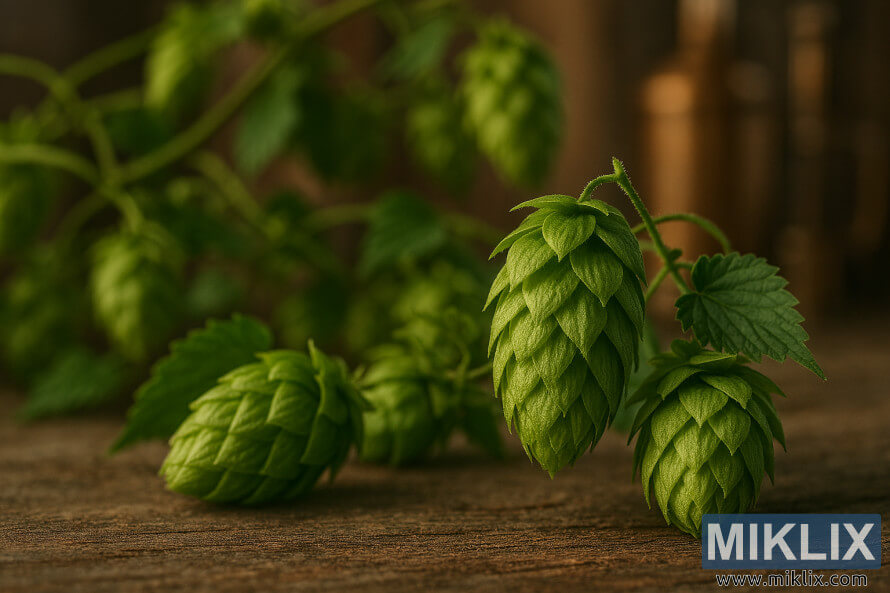
Satus, a hop variety developed in the United States, is identified by the code SAT and cultivar ID YCR 7. It is registered to Yakima Chief Ranches. Bred as a high-alpha bittering hop, Satus provides a clean, reliable foundation for many beer recipes.
Historically, Satus hops were used early in the boil. This was due to their high alpha-acid levels, making them ideal for bittering. Although discontinued since about 2016, Satus brewing records and analysis are still valuable for recipe formulation and substitution decisions.
Hop compendia and databases, such as BeerMaverick, list Satus among US hop varieties. They note its citrus-leaning, clean bitterness. Brewers often reference Satus for its predictable alpha range and straightforward contribution to bitterness, rather than complex late-hop aroma.
Key Takeaways
- Satus hop (SAT, YCR 7) is registered to Yakima Chief Ranches and known as a high-alpha bittering hop.
- Used mainly early in the boil for clean, predictable bitterness in recipes.
- Discontinued around 2016, but historic data still guides Satus brewing substitutions.
- Databases list Satus hops among US hop varieties with citrus and clean aroma notes.
- Valuable for recreating older formulations or selecting modern bittering equivalents.
Overview of Satus hops and its role in brewing
The story of Satus hops begins in the U.S., bred by Yakima Chief Ranches and introduced as YCR 7. It was designed to be a dependable bittering hop for American craft brewers.
In brewing, Satus is typically added early in the boil to provide a clean, consistent bitterness. It's valued for its high-alpha content, making it a versatile option for those seeking a robust hop flavor.
Its roots in the Pacific Northwest connect it to many U.S.-grown hops used in both commercial and homebrew recipes. Despite being discontinued around 2016, Satus remains in brewing databases, offering insights for recipe adjustments.
Recipes featuring Satus often include it in significant quantities. Historical data reveal it comprised about 37% of the hop bill in recipes where it was used. This underscores its critical role as a primary bittering agent.
Understanding the distinction between bittering and aroma hops is key to appreciating Satus. It falls on the bittering side, prized for its alpha acids and clean bitterness. This contrasts with aroma hops, which are valued for their volatile oils used in late additions or dry hopping.
- Breeder: Yakima Chief Ranches (YCR 7)
- Primary use: bittering; occasional dual-use for extra punch
- Commercial status: limited availability after discontinuation circa 2016
- Historical impact: substantial share in recipes that used it
Alpha and beta acid profile of Satus
Satus is known for its firm bittering character, thanks to its alpha acids. Lab reports show Satus AA% ranges from 12.0–14.5%. The average is around 13.3%, with medians between 13.0–13.3% in various datasets.
The beta acids in Satus are notable for their stability. Satus BB% values usually fall between 8.5% and 9.0%. This results in an average of 8.8%, aiding in aroma retention without excessive bitterness.
The ratio of alpha to beta acids guides brewers in hop usage. Ratios range from 1:1 to 2:1, with most samples near 2:1. This indicates a strong bittering presence, especially when added early in the boil.
Practical application of Satus in brewing is evident. As a high-alpha hop, it's added early to maximize alpha acid isomerization. Brewers closely monitor Satus AA% to calculate IBUs and adjust bitterness levels.
- Typical Satus AA%: 12.0–14.5%, average ~13.3%
- Typical Satus BB%: 8.5–9.0%, average ~8.8%
- Alpha–beta ratio: commonly near 2:1, indicating bittering dominance
Recipe history shows Satus' role in heavy bittering. It often makes up a significant portion of hops, used in both small amounts and as the main hop in robust recipes.
For brewers formulating recipes, keep an eye on Satus AA% and BB%. Use these values in your calculations to achieve consistent bitterness across batches.
Essential oil composition and aroma contributors
Satus essential oils typically measure around 2.2 mL per 100 g. Values range from 1.5 to 2.8 mL. This profile is ideal for both bittering and late-addition uses in brewing.
Myrcene, humulene, and caryophyllene are the key fractions in hop oil. Myrcene, making up 40–45 percent, contributes resinous, citrus, and fruity notes. These notes are preserved in the wort.
Humulene, present at 15–20 percent, adds a woody, spicy, and noble hop character. Caryophyllene, at 7–10 percent, brings peppery, woody, and herbal facets to the Satus aroma compounds.
Minor constituents like farnesene average about 0.5 percent, adding a green and floral lift. The remaining 24–38 percent includes β-pinene, linalool, geraniol, and selinene. These contribute subtle floral, pine, and citrus accents.
Brewers should be aware that most of these oils are volatile and decrease with long boils. Adding Satus late in the boil, in the whirlpool, or as a dry hop helps preserve the delicate Satus aroma compounds. This approach enhances the hop oil breakdown, resulting in citrus and clean aromatics.
Flavor and aroma profile: citrus and clean notes
The Satus flavor profile is marked by a subtle citrus character and a clean, unobtrusive bitterness. Early in the boil, it establishes a stable backbone. This acts as a clean bittering hop, supporting malt and yeast without overshadowing other ingredients.
Late additions or whirlpool hops enhance the citrus notes, making them more pronounced. For brewers aiming for a soft citrus hop touch, Satus aroma enhances drinkability while maintaining balance.
This variety is not designed to compete with modern aroma-first hops. It serves as a utility player, providing a gentle citrus hop lift when needed and crisp bitterness for early extraction.
To maximize the impact of volatile oils like myrcene and humulene, minimize boil time for late additions. This approach ensures the Satus aroma is fully realized without compromising its clean bittering hop role at the start of the boil.
Click or tap the image for more information and higher resolutions.
Brewing applications and recommended uses
Satus is a top pick for early-boil bitterness. It's favored for its ability to create a solid foundation in ales and lagers. This is crucial for beers that require clean, lasting bitterness.
For consistent alpha-acid extraction, add Satus in the first 60 minutes. This method helps keep hop flavor in check. It allows malt and yeast to shine in balanced recipes.
For a citrus boost without overpowering aromas, add Satus late in the boil or during whirlpool steps. A short steep at 170–180°F brings out delicate citrus and herbal notes.
Satus can also serve as a dual-purpose hop. Early additions for bitterness pair well with late additions for brightness. This combination creates a complex flavor profile without overshadowing the beer's base.
- Primary use: early-boil bittering additions for stable IBUs.
- Dual-purpose: early bitterness plus late citrus lift when desired.
- Late roles: Satus late addition or whirlpool Satus for subtle aroma.
- Dry hop: occasional, for restrained citrus or dry herbal touches.
Dry hopping with Satus is less common. Its moderate oil content prevents it from dominating the aroma. It's perfect for adding a subtle citrus or herbal note.
For those looking for substitutes, Nugget or Galena are good alternatives. They offer similar alpha-acid strength and a clean bitterness profile when Satus is not available.
Beer styles that pair well with Satus
Satus is versatile, fitting into various beer styles. It's a favorite for IPAs and pale ales, providing a solid bitter base and a refreshing citrus note. In these beers, late hop additions enhance the citrus without overwhelming the aroma.
For pale ales, Satus is used in moderation to counterbalance malt sweetness. Its reliability makes it a staple in single-hop and sessionable pale ales. This consistency allows brewers to focus on other aspects of the beer.
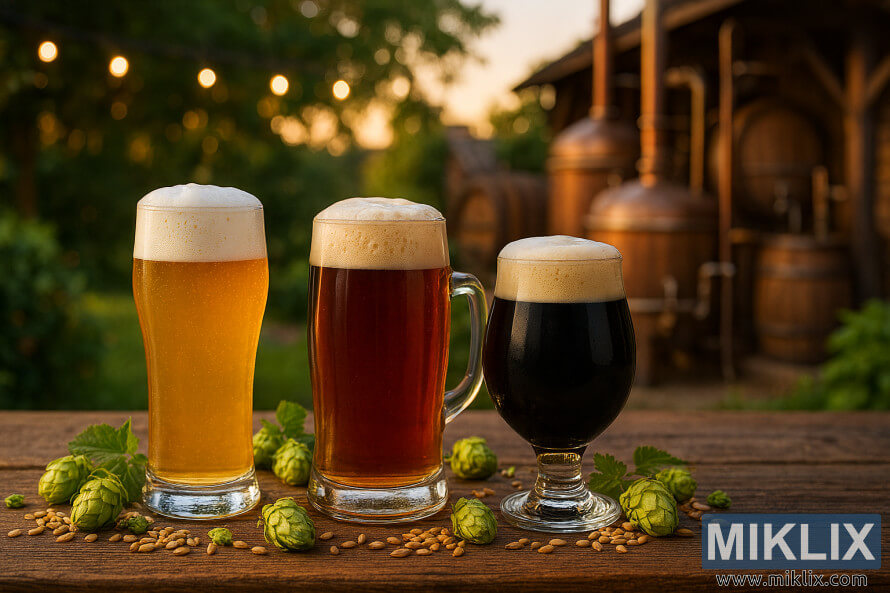
In darker beers, Satus proves its worth as well. It's chosen for stouts to create a clear, bitter foundation that complements roasted malts. In porters, imperial stouts, and barleywines, Satus ensures that chocolate and caramel flavors remain dominant.
- IPA: bold bittering with citrus lift, good for dry-hopped expressions.
- Pale Ale: balanced bitterness, supports malt character without masking it.
- Stout and Imperial Stout: clean bittering to tame heavy roast and alcohol.
- Barleywine: structural bitterness for long-aged, high-gravity beers.
Recipe data reveals Satus' significant role in many brews. It typically makes up a third to two-fifths of the total hops. This highlights brewers' trust in its ability to provide bitterness and clarity.
When brewing, match Satus' intensity to the malt profile. Use it more in malty, strong beers for balance. In pale ales and single-hop IPAs, use it sparingly to showcase citrus without hiding subtle aromas.
Click or tap the image for more information and higher resolutions.
Recipe examples and typical formulations using Satus
Homebrew and small commercial datasets list 14 documented Satus recipes. These examples show Satus used primarily as an early-boil bittering hop with alpha acids near 13%. This high AA level makes it straightforward to calculate IBU targets for pale ales and strong bitters.
Typical Satus hop formulations lean toward a significant share of the hop bill. Historical recipe analysis places the central tendency around a 36–37% Satus hop bill percentage. Some recipes used only 3.4% Satus, while extreme formulations relied on Satus for up to 97.8% of the hop mass.
- Common bittering charge: add Satus in the first 60–90 minutes for steady isomerization and predictable IBUs.
- Balance: pair Satus bittering with late additions of aromatic hops to preserve citrus and clean notes.
- Alpha adjustment: treat Satus at ~13% AA when scaling recipes or converting hop amounts.
Because Satus is discontinued commercially, brewers must reformulate when a recipe lists it. Nugget and Galena serve as practical substitutes for bittering stages because they mimic Satus's aggressive alpha-acid contribution. Adjust weights to match alpha values and recalc IBUs.
Practical conversion steps:
- Determine original Satus hop bill percentage in the recipe.
- Choose Nugget or Galena with their lab-stated AA and compute new hop masses to meet IBU goals.
- Retain the original timing scheme for bittering and late additions, then tweak sensory tests in pilot batches.
When documenting a reformulated brew, note the original Satus recipes and record the replacement's effect on bitterness, mouthfeel, and perceived citrus. This keeps traceability for future iterations and aids consistency across batches.
Comparing Satus to other bittering hops
Satus is categorized as a high-alpha bittering hop, alongside Nugget and Galena. It's a top choice for brewers aiming for consistent IBUs from early-boil additions. In recipes that require Nugget or Galena, Satus can often achieve the desired bitterness with minimal adjustments to the weight.
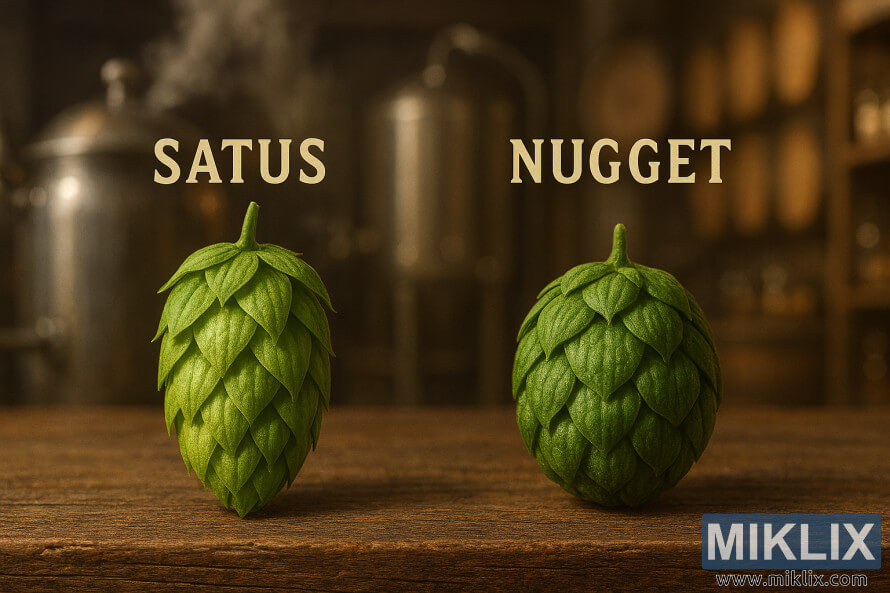
When comparing Satus to Nugget, both offer similar alpha acid ranges and consistent isomerization during boiling. Nugget contributes a greener, resinous character, whereas Satus provides a cleaner citrus note. This makes Satus ideal for pale ales and lagers.
In the comparison with Galena, both are dependable for high-IBU beers. However, Galena may appear heavier and earthier in the finish. Satus, on the other hand, is more restrained aromatically when used late. This makes it perfect for adding a crisp, moderate citrus flavor without overpowering the hop aroma.
When comparing Satus to other bittering hops, consider co-humulone and perceived bitterness. Small variations in co-humulone can significantly alter the mouthfeel and bitterness perception. Always refer to analytical values for precise substitutions. For general swaps, adjust the weight based on alpha acid percentages and maintain the same early-boil schedule.
- Substitution tip: Match target IBUs by adjusting weight for alpha acid differences.
- Aromatic impact: Satus is cleaner and less assertive than Citra, Mosaic, or Idaho 7 when used late.
- Use case: Early additions for bittering; reserve late hops for aroma-focused varieties.
Click or tap the image for more information and higher resolutions.
Analytical brewing values and co-humulone impact
Brewers depend on precise Satus analytical values for crafting the perfect bittering and aroma. The typical alpha acid content is around 13%, with total oil at approximately 2.2 mL/100g. This information is crucial for calculating IBUs and for late-hop additions to enhance aroma.
The co-humulone percentage in Satus hops ranges from 32% to 35%, averaging 33.5%. This places Satus in a mid-to-high band among bittering hops.
The mid-to-high cohumulone percentage in Satus can impart a sharper bitterness initially. However, brewers note that this sharpness mellow out with time. Therefore, it's essential to consider co-humulone in both kettle and aging strategies.
Alpha–beta ratios for Satus are generally between 1:1 and 2:1, with an average of 2:1. This ratio affects bitterness stability and how it evolves in the beer over time.
- Use reported AA% (~13%) for IBU calculations.
- Consider Satus co-humulone when selecting bittering hops for a desired mouthfeel.
- Factor total oil (~2.2 mL/100g) into late addition choices to retain aroma.
For those aiming to reduce initial sharpness, pairing Satus with softer bittering or lower cohumulone hops is advisable. In hop-forward beers, strategic additions are necessary to preserve volatile oils and shape the beer's long-term bitterness.
Sourcing, availability, and lupulin powder status
Satus was discontinued in 2016, making it scarce. Today, it's only found in archival samples and private collections. Major players like Yakima Chief Hops, BarthHaas, and John I. Haas do not list it in their catalogs. Most retailers also refuse to sell Satus hops.
There are no cryo or lupulin concentrate versions of Satus. Suppliers like Hopsteiner, BarthHaas, and Yakima Chief Hops do not offer Satus lupulin powder. Brewers looking for concentrated forms have no official options for this cultivar.
Breweries that used Satus for bittering must now find substitutes. Nugget or Galena are common replacements. Adjustments are made to match bitterness and stability, rather than exact aroma.
For those interested in hop history, Satus entries in hop databases are still valuable. They help recreate older recipes and trace hop lineage. Even though direct purchase is not possible, this data remains useful.
- Availability note: Satus discontinued from mainstream supply since 2016.
- Buying options: Rare samples only; you generally cannot buy Satus hops from major sellers.
- Lupulin status: No Satus lupulin powder or cryo concentrate was produced by leading suppliers.
- Sourcing action: Substitute Nugget or Galena, or adjust alpha-acid targets during reformulation.
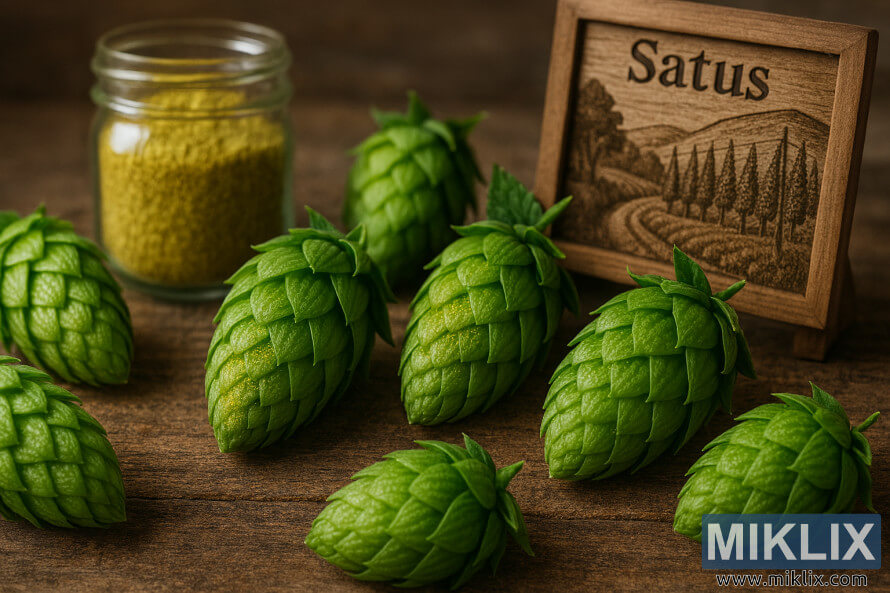
Click or tap the image for more information and higher resolutions.
Practical tips for homebrewers using Satus
Legacy Satus stock should be viewed as a high-alpha bittering hop. Plan for early boil additions and estimate IBUs using an approximate 13% alpha acid. This approach maintains bitterness while allowing for late aroma work.
For aroma, add Satus late in the boil or in the whirlpool. Expect subtle citrus and clean topnotes, unlike modern punchy aromas. Small late additions or a light dry hop with a neutral partner will enhance those delicate citrus facets.
- Storage: vacuum-seal and freeze hops to protect oils and alpha integrity. This is critical for older or discontinued lots.
- Legacy recipes: check how much of the hop bill was Satus. Historic recipes often list it at roughly 37% of the total hops.
- Recipe swaps: when converting, match the IBU contribution rather than the weight to keep balance.
When seeking a bittering substitute, Nugget or Galena are good options. A substitute Satus Nugget Galena approach works well; adjust weights based on alpha acid differences to hit target IBUs. Nugget provides firm bitterness with mild herbal notes, while Galena offers clean bittering with stable alpha.
Use a measured Satus bittering technique: calculate boil gravity, adjust utilization for your kettle, and aim early additions for predictable IBUs. Keep late additions minimal if your goal is gentle citrus rather than hop-forward aroma.
Finally, adapt historic formulations by replacing Satus weight with an equivalent bittering hop quantity to maintain balance. Check hop percentage contributions, recalculate IBUs, and taste as you go to preserve the original character.
Industry context: Satus within the wider hop market
Satus started as a U.S. bittering hop, developed by Yakima Chief Ranches. It's listed in major hop databases alongside other varieties from Yakima Chief Ranches. Here, brewers and researchers can access technical notes and alpha profiles.
After its discontinuation in 2016, Satus left the active market. This decision was typical for breeders, influenced by acreage, demand, and portfolio strategy. Today, Satus is often marked as a discontinued variety, kept for reference rather than sale.
The market trend shifted towards bold aroma hops like Citra, Mosaic, Idaho 7, and Galaxy. Craft brewers favored cryo and lupulin concentrates for intense flavors. Satus, lacking a cryo form, didn't fit these trends and lost its place in new releases.
Despite its discontinuation, Satus' historical data remains valuable. Aggregators and recipe archives keep Satus entries, allowing brewers to recreate older beers or find substitutes. These databases draw from hop farms, breeders, and sellers, making Satus data accessible for comparison and blending.
The tale of Satus sheds light on the evolution of bittering hops in America. Its inclusion in catalogs and archives provides context for the Satus hop market and the lifecycle of Yakima Chief Ranches varieties within broader US hop trends.
Conclusion
Satus summary: Satus is a U.S.-bred hop, known for its high-alpha bittering properties (YCR 7, SAT). Developed by Yakima Chief Ranches, it offers clean bitterness and subtle late-cast citrus when used in moderation. Its alpha acids were historically around 12–14.5%, with co-humulone at 33.5% and moderate total oils. This made it ideal for traditional bittering roles.
This Satus hops review highlights that the variety was discontinued around 2016. It never made it to lupulin or cryo form. This scarcity impacts recipe planning and ingredient sourcing. Brewers looking to recreate older recipes can rely on the recorded analytical values. However, those designing new beers should opt for available bittering hops instead.
Satus brewing conclusion: for practical brewing, substitute Nugget or Galena for similar bittering performance. Adjust for differences in alpha acid and co-humulone. Use Satus hop insights to guide bitterness targets, expected oil contributions, and late-hop aroma restraint. This is especially useful when recreating historic profiles or teaching bittering strategy.
Further Reading
If you enjoyed this post, you may also like these suggestions: